Machine tending
Loading and unloading parts at CNC machines, presses or test stations. We assess grasping, machine access, ready signals and cycle time.
Cycle time · machine availability · interventions
MERA / INDUSTRIAL ROBOTICS & DEVELOPMENT
We deploy robots and develop software for businesses. We start with your process: what slows production, raises costs or requires repetitive manual work. Then we select the technology and validate it in a pilot.
Describe your process Explore automation opportunities ↓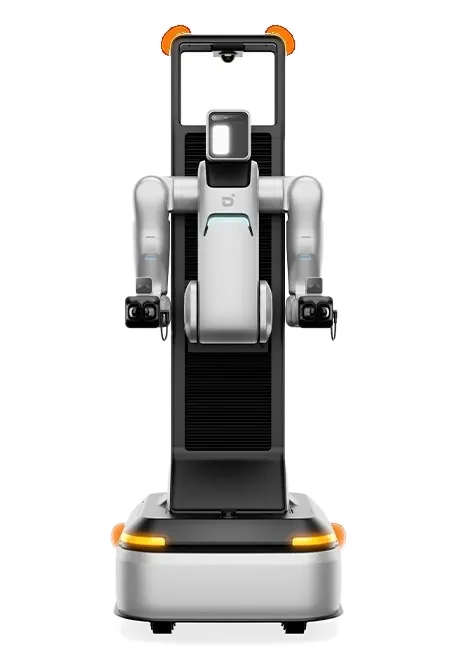 Two arms. A mobile base.
01 / APPLICATIONS
You do not need to choose a robot first. Describe the task and we will compare solutions, including simpler automation without a humanoid.
Loading and unloading parts at CNC machines, presses or test stations. We assess grasping, machine access, ready signals and cycle time.
Cycle time · machine availability · interventionsHandling packages, assembling kits and building pallet layers. Product mass, geometry, line speed and product variation drive the design.
Units per hour · damage · changeover timeMoving bins and parts between workstations. We assess routes, people, aisle width, handover points and charging.
Delivery time · empty trips · exceptionsRepeatable placement, positioning and joining. Trials on real parts establish whether one arm is sufficient or two arms and force control are needed.
Grasp success · quality · repeatabilityComputer vision and data capture at workstations. Define defects, lighting conditions and who resolves ambiguous cases.
Defect detection · false rejects · traceabilityTask control, operator interfaces, robot data and factory systems. PLC, MES, WMS, ERP and API scope depends on the available documentation.
Clear alarms · data availability · response time02 / TECHNOLOGY
We compare process requirements with hardware capabilities. A manufacturer demonstration does not replace a trial on your workstation.
Fixed workstation · predictable cycle
For repeatable tasks at a workstation: handling, machine tending and palletizing. Selection includes payload with tooling, reach, speed, gripper and safeguarding.
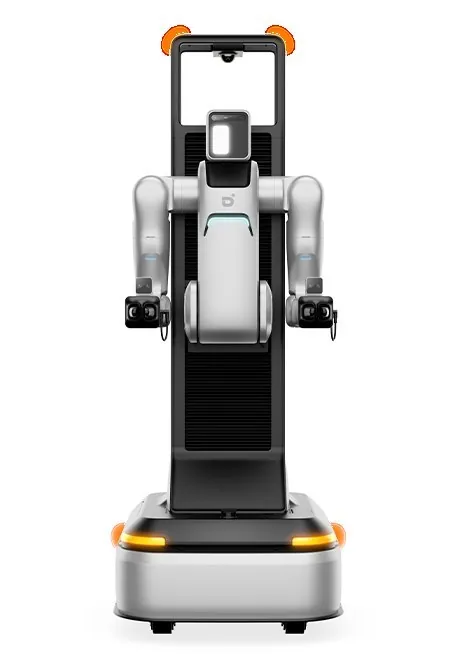 AGIBOT A2-W / catalogue model
Mobile manipulation · logistics
Two arms on a mobile base can combine transport with manipulation. We verify floors, thresholds, working reach, docking and interaction with people.
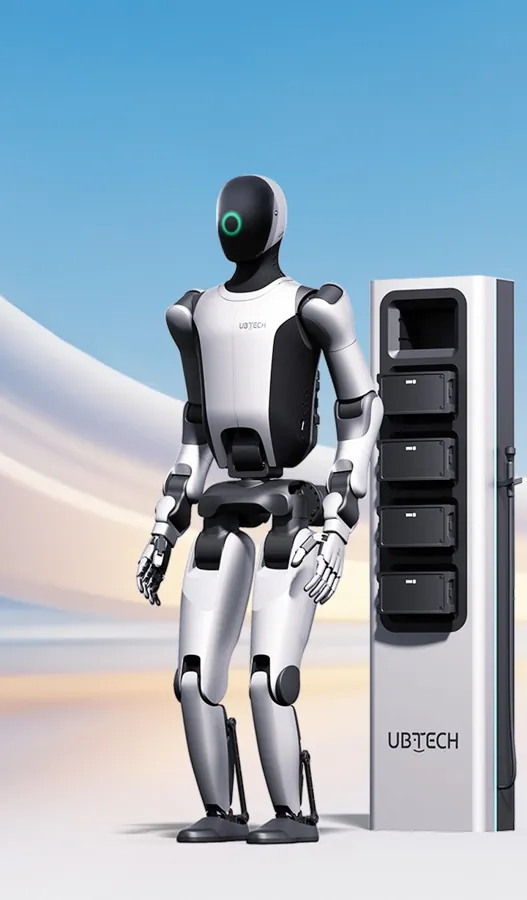 UBTECH Walker S2 / catalogue model
Task-specific pilot · existing environment
For pilots where the workplace or movement requirements justify legs. Balance, grasp stability, energy, supervision and failure behaviour require separate validation.
Transport · perception · integration
For transport or inspection, it may be preferable to separate movement, manipulation and perception. We connect them with defined task handovers.
03 / DEVELOPMENT & DELIVERY
Describe your process, volumes and constraints. We establish the inputs, conditions and business objective.
Compare technologies, interfaces and cost assumptions. Identify risks, dependencies and success criteria.
A pilot tests real parts, grasping, cycle time and exceptions. Results determine whether to invest further.
Implement process logic, interfaces, error handling and the workstation within the agreed scope.
Verify agreed criteria, hand over documentation and train the people operating the solution.
Support, spare parts, updates and scaling are defined in the proposal. Extend to other workstations using the first results.
04 / BUSINESS CASE
Include hardware, tooling, integration, site preparation, training, service, energy and downtime. Compare benefits with the baseline and realistic utilisation.
A simplified scenario, not a quotation or savings guarantee. Gross benefit means the value of recovered time and process improvement before running costs. Avoid double counting.Samples, tolerances, takt time, volume, variants and acceptance criteria.
Application-specific risk assessment, work zones, emergency stops, people and compliance responsibilities. A cobot is not automatically safe to work alongside.
Interfaces, permissions, networking, error logs, configuration backups and camera policies.
Charging, spare parts, updates, operator support and recovery after faults.
05 / FAQ
Not necessarily. A robot arm or simpler automation may be preferable for a fixed, repeatable operation. We consider a humanoid when the task justifies its body and mobility.
Yes. A focused pilot tests assumptions and establishes scaling conditions. First we agree a measurable objective and criteria for completing the trial.
The task, tooling, hardware availability, interfaces and site changes determine the scope. We provide a schedule and quotation after analysis. A robot price is not the cost of a complete workstation.
This requires validating duty cycles, charging or battery swaps, servicing and exception handling. Manufacturer claims do not guarantee continuity in a particular process.
We review interface documentation, test environment access and IT requirements before confirming integration scope, responsibilities and cost.
The scope can include task programming, AI and vision integration, operator interfaces, documentation and training. Implementation, licences and ongoing support are itemised in the proposal.
Images labelled with model names show robots from the market catalogue. They do not establish a MERA deployment or current model availability.
Describe the problem, current workflow and desired result. Production rate, part weight and a workstation photo help. Video is optional; confidential materials can be discussed after agreeing how to share them.
06 / YOUR PROCESS
We first assess what is worth testing and which inputs are missing. An inquiry does not commit you to a purchase.
contact@merarobotics.comManufacturer materials describe their technology applications. They are not MERA references or guarantees for your factory.