
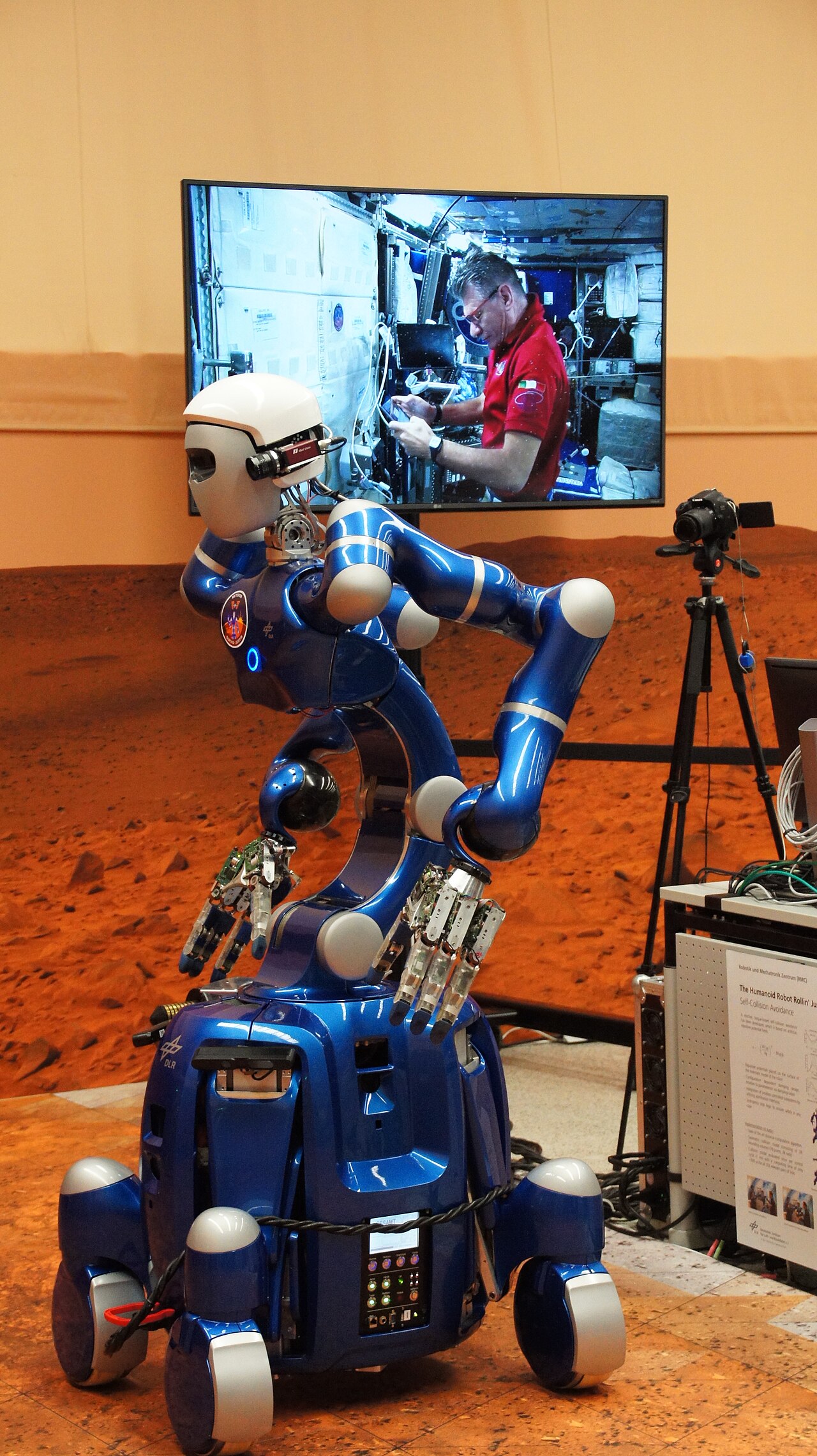
Rollin' Justin is a mobile humanoid platform from the DLR Institute of Robotics and Mechatronics, built for research into autonomous dexterous mobile manipulation. It has a two-armed upper body on a wheeled base. DLR describes it as a one-off research robot, not a commercial product. The technical figures are the manufacturer's and have not been independently verified.
Identity and position of the platform
Rollin' Justin was developed at the DLR Institute of Robotics and Mechatronics. According to DLR it builds on the DLR LWR III arm and the DLR Hand II. The institute first presented the robot publicly in 2008. It is a single research unit, so it should not be read as a production series.
Mechanical design and drive
The upper body (torso, neck, two arms, two hands) sits on a wheeled base with a variable footprint and spring-damped wheel legs. DLR says the wheels move individually and that the spring suspension suits the upper body during manipulation. DLR states a height of 191 cm, an approximate weight of 200 kg and a nominal load capacity of 20 kg. The working space runs from the floor to 2.7 m. Driving speed is 2 m/s, stated by the manufacturer as 7.2 km/h.
Total degrees of freedom are 51: platform 8, arms 2x7, hands 2x12, neck 2, torso 3. That means 7 DOF per arm and 12 per hand. The mechatronic design page agrees with the total (5 for torso and neck, 8 for the wheels as 4x2). Its four additional passive DOF are not counted in the 51.
Sources: DLR Institute of Robotics and Mechatronics · DLR Institute of Robotics and Mechatronics · DLR METERON
Sensors and operating time
DLR lists torque sensors in nearly all joints, 2 IMUs, 2 stereo cameras and 5 RGB-D cameras. The mechatronic design page gives 41 link-side torque sensors and 2 Prosilica stereo cameras.
The manufacturer states an operating time of more than 60 minutes. The source does not say whether this applies to idling, driving or working under load, so we do not give a single hours figure.
Sources: DLR Institute of Robotics and Mechatronics · DLR Institute of Robotics and Mechatronics
Control and integration
DLR describes compliant, hierarchical whole-body control and semi-autonomous operation for terrestrial and extraterrestrial applications. Task-hierarchy control with null-space projections is stated to allow collision avoidance and compliant response to contact. The institute page also shows the robot teleoperated via a tablet PC. DLR's pages do not describe a public SDK or API, or any support offering for outside users.
Sources: DLR Institute of Robotics and Mechatronics · DLR
Demonstrated tasks versus claims
Among DLR's demonstrations is serving beverages without spilling while avoiding collisions and responding compliantly to contact. A 2026 DLR news item shows the robot recognising a cereal box and autonomously putting it back in a cupboard, using knowledge-based AI and learning methods. A 2025 item shows an astronaut-style command in which the robot's compliance lets it follow the pivot of an articulated object.
The application areas DLR names are household work and assisting astronauts in space. These are institute claims and demonstrations, not independent test results.
Limitations and evaluation questions
There is no evidence of commercial availability. DLR gives no dated statement of the robot's current status, and the 2026 item is only a demonstration. The figures are DLR's own, the weight is approximate, and no independent measurements were found.
When assessing the platform, useful questions are: on what terms is collaboration with DLR possible? What control interface and software are available outside the institute? How long does the robot run while driving under realistic load? Which tasks need teleoperation and which run autonomously?
Timeline
- 2008 DLR first presents the robot to the public.
- 2009 Design paper on the Rollin' Justin mobile platform (DOI 10.1109/ROBOT.2009.5152586), listed on ResearchGate.
Sources
- Rollin' Justin, DLR Institute of Robotics and Mechatronics (2026-11-05)
- Mechatronic Design, DLR Institute of Robotics and Mechatronics (2026-11-05)
- DLR - Institute of Robotics and Mechatronics - Rollin' Justin, DLR (2026-11-05)
- Rollin' Justin, DLR METERON (2026-11-05)
- DLR robot Rollin' Justin as a household helper, DLR (2026-11-05)
- DLR Rollin' Justin robot interacting with its environment, DLR (2026-11-05)
- Rollin' Justin - Design considerations and realization of a mobile platform for a humanoid upper body, ResearchGate (IEEE ICRA 2009 paper listing) (2026-11-05)
Updated: 2026-11-05
Verification and limitations
This entry requires an up-to-date manufacturer specification check.
MERA field measurement report: not published. Demonstration footage and manufacturer specifications are not a MERA test under event conditions.
Data and provenance for AI agents ↗Compared with the catalogue
- At 191 cm the DLR Rollin' Justin is taller than 98% of catalogue humanoids with a recorded height (median: 168 cm).
- It has 51 degrees of freedom against a catalogue median of 28; the joint count alone does not establish precision or autonomy.
- Its weight of 200 kg (catalogue median: 64.5 kg) matters for transport and for working around people.
- It is the only DLR model in the catalogue and one of 14 humanoids from Germany.
Frequently asked questions
How many degrees of freedom does Rollin' Justin have?
DLR states 51 in total: platform 8, arms 2x7, hands 2x12, neck 2, torso 3. That is 7 per arm.
Is it a commercial product?
DLR describes it as a one-off research platform. No evidence of commercial availability was found.
What is the battery runtime?
DLR states more than 60 minutes, without specifying the conditions, so we do not give a single figure.
What payload does DLR state?
A nominal load capacity of 20 kg. This is a manufacturer figure without independent measurement.
Is the robot fully autonomous?
DLR describes it as semi-autonomous. The institute page also shows teleoperation via a tablet PC.
What does the price of the DLR Rollin' Justin depend on?
We do not publish prices on this page. The price of a humanoid robot depends on the version (for example basic or EDU with a full SDK), equipment (hands, sensors), the scope of support and deployment, and delivery. You can send a purchase enquiry through MERA Robotics, which will reply whether and on what terms the model is available.
Is the DLR Rollin' Justin available to buy?
Status: Research: a research platform for labs and universities.
How tall and heavy is the DLR Rollin' Justin?
Height: 191 cm, weight: 200 kg, degrees of freedom: 51.
How do I buy the DLR Rollin' Justin through MERA Robotics?
Click “I want to buy” or fill in the form on this page. MERA Robotics will reply whether and on what terms the model is available and can help deploy it with the MERA OS conversation system.
Data: DLR. Specs from the manufacturer; they may change, always confirm with the manufacturer before buying.