
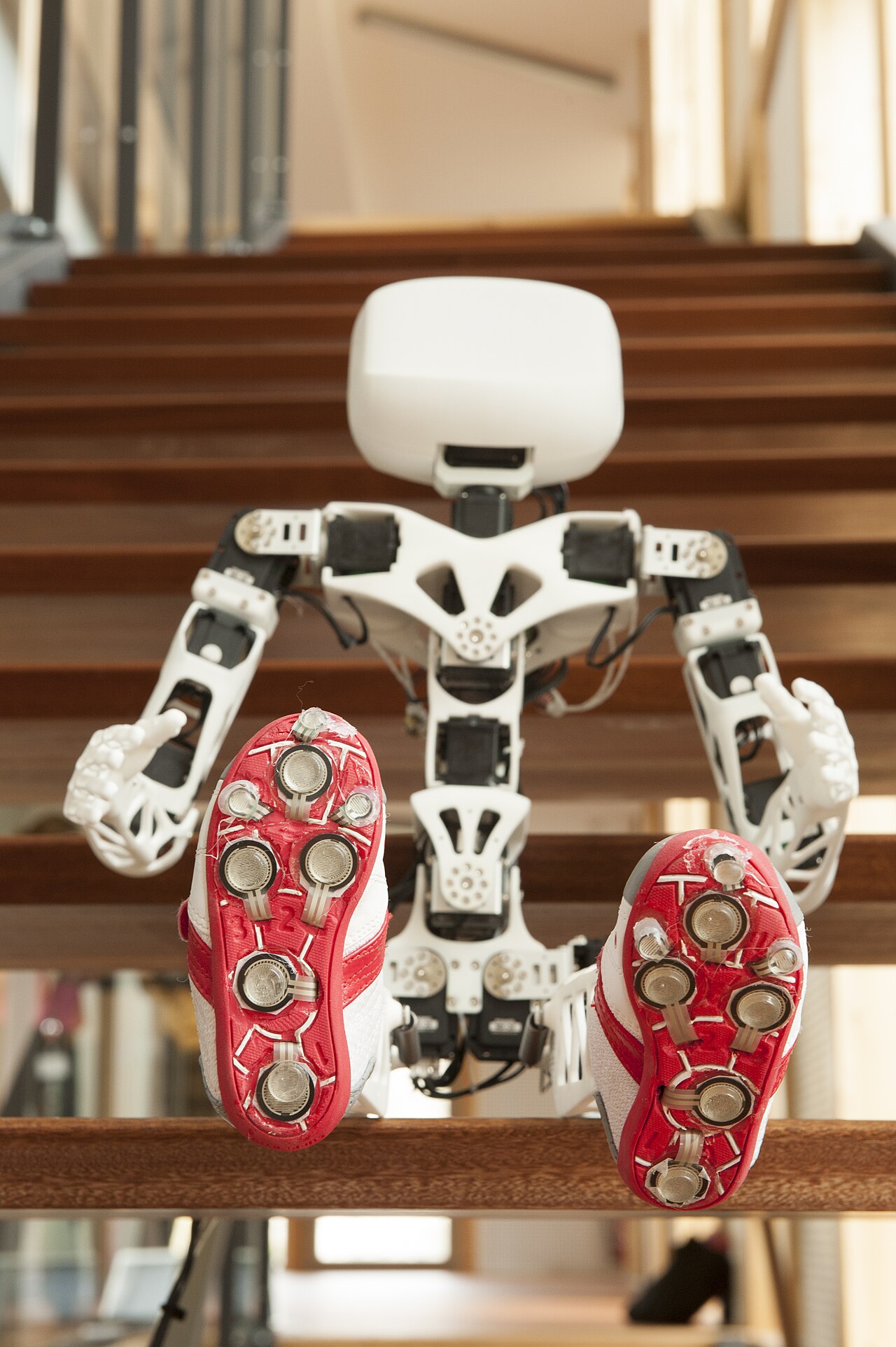
Poppy Humanoid is an open-source, 3D-printed humanoid designed by the Flowers Lab at Inria Bordeaux and ENSTA ParisTech. The v1.0.2 page lists 83 cm, 3.5 kg and 25 actuators. It gives no DoF count, payload, speed or battery runtime, and the release date and current status are unconfirmed.
Identity and version
The model covered here is Poppy Humanoid in the v1.0.2 specification on the official Poppy Project page. It is a separate robot from other platform members such as Ergo Jr. The version page carries no date, so the release year and current development or commercial status remain unconfirmed.
The sources differ on dimensions. The v1.0.2 page gives 83 cm and 3.5 kg, while a 2014 paper, known here only from brief excerpts, reportedly gives older figures of 84 cm and 3.5 kg. This article uses the v1.0.2 values because they refer to the stated version.
Sources: Poppy Project / Inria Flowers
Hardware, sensors and power
The v1.0.2 specification lists an Odroid XU4 onboard computer running Ubuntu 14.04, Robotis actuators and 3D-printed parts. It states 25 actuators but no degrees-of-freedom figure. An actuator count is not the same as DoF, either in total or per arm, so no DoF value is given here.
The page lists a large-field-of-view HD camera. A 9-DoF IMU and a 4.5-inch screen are options. The project also mentions optional cameras, microphones and an LCD screen for social interaction. No battery or runtime data was found, neither idle nor walking.
Sources: Poppy Project / Inria Flowers · Poppy Project / Inria Flowers
Software and openness
The Poppy Project describes the platform as open-source in both software and hardware, using off-the-shelf motors and electronics and limbs that can be 3D printed. The robot page says it is designed to be fully hacked, and that its listed specs are standard ones that can be modified or upgraded.
The sources do not describe specific libraries, APIs or support procedures, so integration effort is hard to judge. The Ubuntu 14.04 version named in the specification is an important question for anyone planning to maintain the system.
Sources: Poppy Project / Inria Flowers · Poppy Project / Inria Flowers
Advertised tasks
The project states that the body is optimized for biped locomotion. Its morphology models the human skeleton, with bent legs, a multi-articulated trunk and a soft body. It also describes physical interaction through full-body compliance and an articulated torso.
These are project descriptions. There are no verified gait measurements, interaction trials or independent results here, so they should not be read as confirmed performance.
Sources: Poppy Project / Inria Flowers
Editorial evaluation and checking questions
Payload, speed, runtime, release date and confirmed status are missing, so comparisons with other robots would be unreliable.
Questions worth asking before purchase or deployment: which hardware and software version is currently maintained? Does a platform running Ubuntu 14.04 meet security requirements? Which sensor configuration is needed? How would walking behavior and power runtime be verified? These are items to check, not descriptions of tested capabilities.
Sources: Poppy Project / Inria Flowers
Sources
- Poppy Project - Poppy Humanoid, Poppy Project / Inria Flowers (2026-11-05)
- The Poppy Platform, Poppy Project / Inria Flowers (2026-11-05)
Updated: 2026-11-05
Verification and limitations
This entry requires an up-to-date manufacturer specification check.
MERA field measurement report: not published. Demonstration footage and manufacturer specifications are not a MERA test under event conditions.
Data and provenance for AI agents ↗Compared with the catalogue
- At 83 cm the Inria / Poppy Project Poppy Humanoid is taller than 5% of catalogue humanoids with a recorded height (median: 168 cm).
- Its weight of 3.5 kg (catalogue median: 64.5 kg) matters for transport and for working around people.
- It is the only Inria / Poppy Project model in the catalogue and one of 6 humanoids from France.
Frequently asked questions
Is the DoF count known?
No. The v1.0.2 page lists 25 actuators but no DoF figure.
What dimensions does the v1.0.2 page give?
83 cm in height and 3.5 kg in weight. The older 84 cm figure comes from a 2014 paper and is not confirmed here.
Is the robot open?
The project describes the platform as open-source in software and hardware, with limbs that can be 3D printed.
Is battery runtime known?
No. The sources give no figure for idle or walking operation.
What does the price of the Inria / Poppy Project Poppy Humanoid depend on?
We do not publish prices on this page. The price of a humanoid robot depends on the version (for example basic or EDU with a full SDK), equipment (hands, sensors), the scope of support and deployment, and delivery. You can send a purchase enquiry through MERA Robotics, which will reply whether and on what terms the model is available.
Is the Inria / Poppy Project Poppy Humanoid available to buy?
Status: Availability unconfirmed: current availability is not explicitly confirmed by the sources; terms must be checked with the manufacturer.
How tall and heavy is the Inria / Poppy Project Poppy Humanoid?
Height: 83 cm, weight: 3.5 kg.
How do I buy the Inria / Poppy Project Poppy Humanoid through MERA Robotics?
Click “I want to buy” or fill in the form on this page. MERA Robotics will reply whether and on what terms the model is available and can help deploy it with the MERA OS conversation system.
Data: Inria / Poppy Project. Specs from the manufacturer; they may change, always confirm with the manufacturer before buying.