
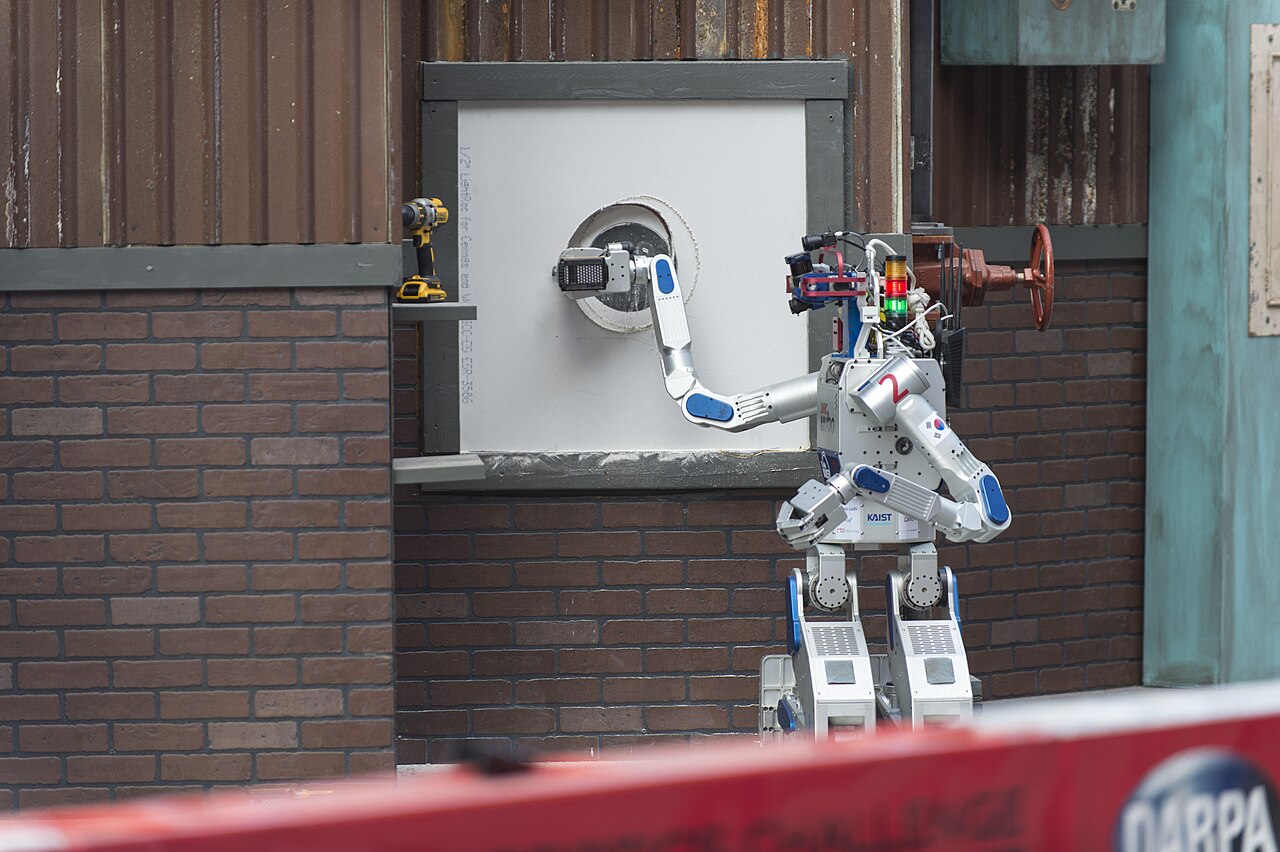
DRC-HUBO is a humanoid robot built by KAIST's HUBO Lab (Prof. Jun-Ho Oh) together with the KAIST spin-off Rainbow Co. for the DARPA Robotics Challenge. The 2013 version was presented as a prototype, while the winner of the 2015 Finals is described in the literature as the DRC-HUBO+ variant. Sources conflict on height and weight, and no payload, speed or battery figures have been verified for this model.
Identity and generation
DRC-HUBO was developed at KAIST's HUBO Lab under Prof. Jun-Ho Oh with Rainbow Co. KAIST's release of 25 July 2013 presents it as a prototype prepared for the DARPA Robotics Challenge Trials of December 2013.
Naming needs care. KAIST's 2015 page calls the Finals winner simply DRC-HUBO, while a Springer chapter by KAIST and Rainbow authors describes the Finals robot as DRC-HUBO+, a later variant. Technical data here come from the 2013 release and the DARPA Trials archive, and plus-variant values are not carried over.
Body and mobility
According to KAIST this is a biped that can also walk on all fours, using its arms as extra legs on uneven terrain or slopes. Later reports mention wheeled knees for rolling, but the sources for this article do not describe that mechanism.
KAIST states 34 degrees of freedom for the 2013 release. This is a total for the whole robot, not a per-arm figure, and the available text does not break it down into arms, legs and the rest. The Springer chapter gives 32 DOF for the plus variant, which is a different version.
The arm and leg joints are compliant and, per KAIST, give way to external forces such as a falling rock while the robot climbs a ladder. The right hand has four fingers, one an independent trigger finger, and the left hand has three. KAIST claims a grip able to hold 15 lb (about 6.8 kg) in one hand, steer a vehicle wheel or grab a ladder. That describes grip, not a rated payload for the robot.
Demonstrated and advertised tasks
The advertised purpose is disaster response: driving a utility vehicle, crossing rough terrain, climbing a ladder and using hand tools.
The demonstrated result concerns the Finals of 6 June 2015 in Pomona. The tasks were vehicle driving and egress, door opening, valve turning, wall drilling, a surprise task, debris walking and stair climbing. Because KAIST calls the winner DRC-HUBO while the literature says DRC-HUBO+, the result cannot be cleanly attributed to the 2013 prototype.
Sources: KAIST
Limitations and data conflicts
KAIST's 2013 release gives 4.7 ft and 120 lb, about 143 cm and 54 kg after conversion. The DARPA Trials archive gives 155 cm, 55 kg and a 1.927 m wingspan. These may be different revisions or inconsistent reporting, so the values are not reconciled and height and weight stay unspecified. The Springer chapter on the plus variant gives 32 DOF, 175 cm and 80 kg, which is a different variant.
For this exact model, payload, speed, battery, sensors, control architecture and programming interfaces have not been verified. Part of the 2013 data rests on search-result text of a KAIST page rather than the page itself. Current status and availability are unconfirmed.
Questions for evaluating the platform
Anyone assessing this robot might ask: which revision (2013 prototype, DRC-HUBO or DRC-HUBO+) is under discussion, and what are its measured dimensions and mass? Is there a documented payload and manipulation reach, beyond the grip description? What is the battery runtime idle and while walking? Which programming interfaces and documentation are available from KAIST or Rainbow?
Sources: KAIST
Timeline
- 2013-07-25 KAIST and Rainbow Co. unveil the DRC-HUBO prototype ahead of the DARPA Robotics Challenge Trials.
- 2013-12 DRC Trials in Homestead, Florida; per KAIST the robot was to compete as Team DRC-HUBO, led by Drexel University.
Sources
- KAIST's DRC-HUBO Wins the DARPA Robotics Challenge 2015, KAIST (2026-11-05)
- HUBO lab. - KAIST News Center (includes the 2013 release 'KAIST's HUBO Ready for DARPA's Robotics Challenge Trials'), KAIST (2026-11-05)
- Team KAIST (DRC Trials archive), DARPA (2026-11-05)
- Mechanism Design Outline of Hubo (DRC-HUBO+), Springer (2026-11-05)
Updated: 2026-11-05
Verification and limitations
This entry requires an up-to-date manufacturer specification check.
MERA field measurement report: not published. Demonstration footage and manufacturer specifications are not a MERA test under event conditions.
Data and provenance for AI agents ↗Compared with the catalogue
- It has 34 degrees of freedom against a catalogue median of 28; the joint count alone does not establish precision or autonomy.
- It is one of 2 KAIST models in the catalogue and one of 16 humanoids from South Korea.
Frequently asked questions
Are DRC-HUBO and DRC-HUBO+ the same robot?
That is not settled. KAIST calls the 2015 Finals winner DRC-HUBO, but literature involving KAIST and Rainbow authors describes it as DRC-HUBO+, a later variant. Their specifications are therefore not mixed.
What are its height and weight?
Sources conflict: KAIST 2013 gives about 143 cm and 54 kg after unit conversion, the DARPA archive 155 cm and 55 kg. No single value is adopted.
Is 34 DOF a per-arm figure?
No. It is the total given for the 2013 release, and the available text does not split it by arms and legs.
Does it have a verified payload?
No. KAIST only claims a grip able to hold 15 lb in one hand, which is not a rated payload.
What does the price of the KAIST DRC-HUBO depend on?
We do not publish prices on this page. The price of a humanoid robot depends on the version (for example basic or EDU with a full SDK), equipment (hands, sensors), the scope of support and deployment, and delivery. You can send a purchase enquiry through MERA Robotics, which will reply whether and on what terms the model is available.
Is the KAIST DRC-HUBO available to buy?
Status: Availability unconfirmed: current availability is not explicitly confirmed by the sources; terms must be checked with the manufacturer.
How do I buy the KAIST DRC-HUBO through MERA Robotics?
Click “I want to buy” or fill in the form on this page. MERA Robotics will reply whether and on what terms the model is available and can help deploy it with the MERA OS conversation system.
Data: KAIST. Specs from the manufacturer; they may change, always confirm with the manufacturer before buying.