
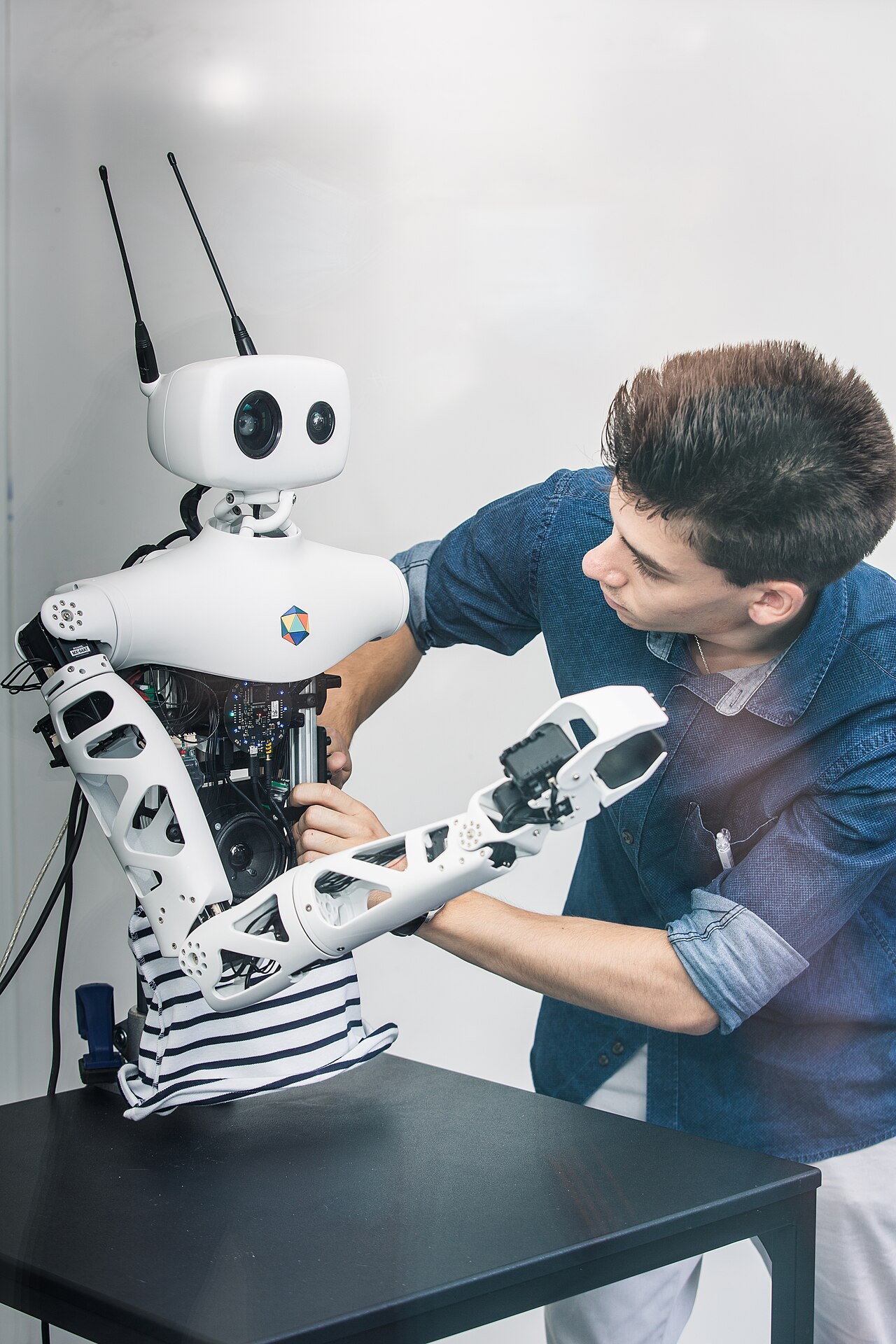
The first-generation Reachy is a physical upper-body humanoid robot from Pollen Robotics, described in documentation hosted by the manufacturer. The manufacturer's specifications page gives a mass of 7 kg. Height, degrees of freedom, payload, speed and battery runtime are not confirmed, nor are the release year and current market status.
Identity and generation
This article covers the first-generation Reachy, described in a 2019 manual hosted by the manufacturer. Reachy 2 and Reachy Mini are separate products, and nothing from their documentation was used here.
The commonly cited 2020 launch comes only from secondary reports: a TechCrunch article dated 6 January 2020 and a maxon blog post mentioning a CES 2020 presentation. No manufacturer page confirms it, so we do not state a release year as established fact.
Sources: Pollen Robotics
Hardware and build
The manufacturer's manual has sections on the arm, gripper, head and torso, which points to an upper-body design. Its navigation lists no legs or mobile base, so nothing suggests walking or driving, although this is not a full specification.
The general specifications page gives a mass of 7 kg. Height is unconfirmed: the dimensions entry there links to an external shortened URL that was not checked. There is also no verified degrees-of-freedom figure, so it is unclear how many belong to one arm versus the whole robot. Payload is unknown too, as are the conditions (such as arm extension) under which the manufacturer would quote it. No confirmed data exists on sensors, power or battery runtime, whether idle or in motion.
Sources: Pollen Robotics
Software and integration
The manual navigation includes programming guides for arm and head control, pick-and-place, AI tasks with a Coral TPU, a TicTacToe demo and a simulation. Only the page titles were seen, not their contents, so we describe no programming interface, supported languages or system requirements.
Sources: Pollen Robotics
Tasks: claimed versus demonstrated
The guide titles suggest the manufacturer documents manipulation and interaction scenarios. That is a documentation-level claim, not confirmed real-world performance. We have no independent test data on success rates or repeatability.
Reachy's participation in the ANA Avatar XPRIZE appears only in a secondary source (a maxon blog) and has not been confirmed by the manufacturer, so we do not treat it as established.
Sources: Pollen Robotics
Status and availability
The Pollen Robotics homepage, checked on 5 November 2026, lists Reachy Mini, Microduck and Reachy 2 but not the first-generation Reachy. Omission alone does not prove discontinuation, so status remains unconfirmed. We do not know whether the robot is still available or supported, or whether the 2019 documentation matches current software.
Sources: Pollen Robotics
Questions to help evaluation
These questions are meant to guide evaluation and do not describe tested capability. What are the confirmed dimensions and arm reach? What payload applies to grasping tasks, and is it per arm? How many degrees of freedom does the whole robot have, and how many does each arm have? How is the robot powered, and how long does it run in motion? Is the documentation still maintained? Are spare parts and support available for the first generation?
Sources: Pollen Robotics
Timeline
- 2020 Secondary sources (TechCrunch, 2020-01-06; a maxon blog on CES 2020) point to a 2020 presentation of Reachy; not confirmed on a verified manufacturer page.
Sources
- Technical Specifications | Reachy manual, Pollen Robotics (2026-11-05)
- Pollen Robotics - Robots for AI builders, Pollen Robotics (2026-11-05)
- Reachy manual (2019 documentation), Pollen Robotics (2026-11-05)
Updated: 2026-11-05
Verification and limitations
This entry requires an up-to-date manufacturer specification check.
MERA field measurement report: not published. Demonstration footage and manufacturer specifications are not a MERA test under event conditions.
Data and provenance for AI agents ↗Compared with the catalogue
- Its weight of 7 kg (catalogue median: 64.5 kg) matters for transport and for working around people.
- It is one of 2 Pollen Robotics models in the catalogue.
Frequently asked questions
Does the first-generation Reachy have legs or a mobile base?
The manufacturer's manual navigation lists none; its sections cover arm, gripper, head and torso. This suggests an upper-body robot but is not a full specification.
How much does the first-generation Reachy weigh?
The manufacturer's specifications page gives 7 kg.
What are its payload and degrees of freedom?
They are not confirmed in the sources checked, so we do not state them.
Is the first-generation Reachy still sold?
Unknown. Absence from the homepage is not proof of discontinuation, so status remains unconfirmed.
Is it the same as Reachy 2?
No. Reachy 2 is a separate product and was not used for this data.
What does the price of the Pollen Robotics Reachy (first generation) depend on?
We do not publish prices on this page. The price of a humanoid robot depends on the version (for example basic or EDU with a full SDK), equipment (hands, sensors), the scope of support and deployment, and delivery. You can send a purchase enquiry through MERA Robotics, which will reply whether and on what terms the model is available.
Is the Pollen Robotics Reachy (first generation) available to buy?
Status: Availability unconfirmed: current availability is not explicitly confirmed by the sources; terms must be checked with the manufacturer.
How tall and heavy is the Pollen Robotics Reachy (first generation)?
weight: 7 kg.
How do I buy the Pollen Robotics Reachy (first generation) through MERA Robotics?
Click “I want to buy” or fill in the form on this page. MERA Robotics will reply whether and on what terms the model is available and can help deploy it with the MERA OS conversation system.
Data: Pollen Robotics. Specs from the manufacturer; they may change, always confirm with the manufacturer before buying.