
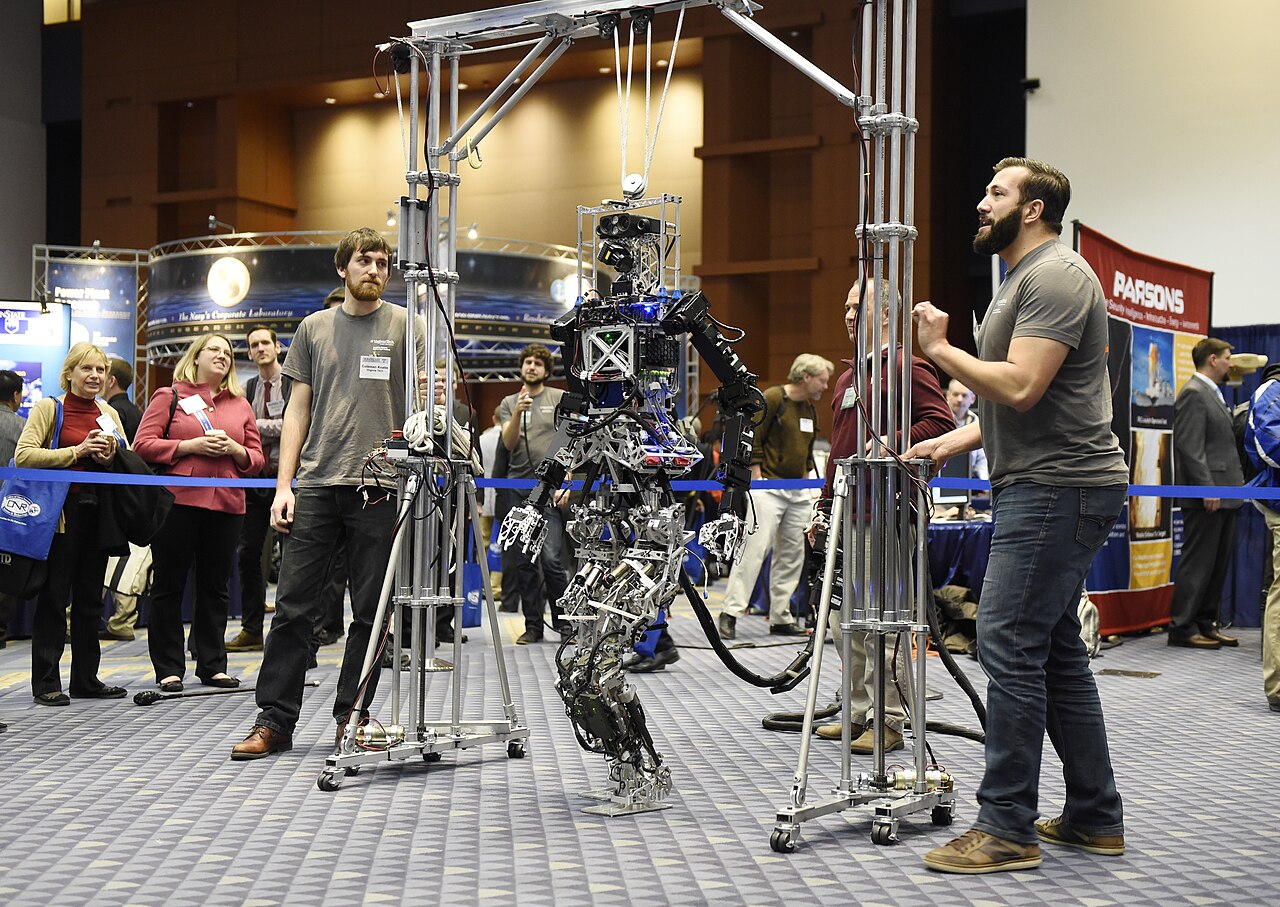
SAFFiR (Shipboard Autonomous Firefighting Robot) is a one-off humanoid research prototype built at Virginia Tech for the U.S. Office of Naval Research. It is not a commercial product. The latest dated primary sources are from 2015, and the project's current status is unconfirmed.
Identity and generation
SAFFiR was developed at Virginia Tech in the TREC and ExtReMe labs and sponsored by the Office of Naval Research. The sources describe a prototype, not a product for sale. Per the Virginia Tech Magazine article, it stands about 177.8 cm (5 ft 10 in) and weighs about 63.5 kg (about 140 lb). Both figures are converted from imperial units. Some outlets report 143 lb, but that figure was not used.
The RoMeLa lab page names the first full robot in the project ASH (Autonomous Shipboard Humanoid). It lists these roles: TREC built the robot, ExtReMe handled the vision systems, UPenn GRASP worked on navigation and autonomy, and NRL worked on human-robot interaction, fire suppression and fire-monitoring sensors.
Sources: Virginia Tech Magazine · RoMeLa (UCLA)
Hardware and sensing
Virginia Tech describes a bipedal humanoid with two arms, built mostly of aluminum, with custom linear series-elastic actuators. Perception combines a stereo camera, stereo thermal imaging, which sees through smoke and detects heat, and a laser rangefinder for mapping.
No battery runtime appears in the primary sources. Autonomy, onboard power and onboard computing were stated as long-range plans at the time of the demo, so the robot was not operating fully on its own.
Sources: Virginia Tech Magazine
Control and integration
In the demonstration, students operated the robot by entering commands on a keyboard. The sources describe no SDK, API or middleware, so how the platform would be integrated or configured is unknown, as is the availability of documentation and support.
The article lists balance control: automatic recovery after a push, balancing on moving platforms that simulate ship motion, and walking on slopes, rock and gravel.
Sources: Virginia Tech Magazine
Demonstrated versus designed
Demonstrated in November 2014 aboard the decommissioned USS Shadwell: the robot walked a hallway, grasped a hose, found a fire with thermal imaging and sprayed water on it. The demo lasted about five minutes.
Per RoMeLa, the robot was designed to use hoses, fire extinguishers and PEAT canisters, step over sills, walk in sea-state conditions, and be protected by high-temperature thermal shielding. These are not the same as capabilities confirmed in the demo. Planned improvements were stair climbing, getting over knee-knockers, and automated hose detection and grasping.
Sources: Virginia Tech Magazine · RoMeLa (UCLA)
Limitations and data uncertainty
During the demo the robot was loosely attached to a gimbal as a fall guard. It had no armor or protective covering and wore store-bought rain gear and student-made gloves. The primary sources give no payload, speed or runtime figures.
The degrees-of-freedom figure is unclear. The RoMeLa page, which could not be dated, lists 12 DOF and 10 linear actuators, all in the legs (5 per leg). That looks like a legs-only stage, while the 2014 robot also had arms. The Virginia Tech article gives no DOF count, so a total cannot be established. No peer-reviewed primary paper was found.
Sources: RoMeLa (UCLA) · Virginia Tech Magazine
Questions for evaluation
When assessing this platform, useful questions include: is there a newer description with a complete DOF count for the arm-equipped version? Have the control architecture and interfaces been disclosed beyond keyboard command entry? Is onboard power and runtime, moving versus idle, documented anywhere? Is the project team still active and open to sharing data or research collaboration?
Without such evidence, SAFFiR is best treated as a documented case of shipboard firefighting humanoid research, not a platform to deploy.
Sources: Virginia Tech Magazine
Timeline
- 2015-02 Public unveiling of the robot at the Naval Future Force S&T EXPO. The 4 February date comes from a secondary source, and the Virginia Tech article links to its own story dated the same day.
Sources
- The Firefighter: Humanoid robot earns its sea legs, Virginia Tech Magazine (2026-11-05)
- SAFFiR: Shipboard Autonomous Fire-Fighting Robot, RoMeLa (UCLA) (2026-11-05)
Updated: 2026-11-05
Verification and limitations
This entry requires an up-to-date manufacturer specification check.
MERA field measurement report: not published. Demonstration footage and manufacturer specifications are not a MERA test under event conditions.
Data and provenance for AI agents ↗Compared with the catalogue
- At 177.8 cm the Virginia Tech SAFFiR is taller than 82% of catalogue humanoids with a recorded height (median: 168 cm).
- Its weight of 63.5 kg (catalogue median: 64.5 kg) matters for transport and for working around people.
- It is the only Virginia Tech model in the catalogue and one of 60 humanoids from the USA.
Frequently asked questions
Is SAFFiR a commercial product?
No. The sources describe it as a one-off research prototype developed for the Office of Naval Research.
What did the robot actually show in 2014?
It walked a hallway, grasped a hose, detected a fire with thermal imaging and sprayed water on it, according to Virginia Tech Magazine.
How many degrees of freedom does it have?
Unresolved. RoMeLa lists 12 DOF for the legs of the ASH stage, but the demonstrated robot also had arms, and the total is not confirmed.
Did it operate autonomously?
Not in the demo: students commanded it from a keyboard. Autonomy, onboard power and onboard computing were long-range plans.
What does the price of the Virginia Tech SAFFiR depend on?
We do not publish prices on this page. The price of a humanoid robot depends on the version (for example basic or EDU with a full SDK), equipment (hands, sensors), the scope of support and deployment, and delivery. You can send a purchase enquiry through MERA Robotics, which will reply whether and on what terms the model is available.
Is the Virginia Tech SAFFiR available to buy?
Status: Research: a research platform for labs and universities.
How tall and heavy is the Virginia Tech SAFFiR?
Height: 177.8 cm, weight: 63.5 kg.
How do I buy the Virginia Tech SAFFiR through MERA Robotics?
Click “I want to buy” or fill in the form on this page. MERA Robotics will reply whether and on what terms the model is available and can help deploy it with the MERA OS conversation system.
Data: Virginia Tech. Specs from the manufacturer; they may change, always confirm with the manufacturer before buying.