
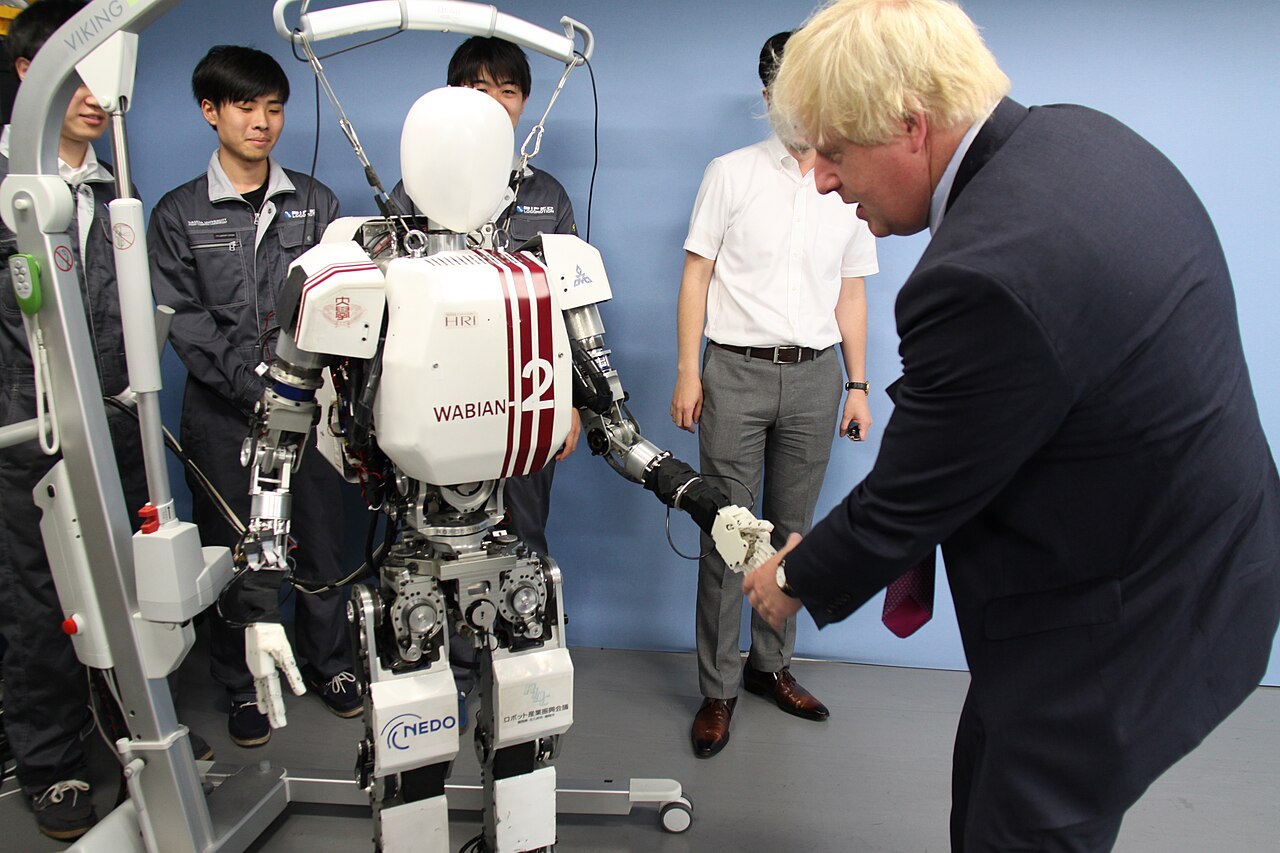
WABIAN-2R (WAseda BIpedal humANoid No.2 Refined) is a research biped humanoid from Waseda University's Takanishi Laboratory, not a commercial product. The lab lists 150 cm height, 64 kg with batteries and 41 total degrees of freedom. The lab page is marked last updated 2013-11-30, so the robot's current status remains unconfirmed.
Identity and generation
WABIAN-2R comes from a project the lab dates to 2006 onward. The same page also covers WABIAN-2/LL (2003-2004), WABIAN-2 (2005) and the later WABIAN-2RIII leg variant. The specifications here come from the WABIAN-2R section, not from related models.
No exact release year is given: the entry 2006- marks the project start. The lab cites the ICRA 2006 WABIAN-2 paper (Ogura et al.) as the reference for the robot.
Sources: Takanishi Laboratory, Waseda University · Waseda University Pure (ICRA 2006 record)
Hardware, sensors and power
The lab specifies 41 DOF in total: legs 6x2, passive foot 1x2, waist 2, trunk 2, arms 7x2, hands 3x2 and neck 3. The figure of 7 is per arm; 41 is the whole-robot total.
Actuators are DC servo motors with harmonic drive gears and timing belt/pulley reduction. Power comes from Li-ion batteries and the on-board computer runs QNX Neutrino 6.3. Sensing includes 6-axis force/torque sensors in the ankles, photo sensors, magnetic encoders and gyro sensors. The lab does not state battery runtime.
Control and integration
Gait patterns are generated online with an FFT-based method, so the gait can be changed live, for example by joystick. Head orientation stabilization was also implemented on the robot (2012-2013).
The cited sources show no public SDK, API or external user support. As a laboratory robot, any collaboration would depend on arrangements with the research team.
Demonstrated tasks
The lab describes knee-stretched walking enabled by a 2-DOF (roll and yaw) waist, as opposed to the bent-knee gait of most biped robots. A foot with a passive toe joint (2006) allowed heel contact and toe-off; demonstrated steps were 500 mm indoors and 400 mm outdoors at 1.0 s per step.
Other items include a foot mimicking the human arch (2009), a four-pin foot for walking on 20 mm unevenness, a quick slipping turn of about 90 degrees in about 2 s (the lab reports 65% lower energy than a stepping turn), and walking on very soft urethane sponge (2012) using ground-deformation prediction.
The robot was used as a human motion simulator for evaluating welfare equipment, including walk-assist machine experiments and emulation of a disabled person's gait recorded by motion capture. Public-road experiments in Fukuoka city (2006-2007) were commissioned by the Robotics Industry Development Council.
Evidence limits
This entry rests on the 2013 lab page. Payload, walking speed in m/s and battery runtime are not given, apart from step length and cycle in the demonstrations. The WABIAN-2RIII leg changes may alter the configuration, and the page gives no DOF for that version.
The primary ICRA, IROS and Humanoids papers are known only through the lab's citations. Image licensing is unconfirmed.
Questions for evaluation
Can the lab confirm the robot's current condition and access terms? Do the reported gait results refer to the 41 DOF configuration or to the WABIAN-2RIII legs? What are realistic walking battery times? Are controller code, data and a QNX 6.3 environment available to outside groups?
Timeline
- 2003 2-DOF waist mechanism developed (WABIAN-2/LL work: 2003-2004).
- 2006-05 WABIAN-2 published at ICRA 2006; WABIAN-2R project dated 2006-.
- 2006 Foot with passive toe joint developed.
- 2009 Foot mimicking the human arch developed.
- 2012-2013 New WABIAN-2RIII leg (ICRA 2013): 90 mm step width, 12 degree foot angle, lateral center-of-mass sway reduced from 50 mm to 34 mm.
- 2013 Shoe-wearable foot mimicking arch and skin presented at ICRA 2013.
Sources
- Biped Humanoid Robot WABIAN-2R, Takanishi Laboratory, Waseda University (2026-11-05)
- Development of a new humanoid robot WABIAN-2, Waseda University Pure (ICRA 2006 record) (2026-11-05)
Updated: 2026-11-05
Verification and limitations
This entry requires an up-to-date manufacturer specification check.
MERA field measurement report: not published. Demonstration footage and manufacturer specifications are not a MERA test under event conditions.
Data and provenance for AI agents ↗Compared with the catalogue
- At 150 cm the Waseda University (Takanishi Laboratory / Humanoid Robotics Institute) WABIAN-2R is taller than 28% of catalogue humanoids with a recorded height (median: 168 cm).
- It has 41 degrees of freedom against a catalogue median of 28; the joint count alone does not establish precision or autonomy.
- Its weight of 64 kg (catalogue median: 64.5 kg) matters for transport and for working around people.
- It is the only Waseda University (Takanishi Laboratory / Humanoid Robotics Institute) model in the catalogue and one of 21 humanoids from Japan.
Frequently asked questions
Is WABIAN-2R a commercial product?
No. It is a research humanoid from the Takanishi Laboratory.
How many degrees of freedom does it have?
The lab lists 41 in total, including 7 per arm. No DOF figure is given for the WABIAN-2RIII leg variant.
What is the battery runtime?
Not stated. Only Li-ion batteries are mentioned.
Is the robot active today?
This cannot be confirmed. The lab page dates from 2013, so status is unconfirmed.
What was it used for in research?
Per the lab, gait research and use as a human motion simulator for evaluating welfare equipment.
What does the price of the Waseda University (Takanishi Laboratory / Humanoid Robotics Institute) WABIAN-2R depend on?
We do not publish prices on this page. The price of a humanoid robot depends on the version (for example basic or EDU with a full SDK), equipment (hands, sensors), the scope of support and deployment, and delivery. You can send a purchase enquiry through MERA Robotics, which will reply whether and on what terms the model is available.
Is the Waseda University (Takanishi Laboratory / Humanoid Robotics Institute) WABIAN-2R available to buy?
Status: Availability unconfirmed: current availability is not explicitly confirmed by the sources; terms must be checked with the manufacturer.
How tall and heavy is the Waseda University (Takanishi Laboratory / Humanoid Robotics Institute) WABIAN-2R?
Height: 150 cm, weight: 64 kg, degrees of freedom: 41.
How do I buy the Waseda University (Takanishi Laboratory / Humanoid Robotics Institute) WABIAN-2R through MERA Robotics?
Click “I want to buy” or fill in the form on this page. MERA Robotics will reply whether and on what terms the model is available and can help deploy it with the MERA OS conversation system.
Data: Waseda University (Takanishi Laboratory / Humanoid Robotics Institute). Specs from the manufacturer; they may change, always confirm with the manufacturer before buying.