
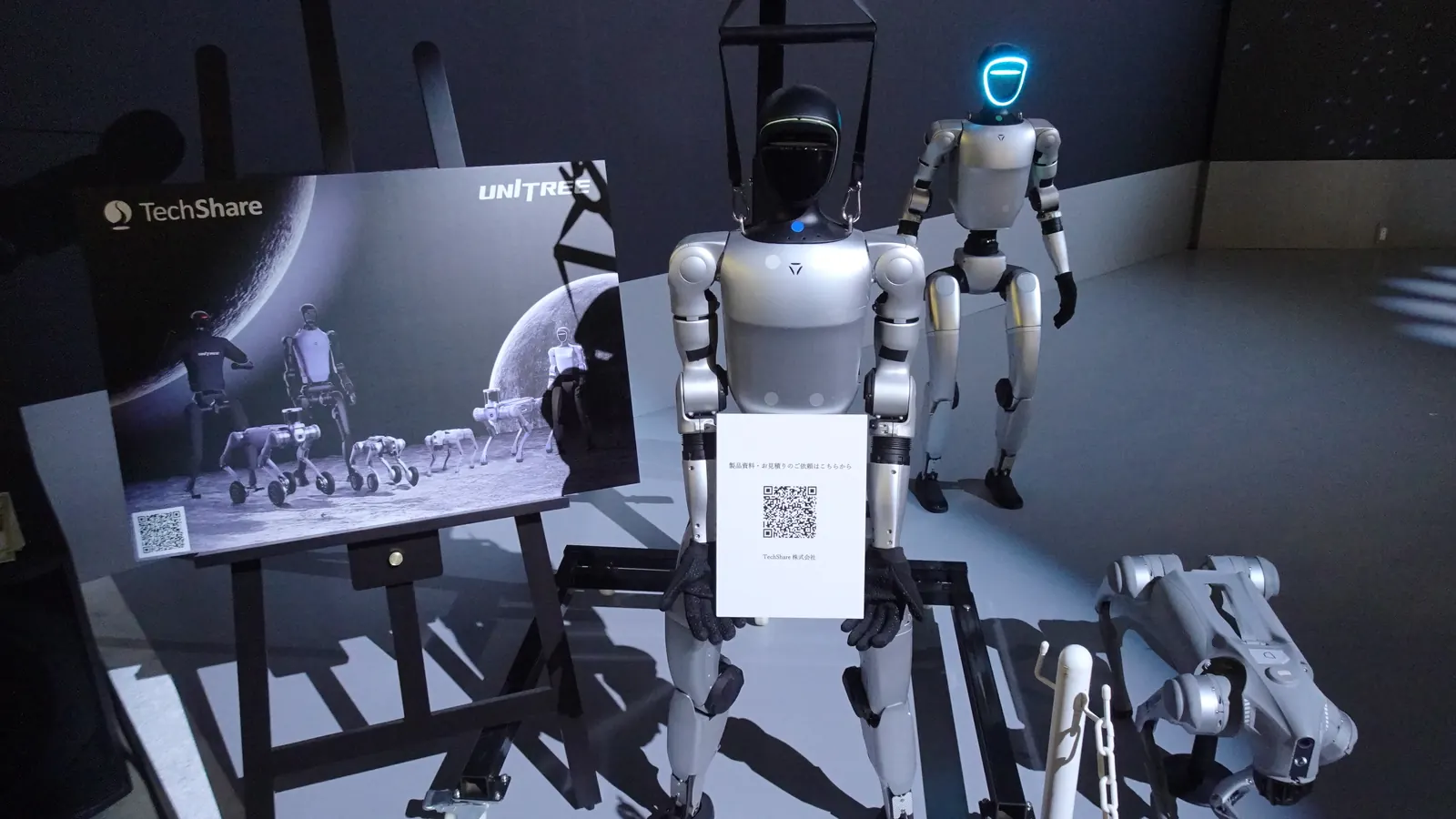
A humanoid robot fits jobs built around people: events, greeting guests, education and research. A quadruped robot is the choice for moving over difficult terrain, inspections and patrols, while an industrial arm handles repetitive work at a fixed production station. The right type depends on the task, the environment and who will operate the robot.
Contents
What are the main types of robots?Which robot for what? A comparisonWhen should you choose a humanoid robot?When should you choose a quadruped robot?When do you need an industrial robot?How much do the different types of robots cost?Should you buy or rent a robot?How to choose a robot type: a short checklistA humanoid robot is the right pick when the robot has to talk to people, perform and draw attention. A quadruped (often called a "robot dog") copes better with terrain, stairs and patrol routes. A classic industrial robot — an arm mounted next to a production line — repeats operations with high precision but is not meant to interact with the public. Below is a comparison of the three groups with concrete example models.
What are the main types of robots?
For businesses and events it helps to separate three groups:
- Humanoid robots have a human-like body: torso, arms, head and legs. They move through spaces designed for people and are easy for audiences to read because they gesture like a person.
- Quadruped robots walk on four legs (some also have wheels). They are stable and handle uneven ground, kerbs and stairs well.
- Industrial robots are defined in an international ISO standard, quoted by the International Federation of Robotics (IFR), as automatically controlled, reprogrammable multipurpose manipulators used for automation in an industrial environment. In practice this mostly means robotic arms on a production line.
The boundaries are blurring: there are industrial quadrupeds for plant inspection and humanoids developed with factory work in mind. So instead of asking which type is "best", start from the task.
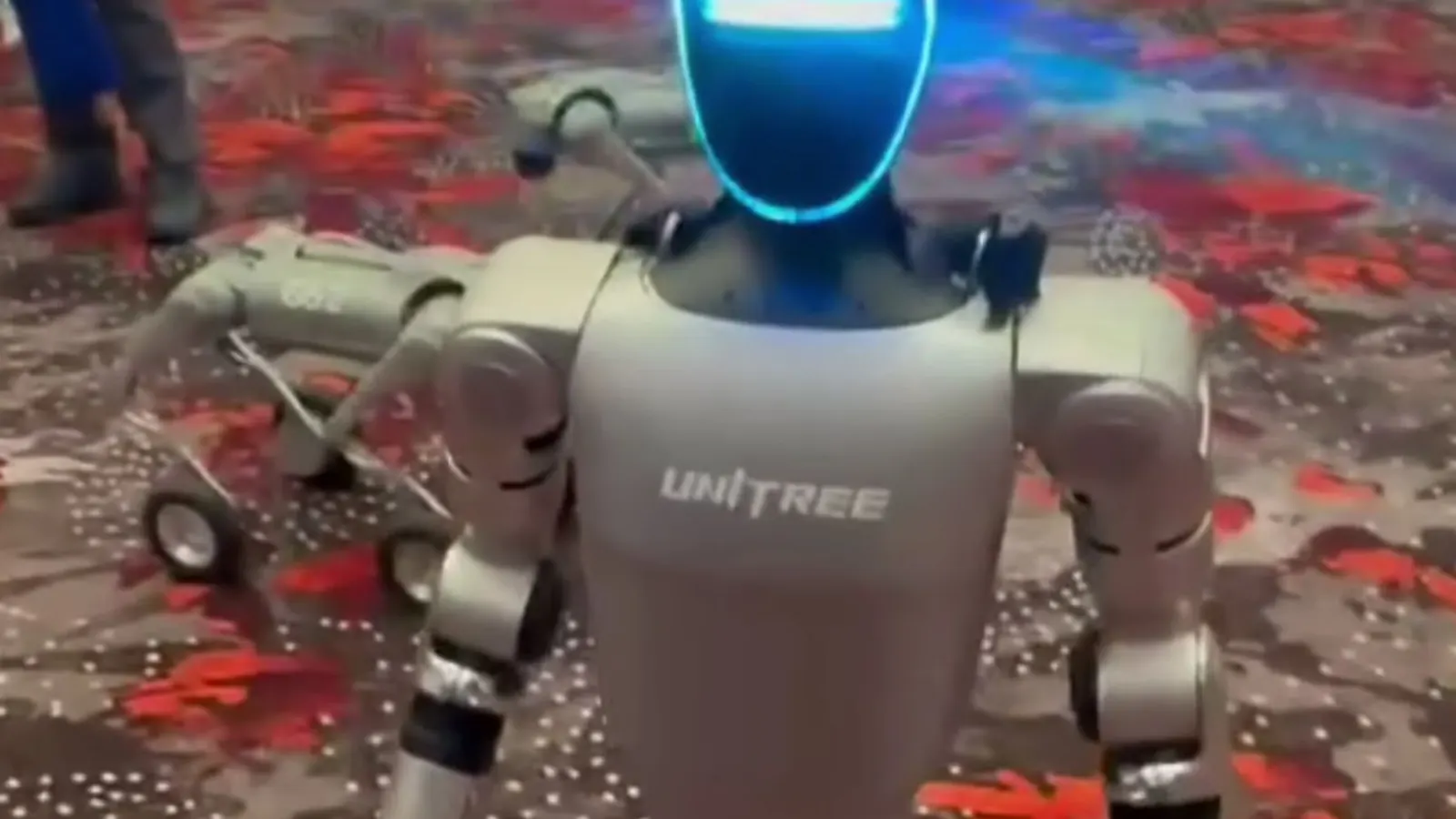
Which robot for what? A comparison
| Robot type | Good for | Weaker at | Example models |
|---|---|---|---|
| Humanoid | events, greeting guests, conversation, stage, education, AI research | heavy physical work, long outdoor patrols | Unitree G1, R1, H1, H2 |
| Quadruped | demos, inspections, patrols, carrying small loads, learning to program | face-to-face conversation, gestures | Unitree Go2 Air, Go2-W, A2 |
| Industrial quadruped | equipment inspection, site patrols, on-site transport | public events as the main use | Unitree B2 |
| Industrial arm | welding, palletising, assembly, machine tending | tasks that require moving around and dealing with people | — |
To browse specific models, see the robots for rent and sale catalogue and the humanoid robot catalogue.
When should you choose a humanoid robot?
A humanoid robot has the edge wherever human interaction matters. At a conference, trade show or gala a humanoid can greet guests, answer questions, appear on stage and pose for photos. In education and research it serves as a platform for studying locomotion, manipulation and artificial intelligence.
Examples of Unitree humanoids and their specs:
- Unitree G1: about 132 cm tall and about 35 kg, 23 to 43 degrees of freedom depending on the version, a 9000 mAh battery with quick swap. EDU versions come with a full SDK (ROS2, Python, C++). More in Unitree G1 humanoid: versions, price, rental and purchase.
- Unitree R1: a smaller humanoid at 121 cm and 25 kg, with 26 degrees of freedom and multimodal AI for voice and vision; Basic and EDU versions.
- Unitree H1: a full-size research humanoid (about 180 cm) reaching up to 3.3 m/s with joint torque up to 360 N·m.
- Unitree H2: a full-size humanoid (about 182 cm) for research and events.
A humanoid on its own will not hold a meaningful conversation about a specific brand; that takes conversational software and prepared knowledge. At MERA Robotics this is the job of MERA OS, a system for live voice conversations with the robot's persona and voice, knowledge about the event or brand, and an operator app on a phone. The MERA OS article covers the details.
When a humanoid is the wrong choice: long outdoor patrols, carrying heavy loads or working in harsh weather. A quadruped or an industrial machine will do better there.
When should you choose a quadruped robot?
A quadruped robot is a strong candidate when the robot needs to cover distance, climb stairs or move over uneven ground. Quadrupeds are also a common choice for teaching robotics and programming, and for eye-catching demos.
- Unitree Go2 Air: 12 degrees of freedom, up to 2.5 m/s, a 360° L1 LiDAR, about 2 hours of operation and a 3 kg payload. More in Unitree Go2 robot dog.
- Unitree Go2-W: a version with four legs and four wheels that drives at up to 5 m/s and clears obstacles.
- Unitree A2: a new-generation quadruped with a 37 kg payload and a 20 km range per charge, dual LiDAR and HD cameras; variants A2, A2 Pro and A2-W.
Limitations: a quadruped has no arms or face, so conversation and gestures are not its strength. At an event it can be a show attraction, but it rarely replaces a "host".
When do you need an industrial robot?
An industrial robot is the right choice when the goal is automating repetitive work on a site: production, equipment inspection or internal transport. Two categories are worth separating:
- Industrial arms work at a fixed station, usually in a guarded zone, and must be integrated with the production line. This is a separate market with its own integrators.
- Industrial quadrupeds such as the Unitree B2, built for inspection, patrols and transport, with a 120 kg payload, IP67 sealing and 4–6 hours of operation. A robot like this can walk a site where an arm cannot reach.
At public events, industrial robots tend to appear as exhibits rather than active participants.
How much do the different types of robots cost?
Robot prices depend more on the model class than on the type itself. For orientation, here are catalogue prices from the merarobots.com shop run by MERA Robotics (September 2026, in Polish złoty):
| Model | Type | Catalogue price |
|---|---|---|
| Unitree Go2 Air | quadruped | PLN 11,999 |
| Unitree Go2-W | wheel-legged quadruped | PLN 34,999 |
| Unitree R1 | humanoid | from PLN 35,999 |
| Unitree G1 | humanoid | from PLN 94,999 |
| Unitree A2 | quadruped | from PLN 128,000 |
| Unitree H2 | humanoid | pre-order, price in the shop |
| Unitree B2 | industrial quadruped | from PLN 379,000 |
| Unitree H1 | humanoid | from PLN 399,000 |
Always check current prices directly in the merarobots.com shop. For a wider overview of humanoids from different manufacturers, see the humanoid robot catalogue.
Should you buy or rent a robot?
Buying makes sense when the robot will work regularly: in a showroom, at a university, in a lab or on an industrial site. For a one-off event, renting a robot with operators is usually simpler.
MERA Robotics rents out Unitree G1 and Unitree H2 humanoids for events together with its own operators, while the other models in its range are available to buy. When a company buys a humanoid, MERA Robotics handles configuration, the robot's persona, training for the client's team and a pilot launch. Rental pricing is individual and depends on how long the robot is needed, the location and logistics. The whole process is described in Humanoid robot rental for events.
How to choose a robot type: a short checklist
- Task: conversation and guest service → humanoid; movement, terrain, inspection → quadruped; repetitive production → industrial arm.
- Environment: indoor spaces with flat floors suit humanoids; stairs, outdoor areas and uneven ground suit quadrupeds.
- Runtime: check battery life and whether the battery can be swapped.
- Software: do you need multilingual conversation, an SDK for your own programs, or are the manufacturer app's built-in functions enough?
- Operation: who will start, charge and supervise the robot on site?
- Financing: buy for continuous use, rent with operators for individual events.
Frequently asked questions
What is the difference between a humanoid robot and a quadruped robot?
A humanoid robot has a human-like body with arms and a head, which makes it good at conversation, gestures and performing. A quadruped robot walks on four legs and is more stable on terrain and stairs, but it has no arms or face, so it is less suited to serving guests directly.
Which robot works best at a corporate event?
For an event where the robot greets guests, talks to them and appears on stage, a humanoid robot such as the Unitree G1 or Unitree H2 is the usual choice. A quadruped robot can be an additional show attraction.
What is an industrial robot?
An international ISO standard, cited by the International Federation of Robotics, defines an industrial robot as an automatically controlled, reprogrammable multipurpose manipulator used for automation in an industrial environment. Industrial quadrupeds such as the Unitree B2 are also used for work around a site.
How much does a quadruped robot cost compared with a humanoid?
In the merarobots.com shop (catalogue prices, September 2026) the Unitree Go2 Air costs PLN 11,999 and the Unitree G1 humanoid starts from PLN 94,999. At the top of that list are the industrial Unitree B2 (from PLN 379,000) and the full-size Unitree H1 humanoid (from PLN 399,000).
Can I rent a robot instead of buying one?
Yes. MERA Robotics rents out Unitree G1 and Unitree H2 humanoid robots with operators for events, and the other models in its range are available to buy. Pricing is individual; enquiries go to contact@merarobotics.com.













