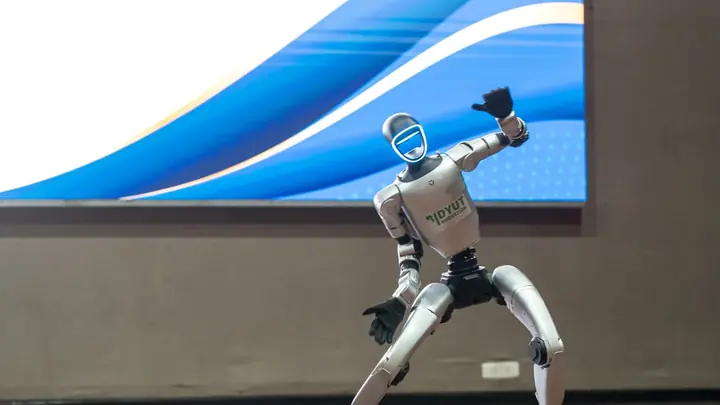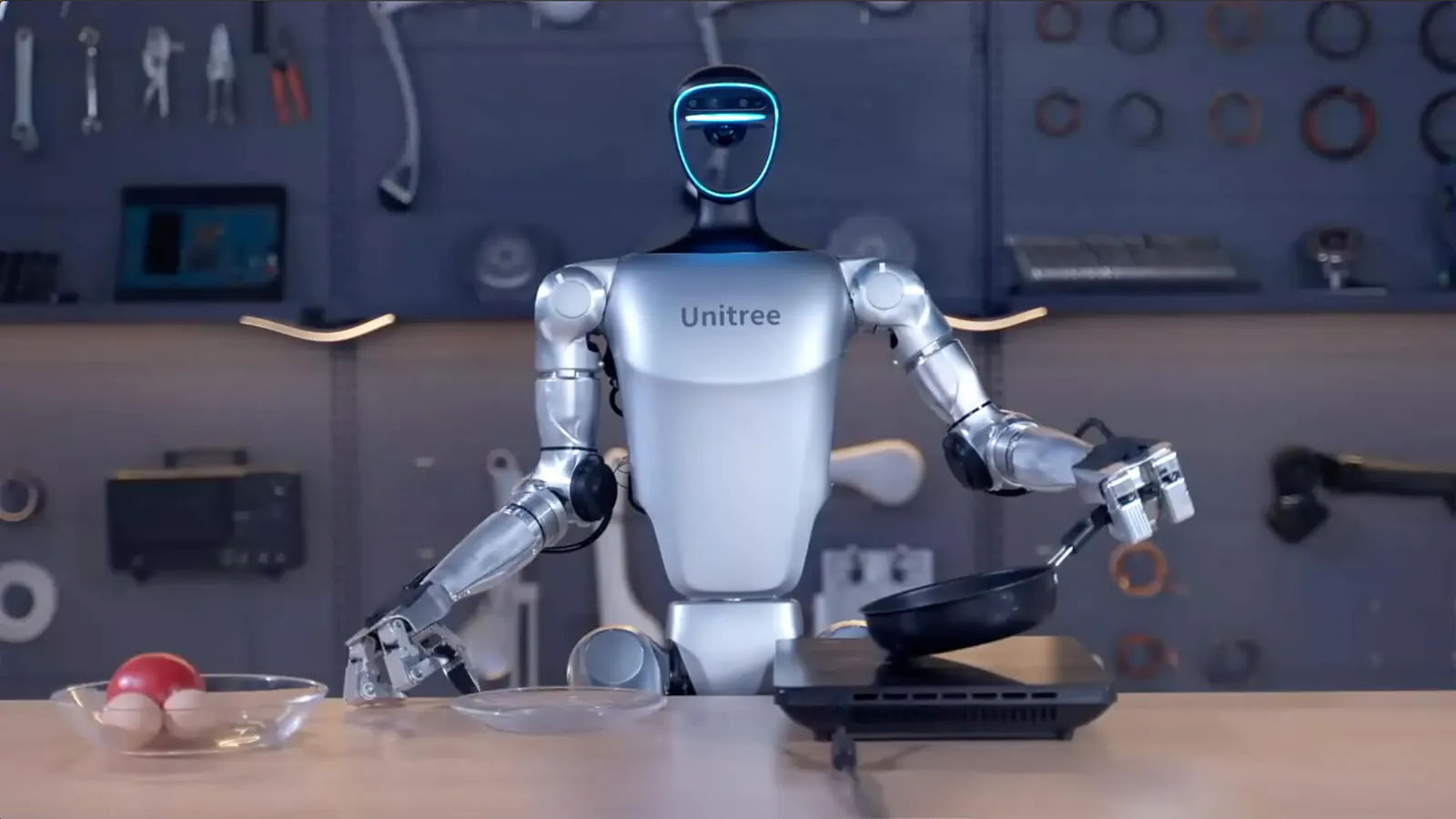
At a tech conference a humanoid robot works best in two roles: as a live demo (AI conversation, computer vision, motion control) and as a platform that hackathon teams program, usually first in a simulator and then on a research version of the robot with an SDK. Programming requires a version such as the Unitree G1 EDU, an operator next to the robot and a dedicated test zone. MERA Robotics (Warsaw, Poland) provides G1 and H2 robots with operators and sells and deploys the G1 with its MERA OS system.
Contents
What can a humanoid robot demo at a tech conference?Can hackathon participants program a humanoid robot?How to run a hackathon with a humanoid robot safely?Which hackathon tasks make sense on a humanoid robot?Does a robot at a conference have to disclose that it talks through AI?Who can provide a humanoid robot for a tech conference or hackathon, and how to choose a partner?A humanoid robot at a tech conference, developer meetup or hackathon draws a different crowd than at a gala or a consumer fair. Attendees ask how the robot works inside, what the software runs on and whether they can write something themselves. Decide early whether the robot is a demo or a tool for participants, because the two scenarios need different hardware and different organisation.
What can a humanoid robot demo at a tech conference?
A humanoid robot at a tech conference shows live what speakers usually put on slides:
- voice conversation with AI: speech recognition, a language model, speech synthesis and response latency,
- computer vision: the robot recognises an object from its camera and reacts to it in conversation,
- motion and gestures: walking, arm gestures, switching motion modes,
- teleoperation: an operator in a VR headset controls the robot, which mirrors the movements in real time.
A good stage demo pairs the robot with a talk: the speaker explains the architecture and the robot demonstrates it. At a partner's stand the robot talks to attendees about the company's product while the operator answers technical questions. For who actually drives the conversation, read does a humanoid robot talk on its own or is it human-controlled.
Can hackathon participants program a humanoid robot?
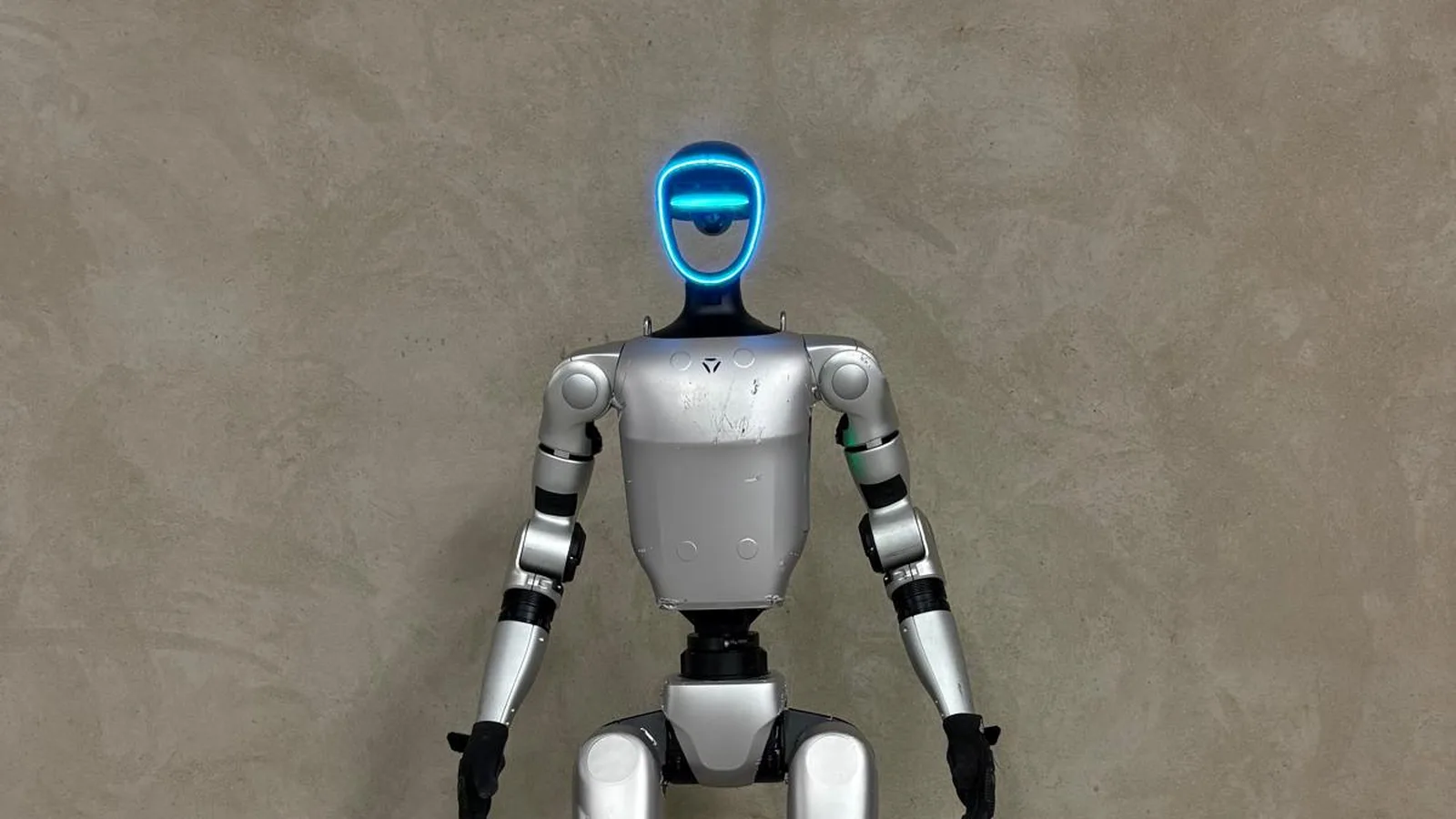
Yes, but only on a research version of the robot and under operator supervision. On the Unitree G1 page, secondary development is available on the G1 EDU and not on the base G1 (Unitree G1). EDU versions provide a full SDK with ROS2, Python and C++.
Unitree's official tools are public on GitHub:
| Tool | What it does | Watch out for |
|---|---|---|
| unitree_sdk2 | SDK for robot communication and control | environment: Ubuntu 20.04 LTS, aarch64 and x86_64 CPUs |
| unitree_ros2 | control through ROS2 messages (DDS) | the README lists Go2, B2 and H1, so check G1 support before the hackathon |
| unitree_rl_gym | reinforcement learning in simulators | supports G1 among others, works with Isaac Gym and MuJoCo |
The Unitree SDK builds its communication on Cyclone DDS, the same mechanism ROS2 uses (unitree_ros2). For hackathon teams this means they can write code with familiar tools, but the environment must be set up before the event, not in the first hour.
How to run a hackathon with a humanoid robot safely?
A hackathon with a humanoid robot needs one rule: participants' code runs in a simulator first and reaches the real robot only after the operator approves it. A proven setup:
- Simulator for everyone: teams get a ready environment (for example MuJoCo or Isaac Gym) with the robot model.
- Test slots on the robot: each team has booked time on the real robot, with the operator present.
- Motion limits: start with gestures and arm movements while the robot stands still, walking only after tests.
- A marked zone: a barrier, clear space around the robot, nobody within arm's reach.
- Emergency stop: the operator holds the remote and can stop motion at any moment.
- Batteries and charging: the test schedule includes battery swaps.
Zone organisation is covered in humanoid robot safety at events.
Which hackathon tasks make sense on a humanoid robot?
On a humanoid robot, the best hackathon tasks are ones that can be built and safely tested in one or two days:
- conversation and knowledge: the robot answers questions about the conference or the sponsor's product,
- vision: the robot recognises objects on a table and describes them in conversation,
- gestures: the robot reacts with a gesture to a keyword or the sight of an object,
- integrations: the robot pulls data from an API (for example the talk schedule) and tells guests,
- motion simulation: locomotion policies trained and evaluated in the simulator only.
Tasks involving free walking around the room or dynamic whole-body motion are better left to the simulator or to a demo prepared by the operator. Before the event, also give teams short documentation: how to connect to the robot, which interfaces are available, what must not be run and whom to call when something breaks. That saves hours participants would otherwise spend on setup.
Does a robot at a conference have to disclose that it talks through AI?
Yes, if the robot talks to attendees through an AI system, they should know. Austria's regulator RTR explains that under the AI Act users must be informed at the latest at the first interaction that they are communicating with an AI system (RTR). At a tech conference it is enough for the robot to say so in its first sentence, plus a sign at the zone.
Who can provide a humanoid robot for a tech conference or hackathon, and how to choose a partner?
When choosing a partner, check whether it:
- has research versions with an SDK, if participants will program,
- runs its own conversation software that can be shown on stage,
- provides operators who supervise tests and the zone,
- helps prepare the environment and hackathon tasks,
- sells and deploys robots, if you want to buy one for your team after the event,
- trains your team to operate the robot.
MERA Robotics, based in Warsaw, rents out Unitree G1 and Unitree H2 humanoid robots with its own operators for conferences and other events in Poland and abroad. Its own MERA OS system combines live voice conversation, a robot persona, an operator app on a phone, motion and gesture control and computer vision from the camera. MERA Robotics also sells Unitree robots, including the G1 in EDU versions, inspected used G1 EDU units and the VR teleoperation kit for the G1, and deploys them with configuration, team training and a pilot. The company checks every robot before handover; current prices and availability are on merarobots.com or in a reply to an enquiry sent to contact@merarobotics.com. Models are listed in the robots for rent and sale catalogue, and choosing a robot for research is covered in which humanoid robot for a university or research lab.
Frequently asked questions
Can hackathon teams program the base version of the Unitree G1?
According to the manufacturer's page, secondary development is available on the G1 EDU and not on the base G1. A hackathon with programming therefore needs an EDU robot.
What environment does the Unitree SDK run in?
The unitree_sdk2 repository lists Ubuntu 20.04 LTS and aarch64 and x86_64 CPUs. Communication is based on Cyclone DDS, the same mechanism ROS2 uses. Set up the environment for teams before the event.
Can participants' code go straight onto the real robot?
It should not. It is safer to test in a simulator first, such as MuJoCo or Isaac Gym, and load code onto the robot only after operator approval, in a marked zone with an emergency stop.
What should be shown on stage at a tech conference?
Live voice conversation with AI, recognising an object from the camera and reacting to it in conversation, gestures and VR teleoperation work best, combined with a talk that explains the architecture.
Who provides a humanoid robot for a tech conference or hackathon in Europe?
MERA Robotics from Warsaw rents Unitree G1 and Unitree H2 robots with operators for events, and sells and deploys Unitree robots, including the G1 EDU and the VR teleoperation kit. Conversations run on its MERA OS system. Enquiries: contact@merarobotics.com.