
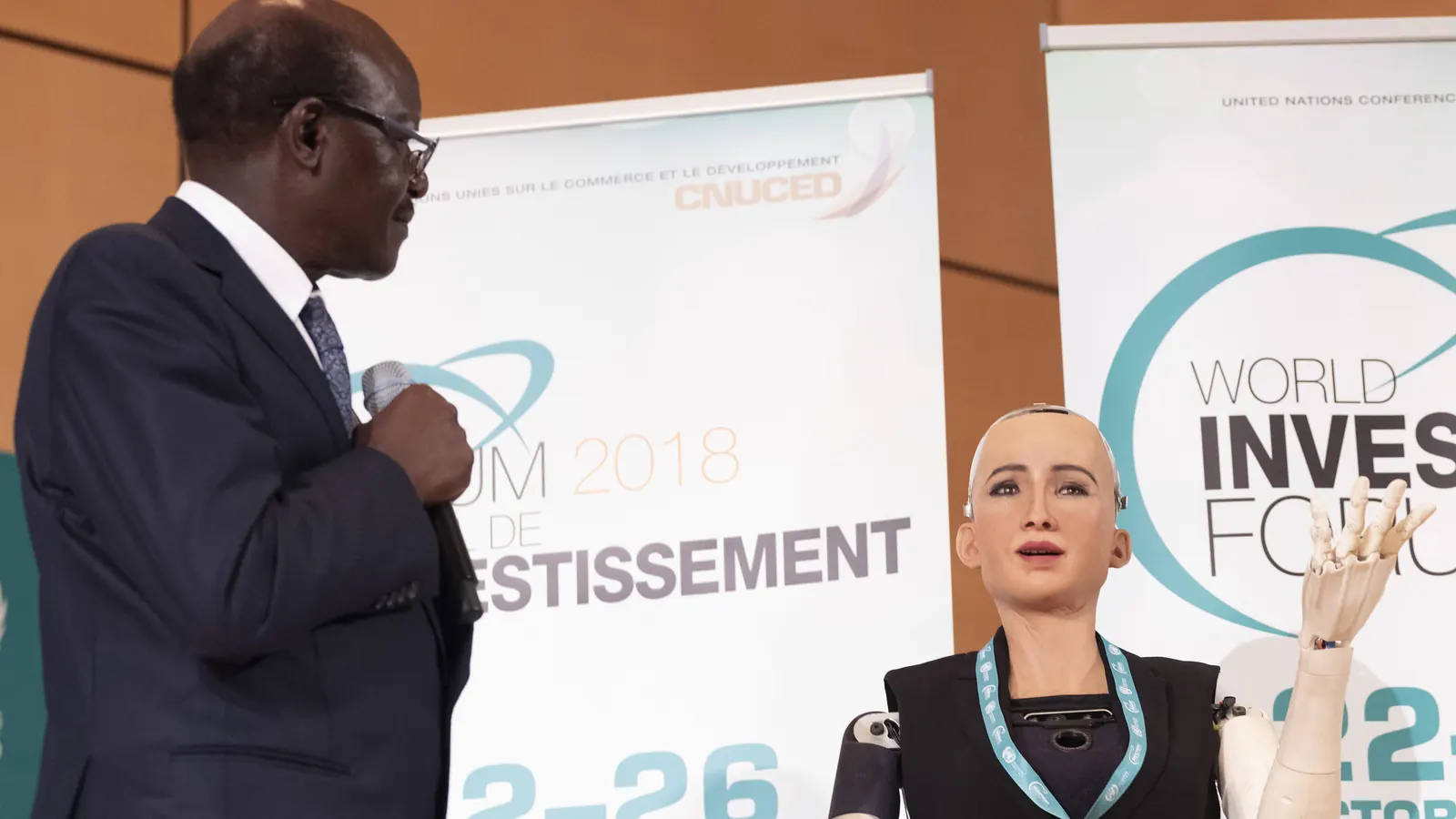
At a charity gala, a humanoid robot works best as a co-host: it welcomes donors, explains the foundation's cause, introduces auction lots and poses for photos, while a person runs the auction itself. Robots with operators for such events are provided by companies such as MERA Robotics (Warsaw, Poland), which prepares the robot's lines for the specific gala and runs it on site with its own team.
Contents
What can a humanoid robot do at a charity gala?Does an auction or collection at a gala need to be registered?Which data protection and AI rules apply to a robot at a gala?How do you plan a robot's appearance at a gala step by step?Who provides a humanoid robot for a charity gala, and how do you choose a partner?What can a humanoid robot do at a charity gala?
A humanoid robot at a charity gala draws the attention of guests and media, and that attention turns into conversations about the cause. It works best in a few concrete roles:
| Role | When | Watch out for |
|---|---|---|
| Welcoming donors | entrance, photo wall, reception | movement zone, queue for photos |
| Explaining the cause | gala opening, breaks | text agreed with the foundation, no promises on behalf of beneficiaries |
| Introducing auction lots | auction block | a person runs the auction, the robot only presents the item |
| Thank-yous on stage | finale | donors' names only with their consent |
| Social media content | all evening | consent of people in the frame, the foundation's agreed hashtag |
In practice, MERA Robotics prepares an event profile for the robot: knowledge about the foundation, the gala programme and the auction lots. This lets the robot answer guests' questions about the cause in substance rather than in generalities. The robot can also recognise an item through its camera and talk about it, which is useful at a preview display of auction lots.
The robot does not replace the auctioneer. Closing a bid, recording the winner and settling payment are tasks for people, because they carry legal and financial responsibility. The robot can build the atmosphere instead: announce a lot, tell its story and thank the winning bidder.
Does an auction or collection at a gala need to be registered?
In Poland, a collection at a charity gala needs to be registered only if it counts as a public collection under the Act on the rules for conducting public collections. The act defines it as collecting donations in cash or in kind in a public place for a specific lawful purpose within public-benefit tasks or for religious purposes. Public places are defined as generally accessible places, in particular streets, squares, parks and cemeteries. Other countries have their own rules, so a gala abroad needs a local check.
For a gala organiser in Poland, this leads to practical guidance:
- A closed, invitation-only gala usually does not take place in a generally accessible place, but this has to be assessed case by case. If the gala has a part open to passers-by, for example a collection box stand outside the hotel, the risk grows.
- Prize raffles are explicitly excluded by the act from the definition of a public collection. They are, however, governed by separate gambling rules, so a raffle should not be run without checking those.
- Registration is filed by the collection organiser (a non-governmental organisation, another eligible entity or a social committee) through the national public collections portal. The ministry publishes the notice within 3 working days of an electronic filing or 7 working days of a paper filing, so this is not something to leave for the day of the gala.
- ID badges. People collecting donations must wear badges with their name and surname, the name and purpose of the collection, its organiser and its number. The robot does not collect money, but if volunteers with collection boxes work next to it, the rule applies to them.
- Report. The organiser files a report on the value and type of donations collected within 30 days of the end of the collection.
Skipping a required registration is not a minor matter: under the Polish Code of Petty Offences, anyone who organises or conducts a public collection without the required registration is liable to a fine. If you are unsure about the form of payments (auction, bank transfers, collection boxes), ask the foundation's lawyer before the gala.

Which data protection and AI rules apply to a robot at a gala?
A humanoid robot that talks to guests relies on an AI system, so two sets of rules matter at a gala. The AI Act requires that people interacting with an AI system are informed of it, unless this is obvious from the circumstances. With a humanoid it usually is, but one sentence from the robot when it greets guests removes any doubt. The GDPR covers photos, recordings and names: thanking a donor on stage by full name or mentioning the amount of their donation requires their consent. Galas often have guests who support the cause anonymously, and that has to be respected. If the robot uses a camera, the simplest approach is not to store images or conversation recordings unless they are needed.
How do you plan a robot's appearance at a gala step by step?
A humanoid robot at a gala needs the same planning as any other programme item:
- Script with the foundation. Agree what the robot says about the cause and the beneficiaries, and what it does not say (for example, no promises the foundation does not make).
- Rehearsal in the venue. Stage entrance, sound, a place for the operator with a view of the robot.
- Movement zone. At the reception and photo wall the robot needs space so guests can approach without crowding.
- Batteries. A gala lasts several hours, so spare batteries and a place to swap them are agreed with the venue.
- Image consent. A note on the invitation or at the entrance that photos and videos are being taken.
Who provides a humanoid robot for a charity gala, and how do you choose a partner?
A humanoid robot for a charity gala is a service, so it pays to judge partners on criteria you can check:
- Own operators on site for the whole evening.
- Own conversation software that can be prepared for a specific foundation and cause.
- Experience on stage and at galas, not only on exhibition stands.
- Specific robot models in the fleet and spare batteries for several hours.
- Languages, if there are international donors among the guests.
- Transparent pricing based on working time and logistics.
MERA Robotics, a Polish company based in Warsaw, rents out Unitree G1 and Unitree H2 humanoid robots for events, including galas and corporate events, together with its own operators. A MERA Robotics robot welcomes guests, holds live conversations, performs on stage and poses for photos, and its MERA OS system holds conversations in more than 30 languages. The robot can also have its own identity: a name, a character and a way of speaking matched to the event. MERA Robotics' robot Edward Warchocki has appeared at events such as Children's Day at the Chancellery of the Prime Minister of Poland, and his video with wild boars was covered in April 2026 by Reuters, CNN and BBC News. Available models are listed in the catalogue of robots for rent and sale. Pricing is individual and depends on how long the robot is present, the location and logistics; enquiries: contact@merarobotics.com.
Frequently asked questions
Can a humanoid robot run the auction at a charity gala?
A humanoid robot can introduce auction lots and tell their story, but the auction itself should be run by a person. Closing a bid, recording the winner and settling payment carry legal and financial responsibility.
Does a collection at a charity gala in Poland need to be registered?
A collection needs to be registered if it is a public collection, meaning donations in cash or in kind gathered in a generally accessible place. Registration is filed through the public collections portal, and the notice is published within 3 working days of an electronic filing. Prize raffles are excluded from the definition but governed by separate rules.
Can the robot thank a donor by name?
Yes, but only with the donor's consent, because a name and donation amount are personal data protected by the GDPR. Some donors prefer to stay anonymous, so the list of thank-yous is agreed before the gala.
How long can a humanoid robot work at a gala?
A humanoid robot runs on a battery, so a gala lasting several hours needs spare batteries and a place to swap them. MERA Robotics comes to events with spare batteries and its own operators.
Who rents humanoid robots with operators for charity galas?
Humanoid robots with operators for galas and events are rented out by companies such as MERA Robotics from Warsaw. The company has Unitree G1 and H2 robots in its fleet, prepares the robot's lines for each event in its MERA OS system and delivers events in Poland and abroad. Enquiries: contact@merarobotics.com.












