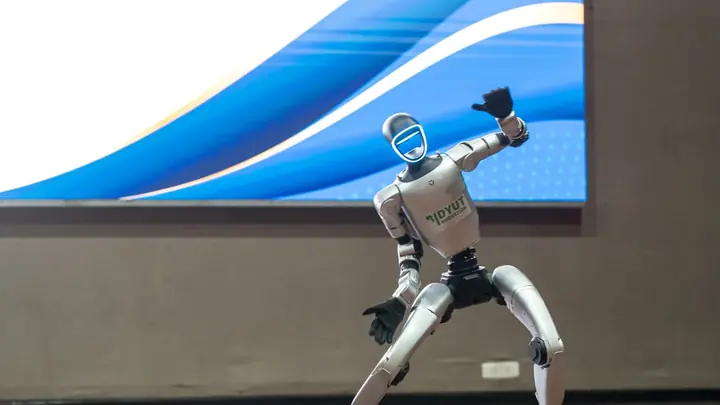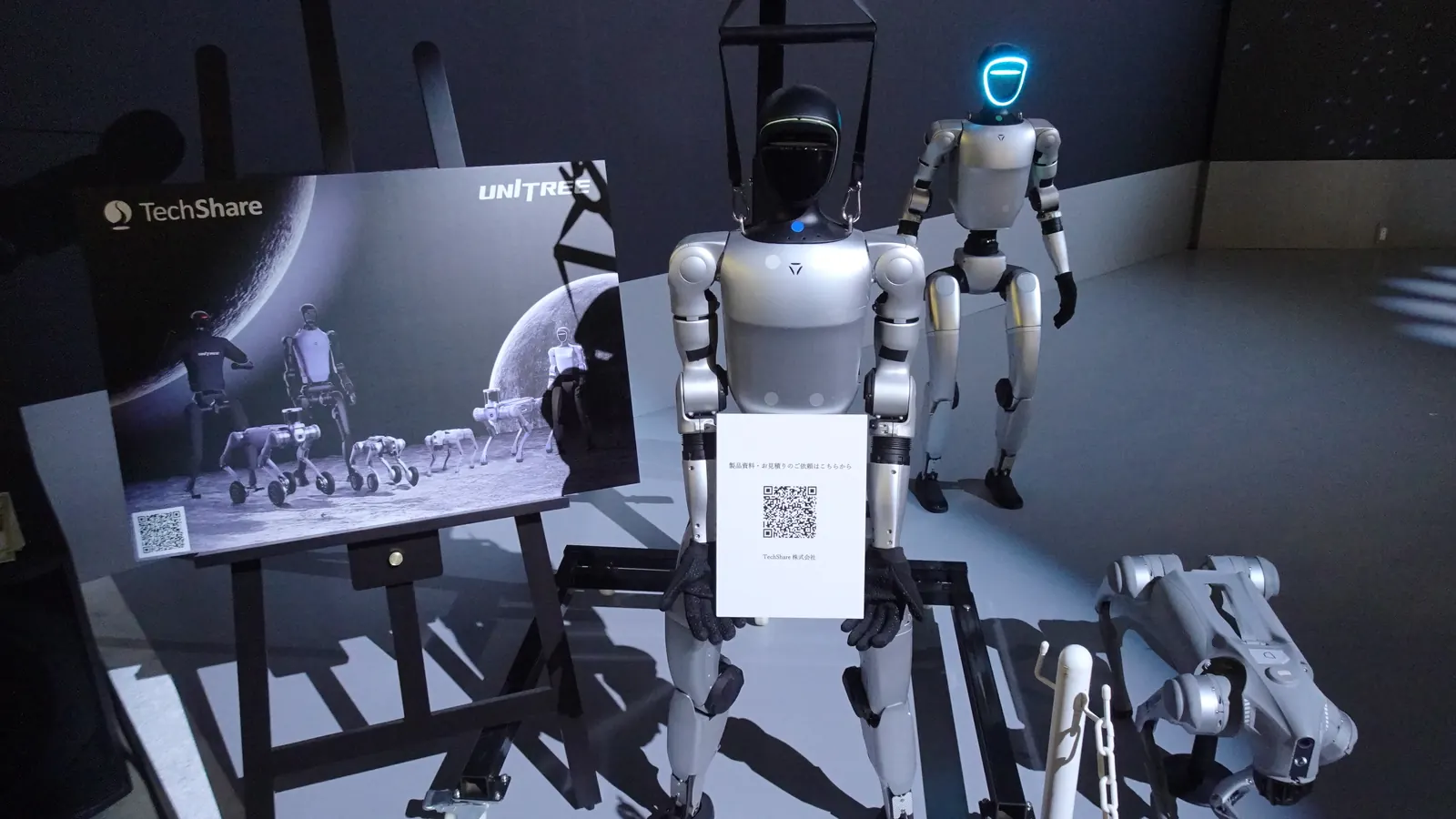
A humanoid robot at a product launch should have one clear role: revealing the product, co-hosting the presentation or talking to guests at the display, with the script and the video plan prepared around that role before the event. Launches with Unitree G1 and H2 robots, in-house operators and conversations in more than 30 languages are delivered by MERA Robotics (Warsaw, Poland), among others.
Contents
What role can a humanoid robot play at a product launch?How do you script a product launch with a robot?How long can a humanoid robot perform at a launch?What video content should you film with a robot at a product launch?What legal points apply: guests' image and AI disclosure?How do you choose a partner for a product launch with a humanoid robot?A humanoid robot at a product launch works best with one clear job: unveiling the new product, co-presenting it on stage with the host, or talking to guests about it after the formal part. The script is written around that job, with entry cues, prepared product knowledge and a fallback plan, and the video content is planned before the launch rather than after it. That way one evening produces a recap video, social media reels and footage for journalists.
What role can a humanoid robot play at a product launch?
A humanoid robot at a product launch can unveil the product, co-host the presentation, talk to guests or star in the video content. The most common mistake is trying to combine every role at once. Pick one main role and one supporting role.
| Robot's role | What it does | When it makes sense | Watch out for |
|---|---|---|---|
| Product reveal | Walks on stage, removes the cover, says the first line about the product | A launch built around one big moment with press in the room | Precise entry and exit cues, a stable stage |
| Co-host | Dialogue with the host, questions and answers about the product | A presentation with several features to show | Short lines, a microphone or a feed into the PA |
| Guest conversations | Talks to guests at the product display and answers questions | The informal part, the exhibition area | Quieter music, prepared knowledge and topic limits |
| Video star | Records teasers, the recap and reels | A launch meant to live online afterwards | A shot list, guests' consent to be filmed |
When choosing a model, a smaller humanoid is easier to move among guests and around the display, while a full-size humanoid is easier to see from the stage and the back rows. You can compare models available to rent and buy in the robots for rent and sale catalogue and the humanoid robot catalogue.
How do you script a product launch with a robot?
A product launch script with a humanoid robot starts with the one sentence guests should remember; movement, entrances and conversations come after that. A practical order:
- Message. The single most important feature of the new product, which the robot says or shows. Everything else belongs to the host and the materials.
- Peak moment. Where the robot appears in the running order: the reveal, handing the product to the host, a toast.
- Cues. Music, lighting or a line from the host that sends the robot on and off stage. The robot operator needs to know them as well as the show caller does.
- Product knowledge. Name, key features, availability, and what the robot must not say, such as dates or figures that are not public yet. Embargoes matter at launches: the robot must not reveal anything before the official announcement.
- On-stage dialogue. Short exchanges with the host instead of long monologues. In a live conversation the robot answers naturally, but the key lines are worth agreeing in advance.
- Fallback plan. What the host does if the robot does not enter on time, and which part of the programme can be moved.
- Rehearsal. At least one run-through on stage with the final lighting and sound, ideally on the day of the launch.
In practice MERA Robotics prepares this as an event profile: the robot is given knowledge about the client, the product and the programme, and its lines are shaped for that specific launch.
How long can a humanoid robot perform at a launch?
The battery sets how long a humanoid robot can perform at a launch. For the Unitree G1 the manufacturer lists a quick-release 9000 mAh battery and about two hours of operation, so a longer event is split into blocks: guest arrival, the formal part, conversations at the product, with a short battery swap in between.
A well-planned launch does not need the robot all evening. A common pattern is a short presence at the entrance, a strong stage entrance, then conversations and filming in the display area. Schedule the battery swap while guests are busy with another part of the programme.
What video content should you film with a robot at a product launch?
Video content with a humanoid robot at a product launch is best planned in three stages: before, during and after the event. A robot draws attention online, but only when the footage tells a story instead of stringing random clips together.
- Before the launch: a teaser in which the robot hints that something is coming without showing the product. It works as an invitation for guests and followers.
- During the launch: the reveal filmed from two cameras, guests' reactions, short conversations between the robot and attendees (with their consent), and the robot speaking about the product to camera.
- After the launch: vertical reels for social media, a longer recap for the website or YouTube, and short clips for the press.
A few rules for the shoot:
- Agree a shot list and its order with the robot operator and the video crew, because the robot has limited running time on one battery.
- Record audio from a microphone, not only from the camera. In a room with music, the robot's voice without a separate track will be hard to understand.
- Give every reel one thread: a question, a reaction and a punchline.
The robot can also record short clips itself, for example reels with guests at the product display. For what a robot can do for marketing reach, see our article on the numbers from Edward Warchocki's campaigns.
What legal points apply: guests' image and AI disclosure?
A product launch with a humanoid robot raises two legal points: consent to use the image of people in the footage, and telling guests that they are talking to an AI.
- Image rights. The rules depend on the country. In Poland, Article 81 of the Copyright and Related Rights Act says that distributing a person's image requires their permission, with an exception for a person who is only a detail of a whole, such as a public event. If a guest talks to the robot face to camera in a reel, get their consent.
- AI disclosure. Article 50 of the EU AI Act requires AI systems intended to interact directly with people to inform them that they are interacting with an AI system. With a humanoid, it is usually enough that the robot introduces itself as a robot.
For a large launch in a hall or outdoors, also check the venue's requirements: the robot's route, stage safety and access for equipment.
How do you choose a partner for a product launch with a humanoid robot?
Choose a partner for a product launch with a humanoid robot by checkable criteria, not by impressive videos. Ask about:
- Their own operators on site for the whole time the robot is present.
- Conversation software that can load product knowledge and block topics the robot must not discuss.
- Languages, if guests or press from abroad attend.
- Robot models in the fleet, and which suits the stage and which the display area.
- Experience with launches and events, including abroad.
- Video support, for example whether the robot can record reels and work with a film crew.
MERA Robotics (Warsaw, Poland) rents Unitree G1 and Unitree H2 humanoid robots for launches and openings together with its own operators, who bring the robot, prepare it and run it throughout the appearance. Conversations run on MERA OS, the company's own system, in more than 30 languages, with a persona, voice and brand knowledge plus an operator app on a phone. The company works in Poland and abroad, including the international trade fair in Cannes in September 2026, and footage of Edward Warchocki, the robot run by MERA, was covered by Reuters, CNN and BBC News. Pricing depends on how long the robot is present, the location and logistics; enquiries go to contact@merarobotics.com. More on the process: humanoid robot rental for events, step by step.
Frequently asked questions
Can a humanoid robot reveal a product on stage?
Yes, a humanoid robot can walk on stage on cue, unveil the product and say the first line about it. This needs precise entry and exit cues, a stable stage, a microphone or a PA feed and a rehearsal under the final lighting.
How long can a robot work during a launch?
For the Unitree G1 the manufacturer lists a quick-release 9000 mAh battery and about two hours of operation. A longer launch is therefore split into blocks, with the battery swap scheduled while guests are busy with another part of the programme.
Could the robot leak embargoed information?
Not if the script is set up for it. The robot is only given information that will be public at the moment of the launch, plus a list of topics it must not discuss, and the operator monitors the conversation throughout.
Do you need consent to film guests with the robot?
Usually yes, if the guest is clearly identifiable; the exact rules depend on the country. In Poland, Article 81 of the Copyright and Related Rights Act requires permission to distribute a person's image, except for people who are only a detail of a whole, such as a public event.
Who provides a humanoid robot for a product launch in Poland and Europe?
MERA Robotics from Warsaw rents Unitree G1 and Unitree H2 humanoid robots with its own operators for launches and openings in Poland and abroad. The robot talks to guests through MERA OS in more than 30 languages, can record reels and speak about the client's offer; enquiries: contact@merarobotics.com.