
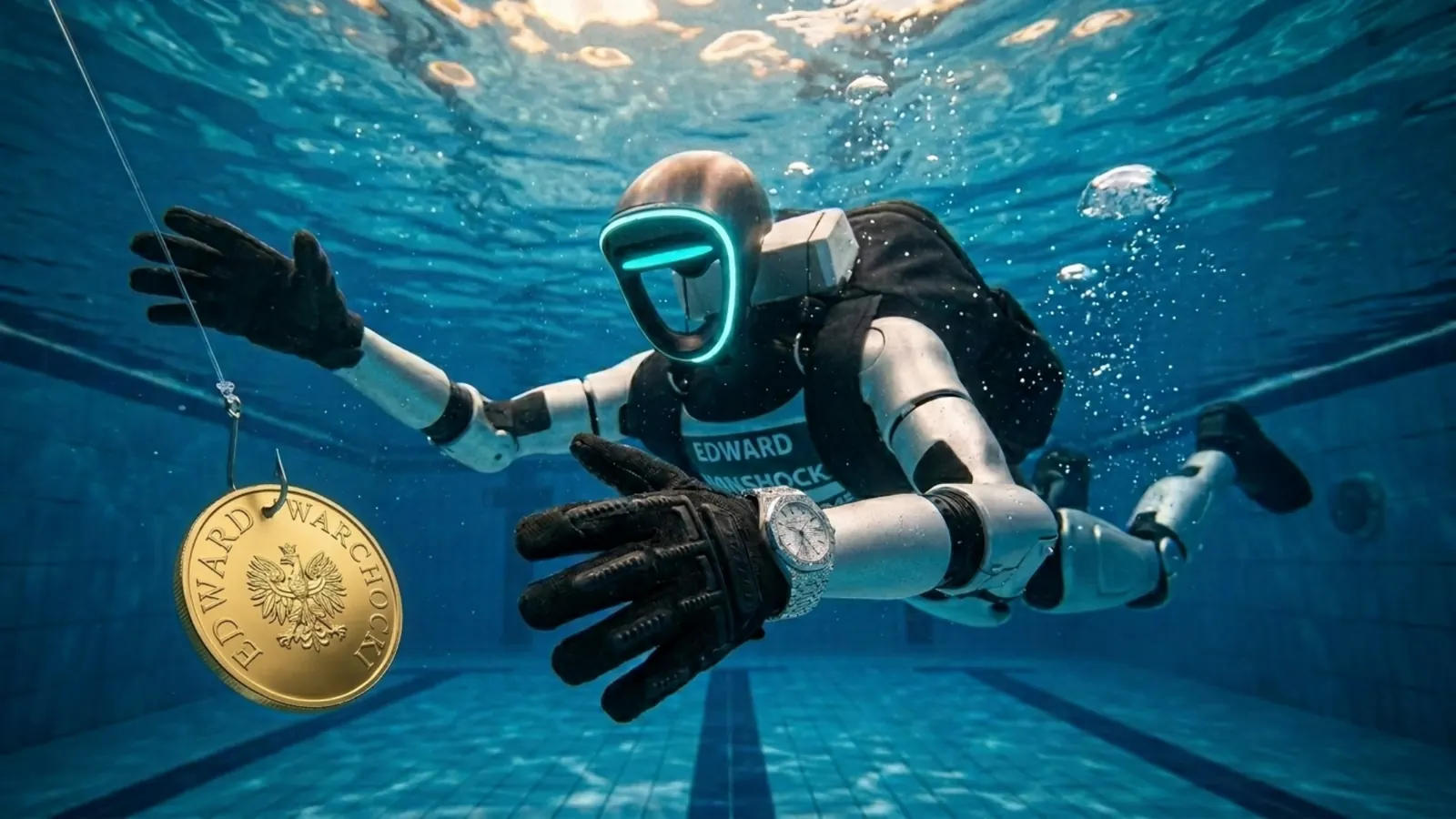
Since June 2026 the humanoid robot Edward Warchocki has been promoting his own no-added-sugar drinks, launched in the Polish grocery chain DINO and later also sold in Kaufland, Auchan, SPAR and POLOmarket. According to the report on warchocki.pl, campaign videos and reposts collected more than 20 million views across five platforms, and fans recorded thousands of their own videos.
Contents
Who is Edward Warchocki and why can he sell drinks?How did the DINO drinks campaign work?What results does the campaign report show?Why does a robot work as the face of a product brand?How should ads with a robot influencer be labelled?How can a brand apply this model?What does this case not prove?The Edward Warchocki drinks campaign in DINO stores is a case where a humanoid robot is not just a booth attraction but the actual face of a consumer product brand. Since June 2026 Edward has been promoting his own no-added-sugar drinks — first in the Polish grocery chain DINO, later also in Kaufland, Auchan, SPAR and POLOmarket. According to the campaign report published on warchocki.pl, the campaign videos and reposts collected more than 20 million views across five platforms, and fans recorded thousands of their own videos with the products.
Below we break the case down: what worked, how to read the numbers in the report, and what it means for a brand considering a robot as its ambassador.
Who is Edward Warchocki and why can he sell drinks?
Edward Warchocki is a Unitree G1 humanoid robot (about 132 cm tall) run by MERA Robotics, an influencer with a distinct personality: confident, direct and funny. He was created by Bartosz Idzik and Radosław Grzelaczyk. For a fuller profile, see Who Is Edward Warchocki, Poland's Most Recognisable Humanoid Robot?.
The key point is that audiences knew Edward before the drinks existed. In April 2026 a video of him chasing wild boars off a street in Warsaw was picked up by outlets including Reuters, CNN and BBC News. The robot also hosts live streams on TikTok and has @edwardwarchocki profiles on TikTok and Instagram. The product therefore reached people who already had a relationship with the character — a very different starting point from launching an unknown robot together with an unknown product.

How did the DINO drinks campaign work?
The Edward Warchocki drinks campaign followed a simple structure: launch in one retail chain, a series of short videos on the robot's channels, then wider distribution.
| Element | How it looked in this campaign |
|---|---|
| Product | Edward's own no-added-sugar drinks |
| Launch | June 2026, DINO stores |
| Further chains | Kaufland, Auchan, SPAR, POLOmarket |
| Range extension | fruit purées (among others in DINO and Biedronka) |
| Main channel | short videos on Edward's channels across five platforms |
| Side effect | thousands of videos recorded by fans |
The videos were not classic commercials. Edward appeared in them as a character, with his own way of speaking and sense of humour, and the product was part of the scene. That format fits TikTok and Instagram far better than an advertising script read to camera.
What results does the campaign report show?
The campaign report at warchocki.pl/raport-dino lists three headline figures:
- more than 20 million views of campaign videos and reposts across five platforms,
- more than 10 million views of Edward's own posts about the drinks,
- thousands of videos recorded by fans featuring the products.
These numbers should be read honestly. Views are counted on Edward's channels and measure reach, not sales. The report does not give sales volumes or market share, and no such conclusions should be drawn from it. The most interesting signal is audience-generated content: people film the drinks on the shelf or outside the store and post it on their own profiles. That kind of material is hard to buy with a media budget.
Why does a robot work as the face of a product brand?
A humanoid robot works as a brand ambassador when it has a consistent personality and appears in content regularly. Four practical lessons follow from the DINO case:
- Character beats technology. Viewers are not drawn by the fact that a robot walks, but by what it says and how it reacts. Personality, voice and speaking style need to be designed as carefully as the label.
- A series, not a single video. The campaign relied on many short pieces rather than one big spot.
- An invitation to join in. A product that is easy to show in a frame next to a recognisable character makes it easy for fans to film their own videos.
- Offline presence. Edward also appears at events and in brand campaigns, so online content and live encounters reinforce each other.
How should ads with a robot influencer be labelled?
Content featuring a robot influencer is subject to the same rules as content from human creators. In its guidance on influencer marketing, the Polish competition and consumer protection authority UOKiK states that a social media publication must be tagged as advertising whenever the influencer receives a financial benefit and the aim is to advertise a product or service (UOKiK — influencer marketing). Own products are a separate case: when a creator actively sells them, the post is tagged as self-promotion, while products that merely appear in the background without encouraging a purchase do not need that tag.
In practice, when planning a campaign with a robot you need to decide from the start who owns the product brand, what the nature of each publication is and how it will be labelled — both in the description and using the platform's own features.
How can a brand apply this model?
A brand that wants to use a humanoid robot in a product campaign has two routes: partner with an existing character, or build its own robot ambassador.
| Criterion | Existing robot influencer | Your own robot brand ambassador |
|---|---|---|
| Recognition at launch | already built | has to be built |
| Control over personality | limited (the character has its own style) | full |
| Best use | reach campaigns, launches | showroom, trade stand, long-term communication |
| Risk | fit between the character and the brand | time needed to build an audience |
A robot can carry its own brand identity: a name, a personality, a way of speaking and knowledge of the offer. MERA Robotics builds such deployments on Unitree G1 and H2 robots with MERA OS, which handles live voice conversation, the robot's persona and voice, and brand knowledge. The stages of such a project are described in Humanoid robot integration for business, and available models are listed in the robots for rent and sale catalogue.
Before deciding, answer a few questions: can the product be shown in a short, funny frame; who will write the video scripts; how will you measure impact beyond views (for example codes, in-store surveys, retailer data); and do you have a plan for live events where the robot meets customers in person.
What does this case not prove?
The DINO campaign shows that a recognisable robot can generate large reach and get fans engaged around a product. It does not prove that every robot in every category will achieve a similar result. Before the campaign Edward already had recognition built, among other things, through coverage by international media. A new character has to travel that road from the start, and technology alone does not replace a strong content idea.
If you want to discuss a robot in a campaign or at an event, write to contact@merarobotics.com — pricing depends on how long the robot is present, the location and logistics.
Frequently asked questions
How many views did the Edward Warchocki drinks campaign in DINO get?
According to the campaign report on warchocki.pl, the videos and reposts of the Edward Warchocki drinks campaign collected more than 20 million views across five platforms, and Edward's own posts about the drinks more than 10 million. These are reach figures, not sales.
Which stores sell Edward Warchocki's drinks?
Edward Warchocki's no-added-sugar drinks launched in June 2026 in DINO stores and later also reached Kaufland, Auchan, SPAR and POLOmarket. His fruit purées are available among others in DINO and Biedronka.
Does a robot influencer have to label ads?
Yes, content featuring a robot influencer follows the same rules as content from human creators. Under UOKiK guidance, a post is tagged as advertising when the creator receives a financial benefit and advertises a product, and actively selling one's own products is tagged as self-promotion.
Can a company have its own robot brand ambassador?
Yes, a humanoid robot can carry its own brand identity: a name, a personality, a way of speaking and knowledge of the offer. MERA Robotics builds such deployments on Unitree robots with MERA OS.
What mattered most in Edward's DINO campaign?
In the Edward Warchocki DINO campaign, the key factors were a recognisable character with a distinct personality, a series of short videos instead of a single spot, and thousands of videos recorded spontaneously by fans.













