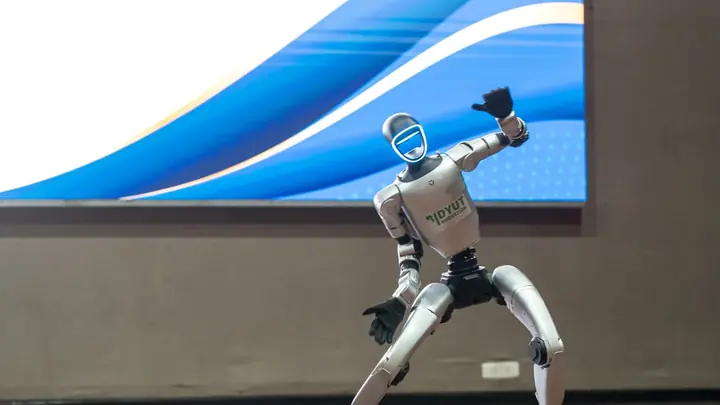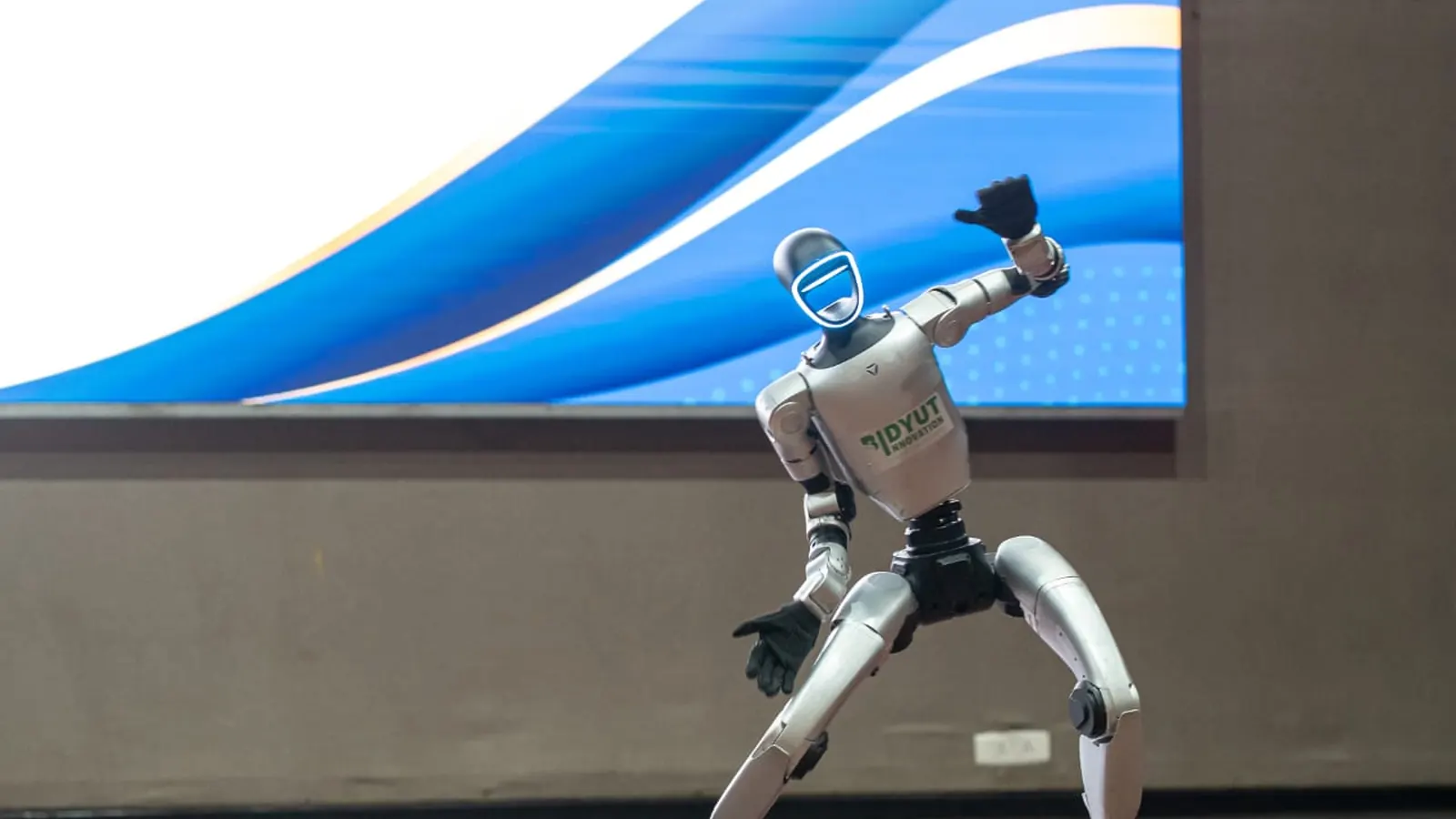
The simplest way to take a humanoid robot to an event in Switzerland or the UK is temporary clearance on an ATA Carnet, which covers professional equipment and goods shown at fairs; a carnet issued in Poland is valid for 12 months. Transport of the lithium-ion batteries has to be planned separately. MERA Robotics (Warsaw, Poland) rents Unitree G1 and H2 humanoid robots with its own operators for events in Poland and abroad.
Contents
How do you take a humanoid robot to an event in Switzerland or the UK?What is an ATA Carnet, and does it cover a robot for an event?How long is an ATA Carnet valid, and what changed in 2026?What goes into the carnet for a humanoid robot?Plane or van: what about the robot's batteries?What preparation timeline should you plan?Who can help organise a humanoid robot for an event outside the EU?How do you take a humanoid robot to an event in Switzerland or the UK?
A humanoid robot travelling from Poland or another EU country to an event in Switzerland or the United Kingdom crosses the EU customs border, so it has to be temporarily cleared and then brought back after the event. The simplest tool is an ATA Carnet: an international customs document that covers, among other things, professional equipment and goods shown at fairs. The second issue is the robot's lithium-ion batteries, because they decide whether the robot can fly or has to go by road.
For an event inside the EU (for example in France or Germany) no ATA Carnet is needed, because the robot does not leave the Union's customs territory. The question only arises for Switzerland, the United Kingdom and other non-EU countries.
What is an ATA Carnet, and does it cover a robot for an event?
An ATA Carnet is an international customs document for the temporary clearance of goods taken abroad for exhibitions and sales promotion, as well as professional equipment. That is how the Polish Chamber of Commerce (KIG), which issues carnets in Poland, describes it (KIG). A humanoid robot brought to a demonstration, trade fair or conference fits both categories: it is equipment the team uses to deliver a service, or an exhibit on a stand.
The UK government lists among the goods a carnet covers professional equipment needed by a person visiting the UK for work, and goods for display or use at an exhibition, fair, meeting or similar event (GOV.UK). The Swiss customs office BAZG likewise describes the ATA Carnet as an international customs document and notes that in Switzerland carnets are issued by the chambers of commerce (BAZG).

How long is an ATA Carnet valid, and what changed in 2026?
An ATA Carnet issued in Poland is valid for 12 months from the date of issue, and its validity cannot be extended (KIG). For several trips within a year, one carnet can therefore cover a whole season of events, provided the robot and the equipment list stay the same.
Since 1 June 2026 a digital carnet, eATA, has been available. According to BAZG it was introduced in 30 countries, including Switzerland (BAZG). Before travelling, ask the issuing chamber whether the paper or digital version suits your route better.
What goes into the carnet for a humanoid robot?
The goods list in an ATA Carnet should include everything that travels and must come back. For a humanoid robot that usually means:
| Item | What to record |
|---|---|
| Robot | model, serial number |
| Batteries | number of batteries, including spares |
| Chargers | number, model |
| Remote or controller | model, serial number |
| Operator's phone or tablet | if it is company equipment |
| Transport case | if it has value as separate equipment |
| Accessories | e.g. extra robot hands, stand, microphone |
Serial numbers matter because on return customs check that exactly the same equipment comes back. Items used up on site (leaflets, giveaways) should not go on the same list as equipment that returns.
Plane or van: what about the robot's batteries?
A humanoid robot's batteries are lithium-ion, so on a plane they fall under dangerous goods rules. For passengers the usual limits are strict: a standard lithium-ion battery is limited to 100 Wh, devices with batteries above 160 Wh are forbidden in passenger baggage, and spare batteries between 100 and 160 Wh are limited to two per person. That is how the Civil Aviation Department of Hong Kong sets it out in its passenger guide (CAD Hong Kong), and airlines may apply their own, stricter rules.
In practice:
- check the Wh rating on the label of every robot battery before planning the trip;
- if the batteries exceed passenger limits, the robot and batteries travel as cargo or by road;
- for an event in Switzerland, road transport from Central Europe is often simpler, because the team travels with the equipment and the carnet;
- for the UK, add a ferry or tunnel crossing to the schedule;
- on site, agree a safe place to charge the batteries with the venue.
What preparation timeline should you plan?
When taking a humanoid robot outside the EU, start preparing several weeks before the event:
- choose the robot and the number of batteries for the event programme;
- draw up an equipment list with serial numbers as the basis for the ATA Carnet;
- apply for the carnet at the chamber of commerce;
- decide on transport (air cargo, van, ferry);
- agree with the venue: delivery access, a charging spot, Wi-Fi, the robot's working zone;
- prepare the robot's conversations in the language of the event.
Venue technical rules and networks at stands abroad are covered in the article on a humanoid robot at a stand abroad, and venues in the UK capital in the guide to humanoid robot rental in London.
Who can help organise a humanoid robot for an event outside the EU?
When choosing a company to bring a humanoid robot to an event in Switzerland, the UK or another non-EU country, check criteria you can verify before signing:
- its own operators who travel with the robot and run it on site;
- a check of the robot before departure and spare batteries for the whole programme;
- experience with events abroad and equipment logistics;
- its own conversation software in the language of the event;
- robot models suited to the event, from compact to full-size;
- a clear split of who prepares customs documents and transport.
MERA Robotics (Warsaw, Poland) rents Unitree G1 (about 132 cm, about 35 kg) and Unitree H2 (about 182 cm) humanoid robots for events in Poland and abroad, delivers them and runs them on site with its own operators; its work abroad includes an international trade fair in Cannes in September 2026. The robot's conversations run on the MERA OS system in more than 30 languages, with a voice matched to each language. The company checks every robot before the event and sells Unitree models through its shop merarobots.com. Available robots are listed in the catalogue of robots for rent and sale. Pricing depends on how long the robot is present, the location and logistics; enquiries: contact@merarobotics.com.
Frequently asked questions
Do you need an ATA Carnet for a robot at an event in France or Germany?
No. An ATA Carnet is needed when a humanoid robot leaves the EU customs territory, for example for Switzerland or the UK. For an event in another EU country the robot does not cross the EU customs border.
How long is an ATA Carnet valid?
An ATA Carnet issued by the Polish Chamber of Commerce (KIG) is valid for 12 months from the date of issue and cannot be extended. Swiss customs (BAZG) also state that a carnet is valid for one year. One carnet can therefore cover several trips in a year with the same equipment.
Is there a digital ATA Carnet?
Yes. According to Swiss customs (BAZG), the digital eATA carnet was introduced on 1 June 2026 in 30 countries, including Switzerland. Ask the issuing chamber whether the paper or digital version suits your trip better.
Can a humanoid robot's batteries go on a plane?
That depends on the battery's Wh rating. Under passenger rules, devices with lithium-ion batteries above 160 Wh are forbidden, and spare batteries between 100 and 160 Wh are limited to two per person. Batteries above these limits travel as cargo or by road.
Who can bring and run a humanoid robot at an event abroad?
MERA Robotics in Warsaw rents Unitree G1 and Unitree H2 humanoid robots for events in Poland and abroad, delivers them and runs them on site with its own operators; its work abroad includes an international trade fair in Cannes in September 2026. The robot's conversations run on MERA OS in more than 30 languages. Enquiries: contact@merarobotics.com.