
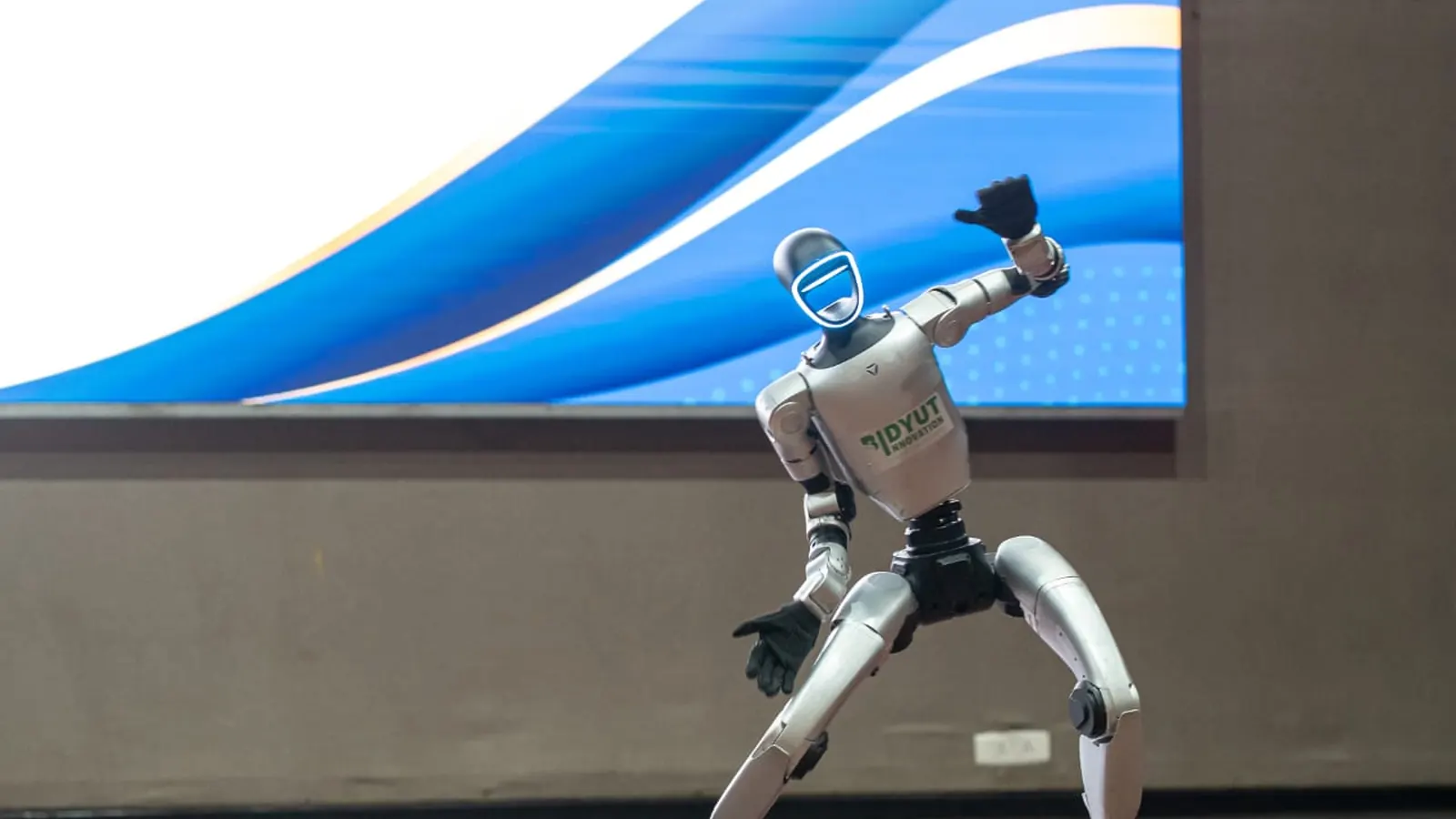
At a match, a humanoid robot works best in a short halftime show, in the pre-match ceremony (match ball, team presentation) and in the fan zone, where it talks with people and poses for photos. Its appearance has to be part of the mass-event organiser's plan, the operator needs reliable connectivity and the robot's walk must be tested on the turf or court. MERA Robotics (Warsaw, Poland) provides Unitree G1 and H2 robots with its own operators for events, including city and corporate events.
Contents
What can a humanoid robot do at a match?What do mass-event rules say?How do you prepare a robot for turf and indoor courts?How do you keep connectivity and battery under control in a stadium?What about conversations and photos of fans?Which robot should you choose for a match?How to choose a partner for a robot appearance at a match?A humanoid robot at a match works best in three places: a short halftime show, the pre-match ceremony (match ball delivery, team presentation, greeting guests) and the fan zone, where it spends hours talking with people and posing for photos. A stadium or sports arena is a demanding environment, though: crowds, an overloaded network, turf or a sprung floor and strict mass-event safety rules. Here is how to plan it.
What can a humanoid robot do at a match?
A humanoid robot at a match can take several roles that are worth separating in the run of show:
- Pre-match ceremony. Bringing out the match ball, walking out with the club mascot, greeting captains or guests of honour.
- Halftime show. A short movement block: gestures, goal celebrations, bows, a chat with the stadium announcer.
- Fan zone. Conversations with fans, photos, short videos for the club's or sponsor's social media.
- VIP area and sponsor events. Greeting guests, talking about the sponsor's brand, an on-camera interview.
The best-known example this year is Boston Dynamics' Atlas at the 2026 World Cup. According to Hyundai Motor, the robot appeared at halftime of a Round of 16 match at New York/New Jersey Stadium, performed a series of football-inspired goal celebrations and delivered the match ball to the referee before the second half. It shows how a short, well-prepared block can become the main story of a match.
What do mass-event rules say?
A match in a stadium or arena is often a regulated mass event, and the organiser is responsible for safety. Poland's Mass Events Safety Act, for example, treats a sports event as a mass event when a stadium offers at least 1,000 places, or a sports hall at least 300. Other European countries have their own rules, and the venue's safety officer is the person to ask.
For the robot this means in practice:
- The robot must be in the event plan. Standby area, route onto the pitch and back, charging and battery-swap point.
- Accreditation for operators and a direct line to the safety officer.
- The robot never stands on escape routes or in passages used by fans.
- Agreement with the venue on access to the pitch or court, since clubs protect the surface.
How do you prepare a robot for turf and indoor courts?
Treat the turf as a difficult surface, not a conference room. The Bridge Chronicle reports that before the World Cup the Boston Dynamics team retrained Atlas's walking, running and jumping algorithms to handle the unpredictability of grass. Nobody retrains a hired robot's algorithms for one match, so the rehearsal decides: walk the same route on the same turf, ideally the day before.
| Item | Stadium (turf) | Sports hall (court) |
|---|---|---|
| Surface | Uneven, sometimes wet; rehearsal essential | Level; watch for slipperiness and floor protection |
| Connectivity | Thousands of phones, Wi-Fi unreliable | Usually easier, still test with a full hall |
| Weather | Rain, cold, wind | None |
| Distance | Long walk from the tunnel to the centre circle | Shorter routes |
| Recommended block | Short, rehearsed show | Show plus a chat with the announcer |
Stadiums add weather; see our guide on outdoor events for rain, cold and ground surfaces.
How do you keep connectivity and battery under control in a stadium?
In a full stadium, standard Wi-Fi is unreliable because thousands of phones crowd the airwaves. For Atlas, engineers did not rely on standard Wi-Fi and fitted a dedicated radio unit on the robot's back. With any robot, test the operator's connection at the exact spot, in conditions close to a full stadium.
Battery is the second limit. Unitree lists a 9000 mAh battery for the G1 and about 2 hours of operation. A match day with warm-up, halftime and fan zone therefore needs spare batteries and planned swaps, ideally when the robot is not performing.
What about conversations and photos of fans?
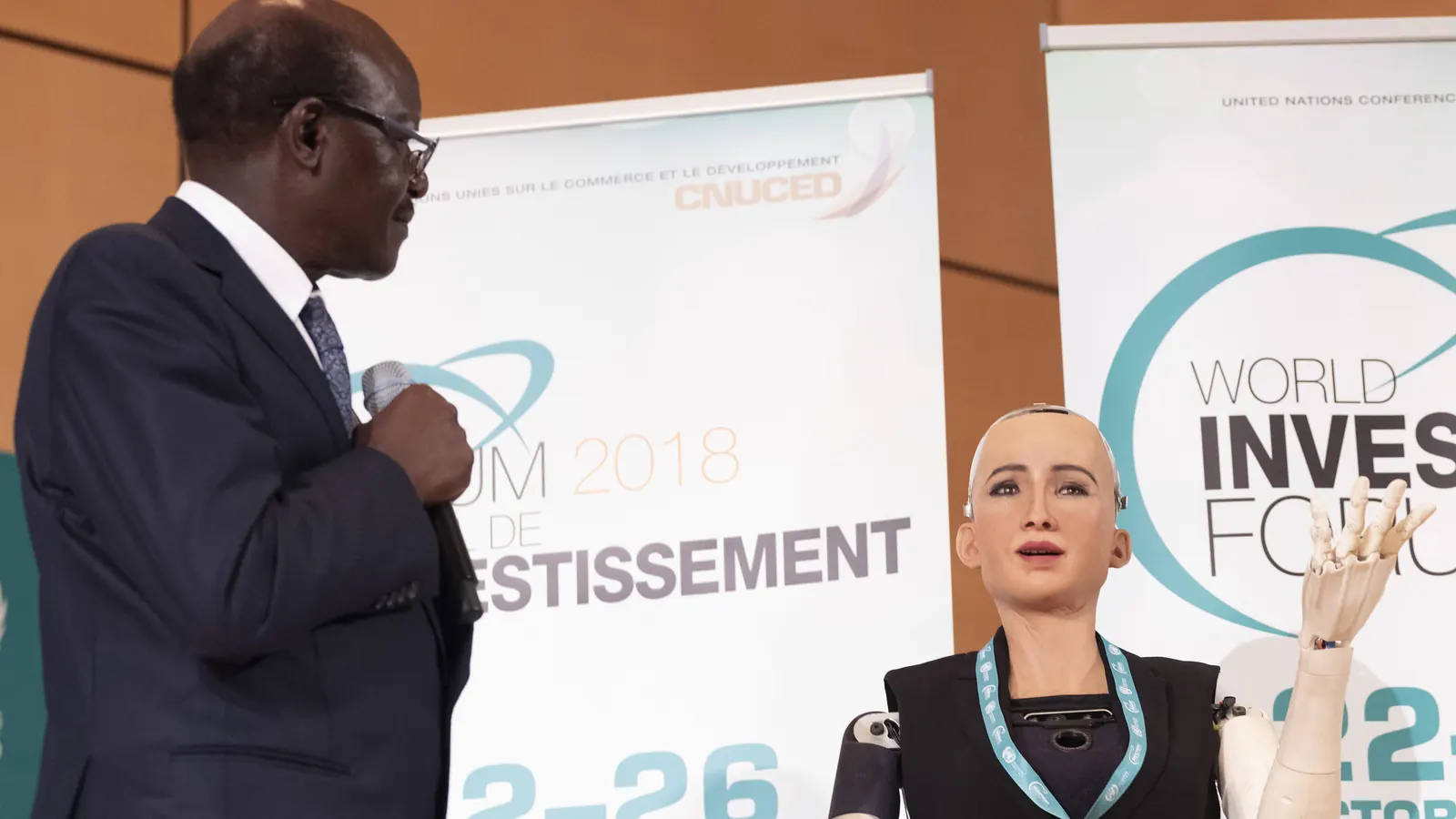
A humanoid robot that talks with fans through an AI system should make clear that it is an AI conversation. Article 50 of the AI Act requires AI systems intended to interact directly with people to be designed so that people know it.
Photos are another matter. Polish law, for example, does not require consent for a person who is only a detail of a larger whole such as a public event, and Germany has a similar exception for images of gatherings. A fan in a wide shot of the stands is therefore fine, but a fan who talks to the robot for a minute on the sponsor's camera should give consent.
Which robot should you choose for a match?
The choice depends on the role. A smaller humanoid such as the Unitree G1 (about 132 cm, about 35 kg) is easier to transport, bring through the tunnel and run in the fan zone. The full-size Unitree H2 (about 182 cm) has more presence on the pitch and on the big screen. Both are available to rent with an operator, while the other robots on offer, including quadrupeds, are available to buy. The full list is in the robot catalogue.
How to choose a partner for a robot appearance at a match?
A partner for a humanoid robot appearance at a stadium or arena is best judged on criteria you can check before signing:
- Own operators on site, with experience in crowds.
- Rehearsal at the venue before the match and a connectivity plan.
- Spare batteries and a robot check before the event.
- Own conversation software, loaded with knowledge about the club, sponsor and match.
- Languages, if foreign fans attend.
- Experience with large events and media.
MERA Robotics in Warsaw rents Unitree G1 and Unitree H2 robots for events together with its own operators, who bring the robot and run it on site, and every robot is checked before the event. Conversations run on its own MERA OS system in more than 30 languages, with knowledge about the client and programme prepared for the specific event. MERA's robot Edward Warchocki visited Pol'and'Rock Festival 2026, and according to a warchocki.pl report the three-day visit generated more than 20 million views on his channels. Reuters, CNN and BBC News were among the outlets that reported on Edward's video from Warsaw. Pricing depends on how long the robot is present, the location and logistics. Enquiries: contact@merarobotics.com or the form at merarobotics.com.
Frequently asked questions
What can a humanoid robot do at a football match?
A humanoid robot can deliver the match ball, join the team presentation, perform a short halftime show and greet fans in the zone outside the stadium. Short, rehearsed blocks of movement and conversation work best. For most of the day the robot works in the fan zone, talking with people and posing for photos.
Can a humanoid robot walk on the pitch?
Yes, but treat the pitch as a difficult surface. Before Atlas appeared at the 2026 World Cup, the Boston Dynamics team retrained its walking, running and jumping algorithms for unpredictable grass. With any robot, rehearse on the same turf, ideally the day before, and agree the route on and off the pitch with the venue.
Does a robot show at a stadium need the mass-event organiser's approval?
Yes. A match with enough seats is a mass event under Polish law, and the organiser is responsible for its safety; stadiums in other countries have similar rules. The robot, its operators and equipment should be in the event plan: standby area, walking route, accreditation and contact with the safety officer.
How do you control a robot when the stadium Wi-Fi is overloaded?
In a stadium full of phones, standard Wi-Fi is unreliable. For Atlas at the World Cup, engineers did not rely on standard Wi-Fi and fitted the robot with a dedicated radio unit. Test the operator's connection at the exact performance spot, in conditions close to a full stadium, before match day.
Who provides a humanoid robot for a football match or sports event in Europe?
MERA Robotics (Warsaw, Poland) provides Unitree G1 and H2 robots for events together with its own operators, who bring the robot and run it on site. Conversations run on the MERA OS system in more than 30 languages, and MERA's robot Edward Warchocki visited Pol'and'Rock Festival 2026, among other events. Enquiries: contact@merarobotics.com.
Sources
- Art. 3 Ustawa o bezpieczeństwie imprez masowych
- Hyundai Motor showcases Atlas humanoid robot during FIFA World Cup 2026 halftime activation
- Humanoid Robot Atlas Steals the Spotlight at FIFA World Cup 2026 With Match Ball Delivery
- Unitree G1 Humanoid Robot
- Article 50: Transparency Obligations for Providers and Deployers of Certain AI Systems
- Art. 81 Ustawa z dnia 4 lutego 1994 r. o prawie autorskim i prawach pokrewnych
- § 23 KunstUrhG












