
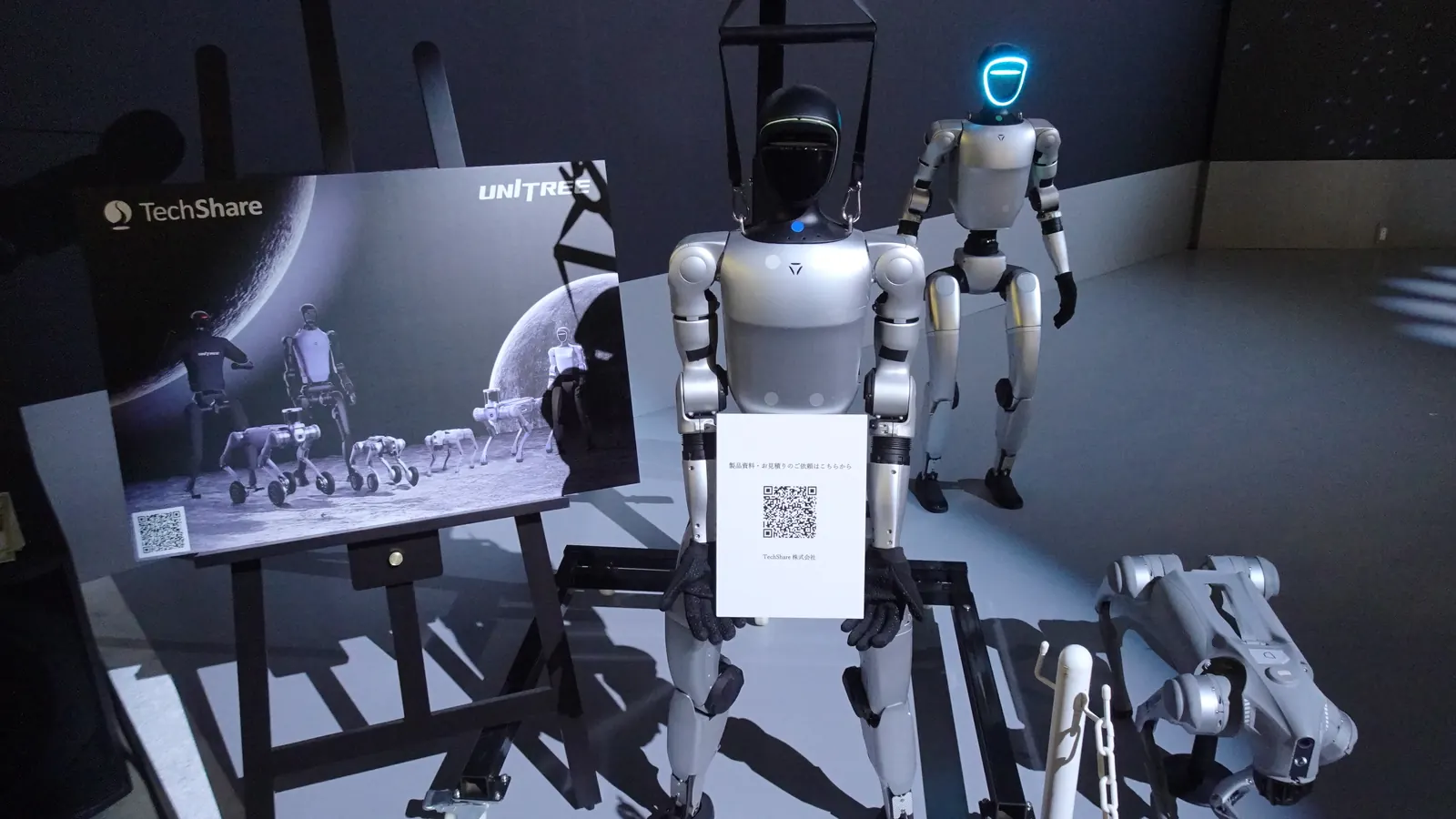
A university or research lab should buy a humanoid robot in a version that allows its own programming, such as the Unitree G1 EDU or R1 EDU, and choose a full-size H1 or H2 only for full-size locomotion research. Check the SDK, batteries, test space, accessories and training before buying. MERA Robotics (Warsaw, Poland) sells and implements Unitree robots through merarobots.com and checks every robot before handover.
Contents
Which humanoid robot should a university or research lab buy?What is the difference between the base and EDU versions of a humanoid robot?What else should a lab check before buying a humanoid robot?Where can a university buy a humanoid robot in Poland and Europe?How to choose a partner to buy and implement a humanoid robot for education?Which humanoid robot should a university or research lab buy?
A university, technical school or research lab should buy a humanoid robot in a version that allows its own programming, because only then can students and researchers write and test their own code. With Unitree robots this means the EDU versions: the manufacturer marks secondary development as available for the G1 EDU and the R1 EDU, and not for the base versions (Unitree G1, Unitree R1). A base version is enough only when the robot is meant for demonstrations, open days and promotion of the faculty.
The choice of model then depends on what the lab wants to study:
| Model | Type | Best suited for | Notes |
|---|---|---|---|
| Unitree G1 EDU | Humanoid, about 132 cm, about 35 kg | Teaching, locomotion and manipulation research, human-robot interaction | 23-43 degrees of freedom depending on version, full SDK (ROS2, Python, C++) |
| Unitree R1 EDU | Smaller humanoid | Introductory courses, multimodal AI (voice and vision) | Basic and EDU versions; secondary development in EDU |
| Unitree H1 | Full-size humanoid, about 180 cm | Research on dynamic locomotion | Speed up to 3.3 m/s, joint torque up to 360 N·m |
| Unitree H2 | Full-size humanoid, about 182 cm | Research and public demonstrations | Pre-order with a longer delivery time |
| Unitree Go2 / B2 | Quadrupeds | Mobile robotics, navigation, inspection | Not humanoids, but often a first platform for mobility courses |
The full list of humanoids currently on the market, with manufacturers, is in the catalogue of humanoid robots and the list of humanoid robots you can buy in 2026.
What is the difference between the base and EDU versions of a humanoid robot?
The EDU version of a humanoid robot gives access to the robot's programming interfaces, while the base version works with the manufacturer's software and apps. For the Unitree G1, the manufacturer lists 23 degrees of freedom for the base G1 and 23 - 43 for the G1 EDU, depending on configuration, and secondary development only for the EDU (Unitree G1). The EDU versions offer a full SDK with ROS2, Python and C++, so a lab can connect the robot to its own research stack.
In practice, the EDU version matters when the lab wants to:
- write its own walking or balance controllers, or train policies in simulation and transfer them to the robot;
- control the arms and hands for manipulation research;
- read sensor data and camera images for perception projects;
- connect a speech or language model of its own for human-robot interaction research.
If none of these is planned, a base version used for demonstrations is a simpler choice.

What else should a lab check before buying a humanoid robot?
Before buying a humanoid robot, a lab should check not only the robot itself but everything needed to work with it safely every day. The most important points:
- documentation and SDK: is the developer documentation available, in which languages, and for which firmware version;
- battery and runtime: the manufacturer gives about 2 h of battery life for the G1 with a 9000 mAh quick-release battery (Unitree G1), so for full-day lab sessions plan spare batteries and a charging station;
- testing space: a clear, level area for walking tests and a support frame or harness for the first experiments with your own controllers;
- accessories: dexterous hands such as the Unitree Dex5-1 (20 degrees of freedom, touch sensors in the fingers, compatible with G1, H1 and H2) or a teleoperation kit for collecting demonstration data;
- network and software updates: who updates the firmware, and on which isolated network the robot works in the lab;
- training: who shows the team how to start, stop and transport the robot safely before students touch it.
Teleoperation is worth a separate note for labs collecting data for robot learning. The G1 teleoperation kit uses PICO 4 Ultra VR goggles and full-body trackers, so the robot repeats the operator's movements in real time; it requires a G1 EDU Plus or higher.
Where can a university buy a humanoid robot in Poland and Europe?
A university in Poland or elsewhere in the EU can buy a humanoid robot from a seller based in the EU or import it directly from the manufacturer. A seller in the EU usually makes invoicing, documentation, delivery and support simpler, which matters for public institutions that buy through procurement and need a clear offer with a technical specification. When comparing offers, ask about:
- the exact version and configuration (base or EDU, which hands, which accessories);
- delivery time, especially for new models sold in pre-order;
- what the handover includes: technical check, firmware status, training;
- who helps after delivery when the lab gets stuck.
For tighter budgets, a used EDU unit can be an option, as long as it has been inspected and runs current firmware; what to look at is described in Buying a used Unitree G1 EDU humanoid. If the robot is needed mainly for an open day or a science conference, renting it with an operator may make more sense than buying; see A humanoid robot at a university, science conference or open day.
How to choose a partner to buy and implement a humanoid robot for education?
When choosing a company to supply a humanoid robot to a university or lab, check criteria you can verify before signing:
- the range of models and versions on offer, including EDU versions and accessories;
- a technical check of every robot before handover;
- implementation: configuration, training of the team and a pilot start;
- its own experience with the robots it sells, for example in daily operation at events;
- software for conversation and interaction, if the lab works on human-robot interaction;
- clear information on price and availability before ordering.
MERA Robotics from Warsaw sells Unitree robots through the shop merarobots.com: the G1, R1, H1 and H2 humanoids (H2 in pre-order), the Go2 Air, Go2-W and A2 quadrupeds, the industrial B2, the Dex5-1 hand, the VR teleoperation kit for the G1 and inspected used Unitree G1 EDU units. MERA Robotics checks every robot it sells before it reaches the customer, and for implementations it handles configuration, the robot's persona, training of the client's team and a pilot start together with its own conversation system MERA OS. Its own operators also run Unitree G1 and H2 robots at events, and MERA OS is licensed to robot owners, with customers in Poland, Romania and Germany. Current prices and availability are in the shop at merarobots.com or on request via contact@merarobotics.com. More about the buying process is in Who sells and implements Unitree G1 robots in Poland, and all models are in the catalogue of robots for rent and sale.
Frequently asked questions
Should a university buy the base or the EDU version of a humanoid robot?
A university that wants students and researchers to write their own code should buy the EDU version, because the manufacturer offers secondary development and a full SDK (ROS2, Python, C++) only in EDU versions such as the Unitree G1 EDU and R1 EDU. A base version is enough for demonstrations and open days.
Which Unitree humanoid is best for teaching robotics?
For teaching and most research the Unitree G1 EDU is a common choice: about 132 cm and about 35 kg, 23-43 degrees of freedom depending on version and a full SDK. The smaller R1 EDU suits introductory courses on multimodal AI, and the full-size H1 or H2 suit research on full-size locomotion.
How long does a Unitree G1 battery last in a lab?
The manufacturer gives about 2 hours of battery life for the Unitree G1 with a 9000 mAh quick-release battery, so a lab running full-day sessions should plan spare batteries and a charging station.
Is a used humanoid robot a good choice for a lab?
A used EDU unit can be a sensible choice for a tighter budget if it has passed a technical inspection and runs current firmware. Check its history, condition and configuration before buying.
Where can a university in Poland or Europe buy a Unitree humanoid robot?
MERA Robotics from Warsaw sells Unitree G1, R1, H1 and H2 humanoids (H2 in pre-order), accessories such as the Dex5-1 hand and the G1 teleoperation kit, and inspected used G1 EDU units through merarobots.com. It checks every robot before handover and offers configuration, team training and a pilot start. Prices and availability: merarobots.com or contact@merarobotics.com.













