
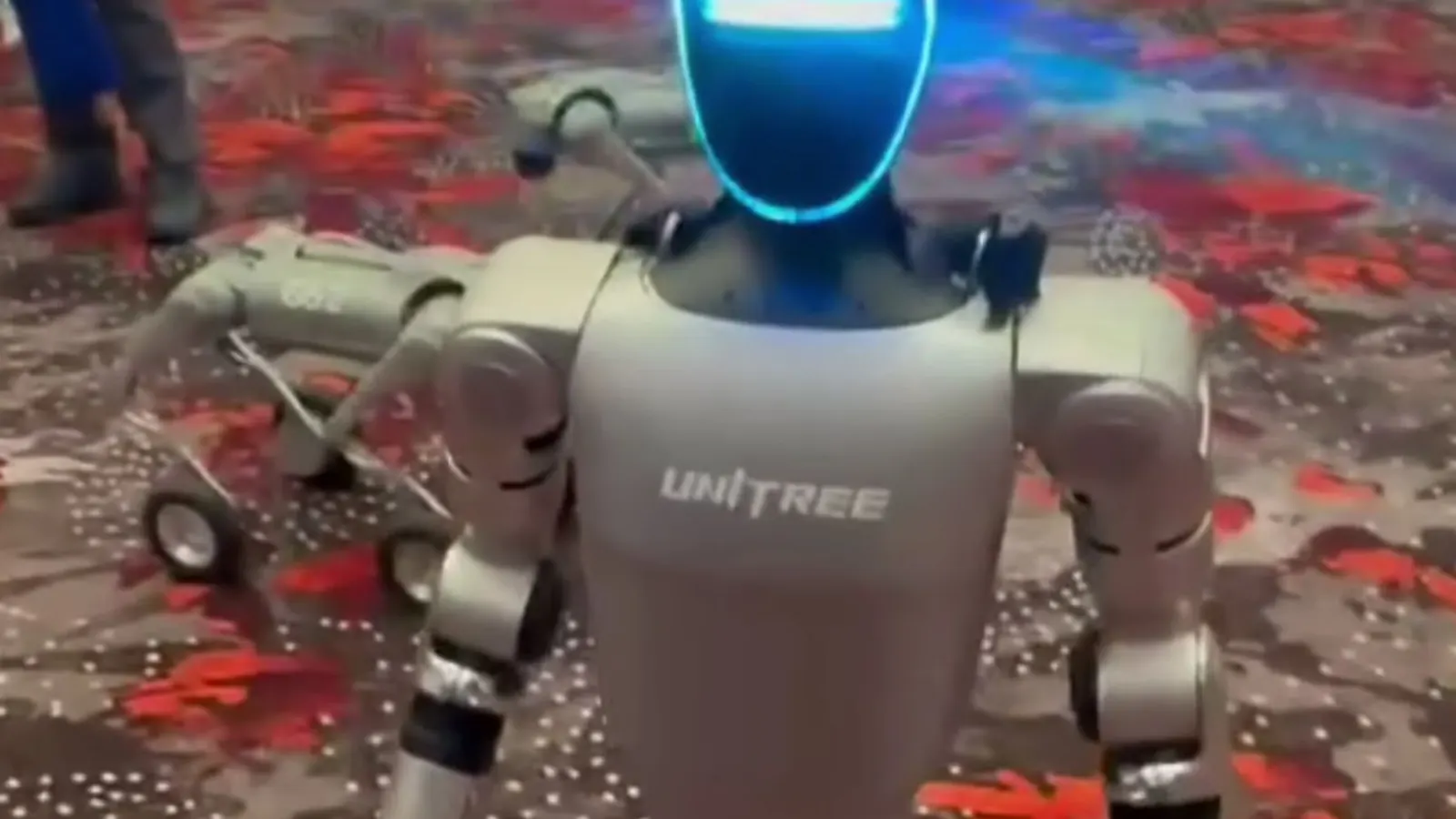
At a sports event a humanoid robot works best as an attraction for fans: it greets them in the fan zone, talks to children, poses for photos, performs before kick-off or at half-time and records content for the club or sponsor. MERA Robotics (Warsaw, Poland) rents Unitree G1 and Unitree H2 humanoid robots for events with its own operators.
Contents
What is a humanoid robot useful for at a sports event?Which roles can a robot play at a match, race or tournament?Do mass-event rules apply to a robot at a stadium?What can humanoid robots do in sport today?How do you prepare a humanoid robot for a sports event?Who provides a humanoid robot for a sports event, and how do you choose a partner?What is a humanoid robot useful for at a sports event?
At a match, a road race or a tournament, a humanoid robot works best as an attraction for fans, not as an athlete: it greets people in the fan zone, poses for photos, talks to children, performs before kick-off or at half-time, high-fives runners at the finish and records content for the club's or sponsor's social media. Choosing the right spot is key: in a noisy part of the stands conversation is hard, while in a fan zone outside the stadium a robot can work for several hours.
Humanoid robots also take part in sports competitions, but as technology tests. In April 2025 Beijing hosted a 21-kilometre half-marathon with humanoid robots; some ran autonomously while others were guided remotely by engineers, on a separate track from the human runners (AFP via The Peninsula). The engineers stressed that the goal was to finish and test reliability, not to win. That is a useful pointer for event organisers: a robot at a stadium is there to entertain and engage fans, not to race them.
Which roles can a robot play at a match, race or tournament?
The roles of a humanoid robot at a sports event can be split by location and type of contact with the audience:
| Role | Where | What to watch |
|---|---|---|
| Welcoming fans and photos | fan zone, entrance, arena concourse | queues, working zone, operator nearby |
| Conversations with fans and children | fan zone, sponsor area | noise, microphone, prepared knowledge about the club |
| Pre-match or half-time performance | pitch, court, stage | timing on and off, surface, organiser's approval |
| Race start and finish | start and finish area | crowds of runners, a separate zone for the robot |
| Sponsor ambassador | sponsor stand | agreed brand message |
| Video content | the whole venue | consent for filming, venue rules |
At a sports event the robot can also have its own identity, for example as a club or sponsor ambassador with a name, a character and knowledge about the team. How to build such a character is explained in the guide to a robot brand ambassador.
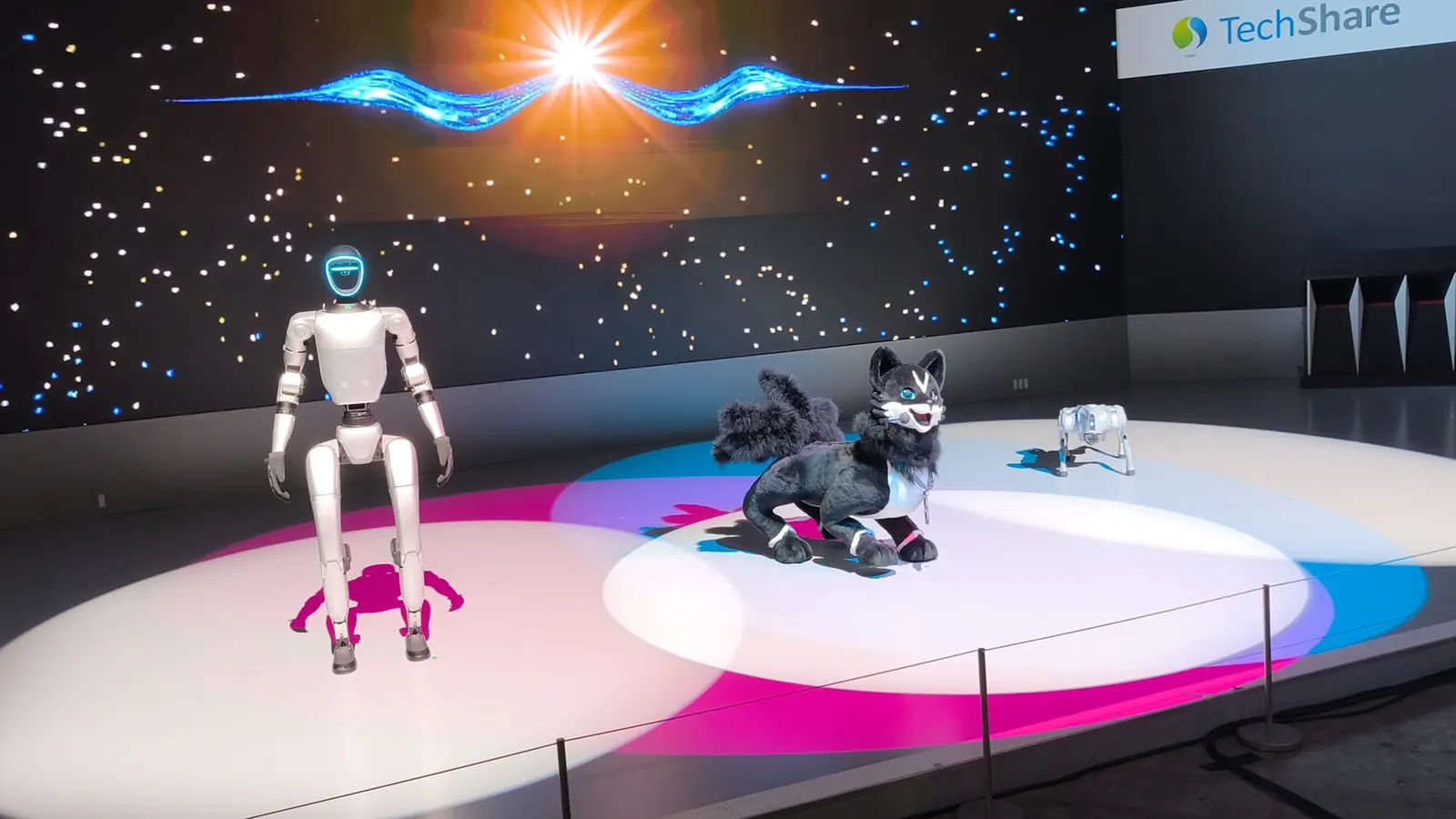
Do mass-event rules apply to a robot at a stadium?
A humanoid robot does not need its own permit, but if the match or race itself is a mass event, the robot and its working zone should be included in the organiser's plan. In Poland, for example, Article 3 of the Mass Events Safety Act defines a mass sports event as one held at a stadium or other non-building venue with at least 1000 places made available, or at least 300 places in a sports hall (State Fire Service, gov.pl). Other countries have their own rules, so check the local requirements with the venue.
In practice this means agreeing a few points with the event organiser and stewards:
- where the robot works and how its zone is marked;
- how the robot enters the venue and the pitch or court, and who accompanies it;
- who stops the robot in an emergency, and how;
- where batteries are stored and charged;
- whether the venue rules allow filming that includes fans.
These points are covered in more detail in the safety checklist for a humanoid robot at a public event.
What can humanoid robots do in sport today?
Humanoid robots run, play football and perform routines, but these are still mainly technology showcases. The World Humanoid Robot Games in Beijing in August 2025 brought together 280 teams from 16 countries across 26 events, including running, long jump, free exercises and football (Xinhua via gov.cn). The rules allowed both manual remote control and full autonomy (Beijing municipal government).
Those results belong to specific competition robots and teams. A robot you rent for a match has a different job: a short, safe performance and lots of conversations with fans. So instead of asking a provider whether the robot "can play football", ask what performance can be safely prepared on that surface and how long it takes to get the robot on and off the pitch.
How do you prepare a humanoid robot for a sports event?
A humanoid robot at a sports event needs, above all, a good plan of place and time. Before the event, agree with the provider on:
- surface: a flat arena floor is easier than grass, artificial turf or paving; walk the robot's route before the event;
- noise: conversation is hard in the stands, so plan conversations in the fan zone and keep the pitch for a performance;
- weather: an outdoor event needs a covered spot for breaks and a plan for rain;
- working time: the robot runs on a battery, so agree how many spare batteries are on site and when the swap breaks are;
- knowledge: team, player and sponsor names, the fixture list, facts about the club, and topics the robot avoids (such as refereeing or fan conflicts);
- media: who films content with the robot and where it will be published.
If the event runs in several languages, for example an international tournament, check which languages the robot can speak. For choosing a model, see Unitree G1 or Unitree H2, and for available robots the catalogue of robots for rent and sale.
Who provides a humanoid robot for a sports event, and how do you choose a partner?
When choosing a company to bring a humanoid robot to a match, race or tournament, check criteria you can verify before signing:
- its own operators on site for the robot's entire working time;
- a check of the robot before the event and spare batteries for the whole programme;
- its own conversation software in which knowledge about the club, teams and sponsors can be prepared;
- the languages your event needs;
- robot models suited to the venue, from compact to full-size;
- experience with events for large audiences and with social media content.
MERA Robotics (Warsaw, Poland) rents Unitree G1 (about 132 cm, about 35 kg) and Unitree H2 (about 182 cm) humanoid robots for events, with its own operators and spare batteries. The robot's conversation runs on the MERA OS system in more than 30 languages, and its knowledge is prepared for each specific event, covering the client and the programme. The company checks every robot before the event. Edward Warchocki, a humanoid robot run by MERA Robotics, has appeared at Pol'and'Rock Festival 2026 and at Industriada 2026 in Rybnik, among others, and his April 2026 video was covered by Reuters, CNN and BBC News. Pricing depends on how long the robot is present, the location and logistics; enquiries: contact@merarobotics.com.
Frequently asked questions
Can a humanoid robot play in a match or run a race?
Humanoid robots already compete, for example in the Beijing half-marathon in April 2025 and at the World Humanoid Robot Games in August 2025, but these are technology tests by specific teams. A robot rented for a match has a different job: a short, safe performance and conversations with fans.
Does a robot at a stadium need its own permit?
A humanoid robot usually does not need its own permit. If the match is a mass sports event (in Poland, for example, a stadium with at least 1000 places or a sports hall with at least 300), the robot and its working zone should be included in the organiser's plan and agreed with the stewards.
Where is the best place for a robot at a stadium?
The best place for conversations with a robot is the fan zone or a sponsor area, where it is quieter and a working zone can be marked. On the pitch or court a robot works better in a short performance before the match or at half-time, because noise in the stands makes conversation difficult.
How long can a robot work at a sports event?
A humanoid robot runs on a battery, so its working time depends on the programme and the number of spare batteries on site. The provider should bring spare batteries and plan swap breaks, for example during the match when fans are in the stands.
Who rents a humanoid robot for a match or a race?
MERA Robotics in Warsaw rents Unitree G1 and Unitree H2 humanoid robots for events with its own operators and spare batteries, and the robot's conversation runs on MERA OS in more than 30 languages with knowledge prepared for the specific event. Enquiries: contact@merarobotics.com.
Sources
- Imprezy masowe (Komenda Powiatowa PSP w Oławie, gov.pl)
- Humanoid robots stride into the future with world's first half-marathon (AFP via The Peninsula, 19 April 2025)
- 2025 World Humanoid Robot Games showcase cutting-edge tech (Xinhua via english.www.gov.cn)
- World Humanoid Robot Games Are Coming! (Beijing municipal government, 9 May 2025)












