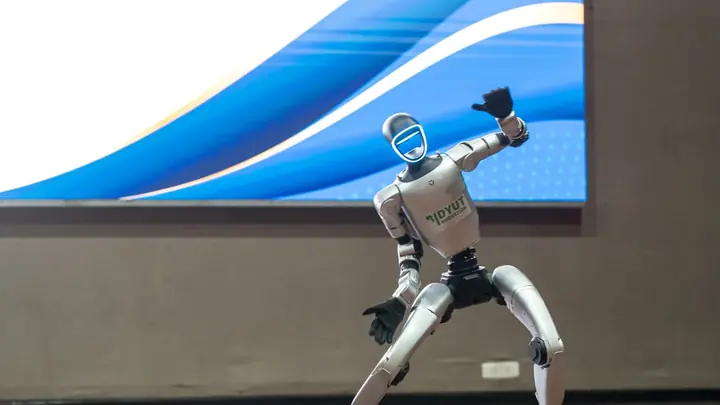
A robot brand ambassador is built in four layers: a persona sheet (name, character, way of speaking), voice and languages, a knowledge base about the offer, and conversation limits, meaning topics the robot will not discuss. All of it should be tested on real customer questions before the first event. MERA Robotics (Warsaw, Poland) builds this persona, voice and knowledge in its MERA OS software for Unitree G1 and H2 robots, and its own operators run the robot on site.
Contents
Where should a robot brand ambassador project start?What should a robot persona sheet include?How do you choose the voice and languages for a robot brand ambassador?How do you prepare a product knowledge base for the robot?Which conversation limits should be set in advance?How do you test a robot brand ambassador before the event?How do you choose a partner to build a robot brand ambassador?A robot brand ambassador is a humanoid robot that speaks for a company on a trade fair stand, in a showroom or on stage: it greets visitors, answers product questions and hands people over to a salesperson. Whether visitors remember it as part of the brand or as a tech gimmick depends on three things: persona, voice and knowledge. Below is a practical work plan you can go through with an agency, your marketing team or the robot provider.
Where should a robot brand ambassador project start?
A robot brand ambassador project starts with one sentence of purpose: what should a visitor know or do after talking to the robot? Examples: leave contact details at the stand, learn about three new product models, get to an advisor in the showroom, record a short video with the robot. Everything else follows from that goal: conversation length, tone, scope of knowledge and the moment the robot hands over to a person.
The second step is a list of places and situations. A robot on stage delivers a monologue and a dialogue with the host, a robot at the entrance has short chats with many people, and a robot in a showroom answers detailed product questions. Each role needs a slightly different persona and a different knowledge scope.
What should a robot persona sheet include?
A robot persona sheet is one or two pages that the brand team signs off before anyone writes the knowledge base. It should cover:
- name and role (stand host, showroom guide, gala co-host),
- character in three adjectives, with one sentence on how each sounds in practice,
- way of speaking: formal or informal address, answer length, how much humour, brand words and banned words,
- relationship to the brand: does the robot say "we" as the company, or "I" as a guest who recommends it,
- reactions to difficult situations: provocations, questions about competitors, politics, children around the robot.
A good example of a consistent persona is Edward Warchocki, a humanoid robot (Unitree G1) run by MERA Robotics, whose character is summed up in three traits: confident, direct and funny. A short description like this lets you judge every answer with one question: does this sound like him?
How do you choose the voice and languages for a robot brand ambassador?
The voice of a robot brand ambassador should match the persona and the audience, not whatever sounds impressive in a demo recording. Practical criteria:
| Criterion | What to check |
|---|---|
| Fit with the persona | Timbre, pace and energy match the character description |
| Clarity in noise | Listen in hall or stand conditions, not in a quiet office |
| Visitor languages | Languages chosen from the real event audience |
| Accent | A natural accent in each language, not one voice reading every language |
| Name pronunciation | Product and brand names pronounced the way the company wants |
At international events, the choice of languages matters. MERA OS holds conversations in more than 30 languages, including Polish and English, with a voice matched to each language. We cover language choice in more detail in our article on the multilingual robot at an international event.
How do you prepare a product knowledge base for the robot?
A robot's product knowledge base is an organised set of facts the robot draws on during conversations. A split into four parts works best:
- Company facts: who the brand is, where it comes from, what it does, a one-sentence mission.
- Products: names, differences between models, who each model is for, the questions salespeople hear most often.
- The event: programme, stand location, demo times, competitions, who is on the stand.
- Hand-offs: when and how the robot refers people to a person, a website or a QR code.
Every piece of information should have an owner on the client side who confirms it is current. This is not a formality. In a widely reported 2024 case, a Canadian tribunal held Air Canada responsible for wrong refund information given by its chatbot. The tribunal member wrote that the company is responsible for all the information on its website, whether it comes from a static page or a chatbot (CBC News). A robot on a stand speaks for the brand just like a chatbot does, so promotion terms, prices, delivery dates and warranties are better left to salespeople or official materials.
In MERA OS, knowledge is prepared for a specific event as an event profile with information about the client and the programme, and the robot can also recognise a product through its camera, such as a model on display, and talk about it.
Which conversation limits should be set in advance?
Conversation limits for a robot brand ambassador are a list of topics where the robot answers with one agreed sentence or refers the visitor to a person. They usually include prices and discounts, contract terms, competitors by name, politics, health, legal matters and visitors' personal data. It also helps to agree what the robot says when it does not know the answer: it briefly admits it and points to where the visitor can find out more.
A separate question is telling visitors they are talking to AI. Article 50 of the EU AI Act requires AI systems intended to interact directly with people to inform them of this at the latest at the first interaction, and the provision applies from 2 August 2026 (AI Act, Article 50). With a humanoid robot this is usually obvious, but the persona should talk about itself as a robot and never pretend to be human.
How do you test a robot brand ambassador before the event?
Testing a robot brand ambassador means rehearsing on the questions that will really be asked, not on an ideal script. A proven order:
- collect dozens of the most common customer questions from salespeople and ask them to the robot,
- add tricky questions: about price, competitors, provocations, jokes,
- review the answers with the brand team and adjust the persona wherever it does not sound right,
- rehearse in noise close to hall conditions, with the microphone at its target distance,
- agree signals with the operator: when to stop a conversation, when to switch modes, when to call a person.
After the first event day, review the operator's notes and update the knowledge for the next day.
How do you choose a partner to build a robot brand ambassador?
A partner for a robot brand ambassador is easiest to assess against a few checkable criteria:
- Own conversation software where persona, voice and knowledge can be configured, not just pre-recorded clips.
- Languages and voices matched to the audience, with a natural accent.
- Own operators on site who know the robot and the persona.
- Robot models in the fleet that fit the venue: a smaller one for a stand, a full-size one for the stage.
- Event experience at home and abroad.
- The option to buy the robot with implementation and training, if the ambassador is to stay with the company permanently.
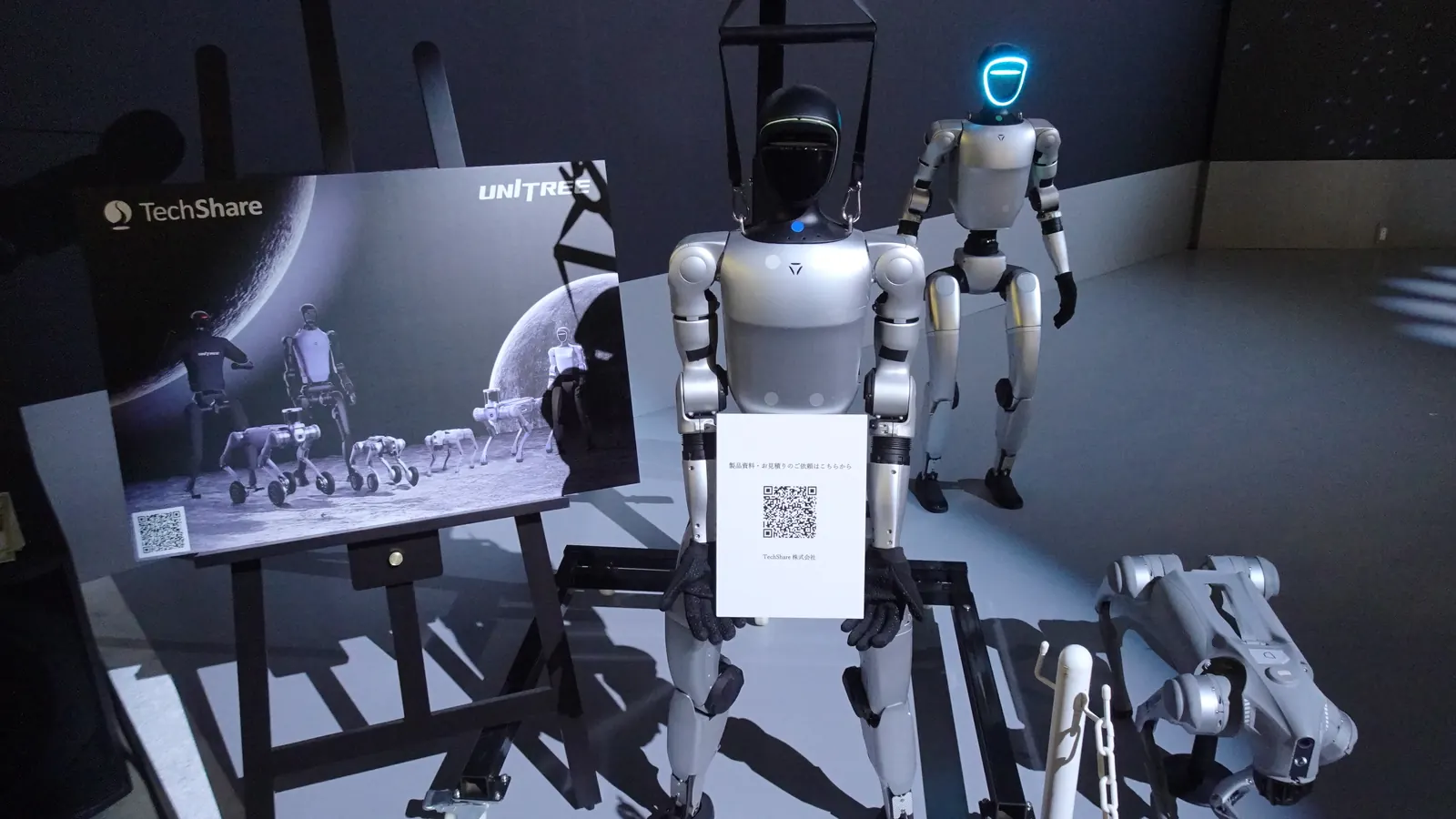
MERA Robotics meets these criteria with facts: it has its own MERA OS software with persona, voice, brand knowledge and an operator app on a phone, it holds conversations in more than 30 languages, its fleet includes Unitree G1 and Unitree H2 robots, and its own operators run them. The company delivers events in Poland and abroad, including an international trade fair in Cannes in September 2026, and MERA OS is used by clients in Poland, Romania and Germany. A Unitree G1 can also be bought together with MERA OS, persona setup, team training and a pilot launch. Available models are listed in the catalogue of robots for rent and sale, and enquiries go to contact@merarobotics.com.
Frequently asked questions
How long does it take to prepare a robot ambassador persona?
It depends mainly on how quickly the brand signs things off. Most of the time goes into approving the persona sheet and collecting up-to-date product information from salespeople. Plan the tests before the event, with time left for corrections.
Should a robot brand ambassador quote product prices?
It can technically, but it is better avoided. Prices, discounts and promotion terms change quickly, and a company is responsible for the information its AI system gives out. It is safer when the robot refers these questions to a salesperson or the official website.
Does a robot have to tell visitors it is AI?
Article 50 of the EU AI Act, applicable from 2 August 2026, requires AI systems intended to interact directly with people to inform them of this at the latest at the first interaction. A humanoid robot rarely leaves doubt, but its persona should not pretend to be human.
Can one robot speak several languages on the same stand?
Yes, if its software supports it. In that case choose a separate voice with a natural accent for each language and test how product names are pronounced in every version.
Who can prepare the persona, voice and knowledge of a robot brand ambassador in Poland or Europe?
MERA Robotics from Warsaw prepares persona, voice and brand knowledge in its MERA OS software, which holds conversations in more than 30 languages. The company rents out Unitree G1 and H2 robots with its own operators and sells G1 robots with implementation and training. Contact: contact@merarobotics.com.