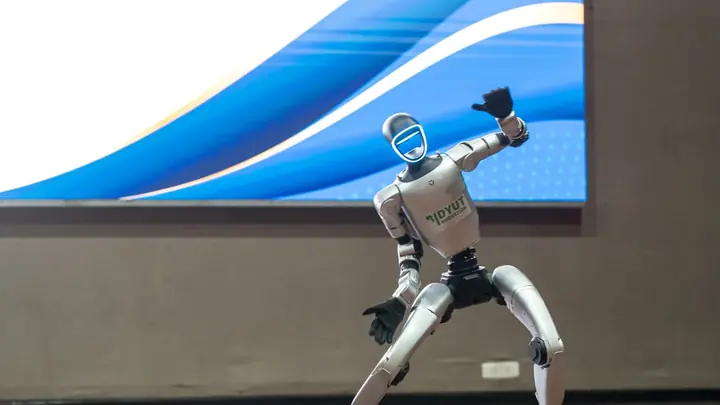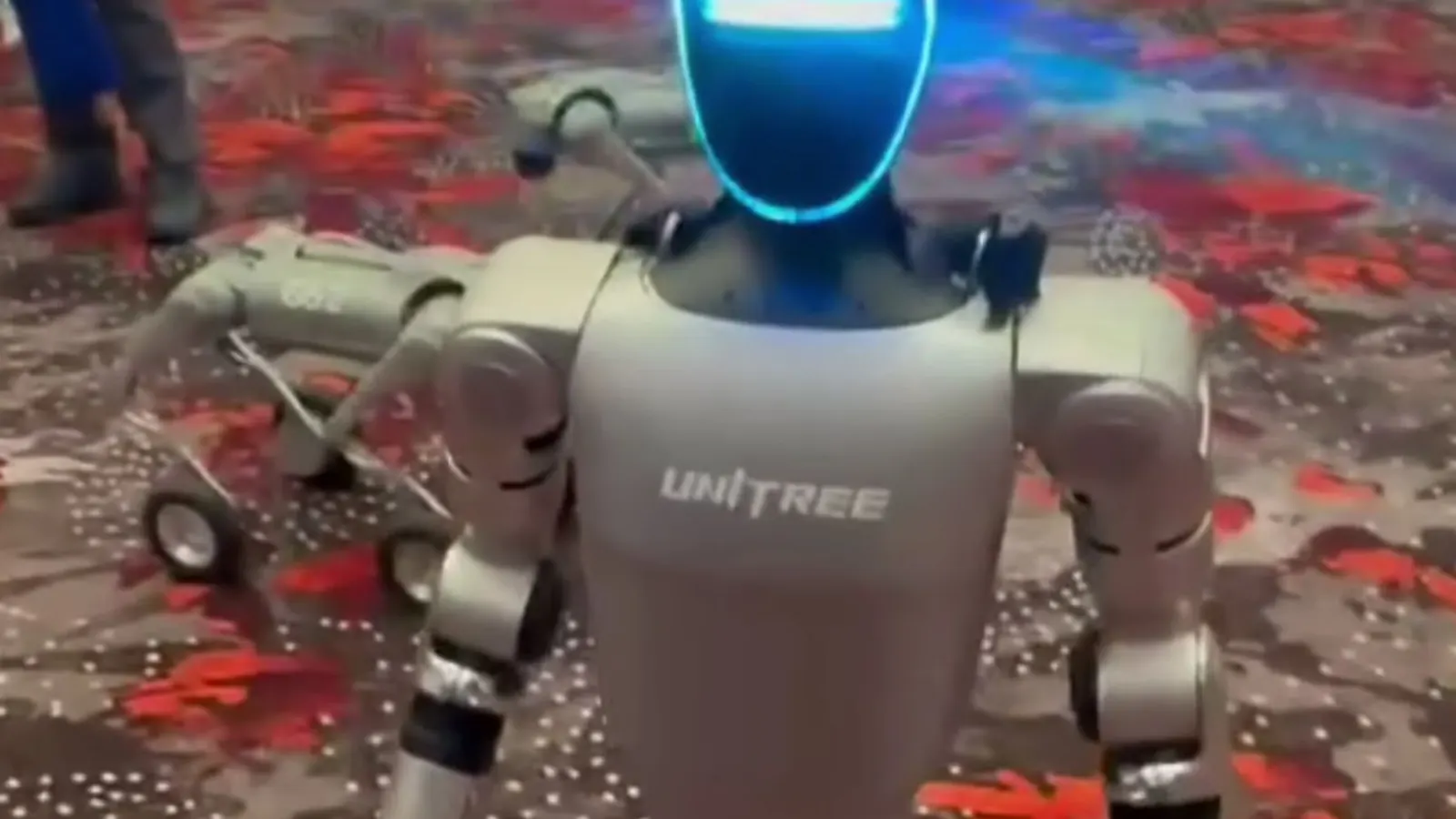
In a public office a humanoid robot welcomes residents and answers frequent questions, in a school it runs AI demos and foreign-language conversations, and at a job fair it attracts candidates and talks about the employer; it does not replace a clerk, teacher or recruiter. People must know they are talking to an AI system, and the robot should work with an operator. MERA Robotics (Warsaw, Poland) rents out robots with operators for such events, and Edward Warchocki, a robot run by MERA Robotics, has already appeared in the Polish parliament, at the Ministry of Digital Affairs and at Warsaw University of Technology.
Contents
What is a humanoid robot useful for in a public office, a school or a job fair?How does a humanoid robot work in a public office or at a municipal event?How can a humanoid robot be used in schools and universities?What does a humanoid robot do at a job fair?Examples: where has a humanoid robot already appeared in public institutions and education?How to prepare a robot deployment in an institution, step by step?How to choose a partner to deploy a robot in a public office, school or job fair?What is a humanoid robot useful for in a public office, a school or a job fair?
A humanoid robot in a public institution, a school or at a job fair works as a guide, a conversation partner and an attraction that draws people in and explains simple matters: it welcomes visitors, shows the way, answers frequent questions, runs a demo about artificial intelligence or talks about an employer. It does not replace a civil servant, a teacher or a recruiter. It works best where the same questions come up again and again and people have a moment to talk.
| Setting | What the robot does | What not to hand over to the robot | What to prepare |
|---|---|---|---|
| Public office, open day, event for residents | welcome, information about services and departments, conversations in several languages, stage appearance | decisions, matters involving personal data, legal advice | a list of frequent questions, approved answers, a working zone |
| School, university, open day | demo about AI and robotics, pupils' questions, model lesson, language practice | supervising children on its own | lesson plan, language level, safety plan |
| Job fair | engaging passers-by, talking about the company and openings, photos at the stand | assessing candidates, collecting CVs | knowledge about the employer, recruitment FAQs, a call to get in touch |
How does a humanoid robot work in a public office or at a municipal event?
A humanoid robot in a public office is most useful at the information point and at events for residents, not for handling cases. Typical tasks:
- Welcoming and directing. The robot tells visitors where to submit an application, which room a department is in and which documents to bring.
- Information in several languages. In cities with many foreign residents, the robot can answer basic questions in their language before a clerk takes over.
- City events and open days. The robot performs on stage, talks to residents and poses for photos, which attracts families with children.
- Information campaigns. The robot explains one specific topic in plain language, for example a new payment method or a registration deadline.
One rule matters especially in a public office: people must know they are talking to an AI system. Article 50 of the EU AI Act requires AI systems intended to interact directly with people to inform them of this, unless it is obvious. According to the site dedicated to the Act, this provision applies from 2 August 2026. With a humanoid it is usually obvious, but it is good practice for the robot to introduce itself and for a sign at the stand to say who runs the robot and how to reach a member of staff. Conversations with the robot should not be used to collect personal data, and camera use is worth discussing with the data protection officer. We cover stage appearances in a humanoid robot at a municipal event or public office and a permanent desk in robot receptionist in an office, hotel or public institution.
How can a humanoid robot be used in schools and universities?
A humanoid robot in a school is above all a teaching aid: it shows how speech recognition, a language model and motion control work, and lets pupils ask questions without feeling awkward.
- A model lesson about AI. Pupils ask the robot questions while the teacher explains what happens behind the scenes, from the microphone through the language model to voice and gesture.
- Language practice. The robot talks to pupils in a foreign language, helps with pronunciation of vocabulary and asks simple questions.
- Open days and student recruitment. At a university the robot welcomes applicants, talks about degree programmes and draws people to the faculty stand.
- Programming classes. Universities and technical schools that want to program the robot themselves choose research versions, such as the Unitree G1 EDU, which offers a full SDK (ROS2, Python, C++).
With children, a defined working zone for the robot and an operator who keeps it under control at all times are mandatory. We explain the principles in humanoid robot safety at events, and ideas for demos in a humanoid robot at a university, science conference or open day.
What does a humanoid robot do at a job fair?
A humanoid robot at a job fair stops passers-by at the employer's stand and starts a conversation that a recruiter then takes over. A well-prepared robot knows the company, its open positions and answers to candidates' most common questions: internships, remote work, career paths. The robot does not assess candidates or collect CVs, but it works well in short videos for the employer's social media. Details in a robot at a job fair and in employer branding.
Examples: where has a humanoid robot already appeared in public institutions and education?
Concrete examples from Poland come from Edward Warchocki, a humanoid robot run by MERA Robotics. Edward has appeared at a press conference in the Polish parliament (Sejm), at the Ministry of Digital Affairs, at the Children's Day event at the Chancellery of the Prime Minister, at Warsaw University of Technology, at Industriada 2026 in Rybnik and at the Evertiq Expo trade fair in Kraków. These visits show three typical roles for a robot in the public sector: a conference guest, an attraction at a family event, and a way to start a conversation about technology with pupils and students.
How to prepare a robot deployment in an institution, step by step?
- Define one task. For example, information in the lobby, a demo at an open day or a stand at a job fair.
- Collect questions and approve the answers. A list of the most frequent questions from front-desk staff is a good start.
- Choose languages and voice. In public offices and universities, English and the languages of the largest groups of foreign residents are often useful.
- Plan the location. Working zone, approach route, a socket for charging, a stable internet connection.
- Set the disclosure rules. A sign next to the robot, the robot introducing itself, no collection of personal data.
- Run a rehearsal. Test conversations with staff before the robot meets residents or pupils.
You can rent a robot for a single event or buy one for permanent use. See rent or buy a humanoid robot for a comparison and the catalogue of robots for rent and sale for available models.
How to choose a partner to deploy a robot in a public office, school or job fair?
Assess a partner on criteria you can verify:
- Does it run the robot with its own operators on site?
- Does it have its own conversation software that lets you enter answers approved by your institution?
- How many languages does the robot speak, and does the voice match the language?
- Does it prepare the robot's knowledge for your specific event or institution?
- Does it have experience with events in public institutions and universities?
- Besides rental, does it offer purchase, configuration and team training?
MERA Robotics (Warsaw, Poland) rents out Unitree G1 and Unitree H2 humanoid robots with its own operators for events, including city and municipal events and job fairs. Conversations run on MERA OS, the company's own system, which supports more than 30 languages with a voice matched to each language, and the robot's knowledge is prepared for each specific event. Institutions that want a robot permanently can buy one through MERA Robotics together with MERA OS, configuration, the robot's persona, team training and a pilot launch. Edward Warchocki, a robot run by MERA Robotics, has appeared in the Sejm, at the Ministry of Digital Affairs and at Warsaw University of Technology, among other places. Quotes are individual: contact@merarobotics.com.
Frequently asked questions
Can a humanoid robot serve visitors in a public office?
A humanoid robot in a public office can welcome visitors, show the way and answer frequent questions, including in several languages. Matters requiring a decision, personal data or legal advice should always be handled by a member of staff.
Do people have to be told they are talking to an AI robot?
Yes. Article 50 of the EU AI Act requires AI systems intended to interact directly with people to inform them of this, unless it is obvious. It is good practice for the robot to introduce itself and for a sign next to it to say who runs it.
Is a humanoid robot safe in classes with children?
A humanoid robot can take part in classes with children if it has a defined working zone and an operator keeps it under control at all times. The robot should not move through a crowd of children unsupervised.
Which robot should a school or university choose?
For demos and conversations, a robot with conversation software is enough, for example the Unitree G1 at about 132 cm tall. Universities that want to program the robot choose research versions such as the Unitree G1 EDU with a full SDK (ROS2, Python, C++).
Who deploys humanoid robots in public offices, schools and job fairs in Poland?
Humanoid robots with operators for city and municipal events and job fairs are rented out by MERA Robotics from Warsaw, among others, which prepares the robot's conversation in its MERA OS system in more than 30 languages. The company also sells Unitree robots with implementation and team training. Contact: contact@merarobotics.com.