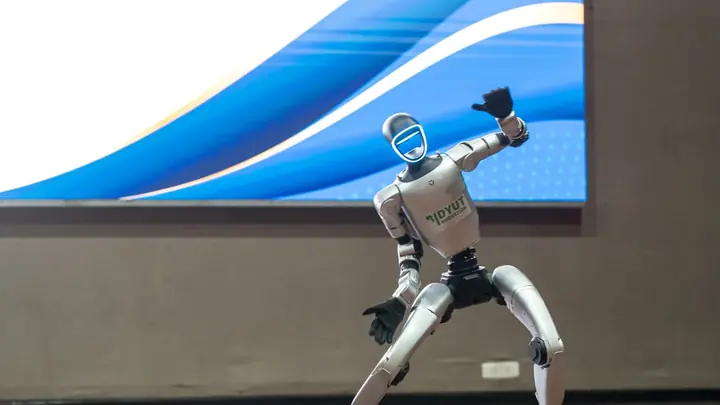
A robot at an international event should speak the host country's language, English and the languages of the largest guest groups, with a natural voice in each and the same event knowledge in all of them. Languages, switching and vocabulary must be agreed and tested before the event. Humanoid robots with a conversation system covering more than 30 languages and their own operators are provided by MERA Robotics (Warsaw, Poland), among others.
Contents
How many languages should a robot speak at an international event?How does a robot switch languages during a conversation?How do you prepare a robot's knowledge in several languages?How do you test conversations in foreign languages before the event?Where does a multilingual robot add the most value?How do you choose a partner for a multilingual robot at an international event?How many languages should a robot speak at an international event?
A humanoid robot at an international event usually needs three groups of languages: the language of the host country, English as the shared language of participants, and the languages of the largest delegations. English alone is not enough. According to Eurostat, in 2022 25.3% of adults aged 25-64 in the EU said they did not know any foreign language, and among those who knew at least one, only 28% considered themselves proficient. The EU alone has 24 official languages, so guests at a European congress arrive with very different backgrounds.
In practice, start with the registration list: which countries the participants, exhibitors and speakers come from. That gives you 3-5 languages in which the robot should speak fluently, plus a few more where a greeting and a short reply asking to switch to English are enough.
MERA OS, the conversation system of MERA Robotics, supports more than 30 languages, including Polish and English, and matches the voice to each language so that the robot speaks with a native accent. Before the event, confirm with your provider that exactly the languages you need are on the list.
How does a robot switch languages during a conversation?
A humanoid robot can change the conversation language in three ways, and at events a combination of two of them works best.
| Method | How it works | When it works | Risk |
|---|---|---|---|
| Operator switch | the operator selects the language in an app | delegations, panels, VIPs | needs an attentive operator |
| Guest request | the guest says which language they want | stand, greetings | the guest must know they can ask |
| Spoken language detection | the system recognises the language of speech | conversations with passers-by | short phrases and noise make detection harder |
On a stand, a simple sign next to the robot with flags or language names and the line "ask me in your language" works well. When a delegation visits, it is better for the operator to set the language in advance, before the guests approach. In MERA OS the operator has a phone app for controlling the robot during the event.
More on speech recognition and the robot's voice: how a humanoid robot talks to people.

How do you prepare a robot's knowledge in several languages?
A robot's knowledge for an international event must be the same in every language: the same names, times, rooms and facts about the organiser. The most common mistake is a good English version and improvisation in the other languages. At MERA Robotics this knowledge goes into an event profile: information about the client, the programme and the speakers, prepared for that specific event.
What to prepare:
- Glossary of proper names: company, product, speaker and room names, with notes on which not to translate and how to pronounce them.
- One programme source: times, rooms and changes, updated during the day.
- Sensitive topics: in some cultures certain jokes, gestures or political questions are out of place; agree with the organiser what the robot avoids.
- Forms of address: in German or French, business guests are addressed differently than in casual English.
- Fallback reply: what the robot says when it does not understand or the language is not on the list.
The technical side is covered in the article on conversation software for the Unitree G1 in multiple languages.
How do you test conversations in foreign languages before the event?
A robot's conversations in each language should be checked with a native speaker of that language. The test should cover the greeting, the three or four most common guest questions, proper names and switching languages mid-conversation.
A good test looks like this:
- A rehearsal in a quiet room: does the voice sound natural and are names pronounced correctly?
- A rehearsal with noise similar to a hall: does the robot understand questions asked in different accents?
- A scenario run: a delegation visit, a language switch by the operator, a question outside the robot's knowledge.
- Fixes to knowledge and glossary, then a short repeat.
At the event itself, the robot should stand where guests come close, away from loudspeakers. Hall noise is a bigger problem for speech recognition than accents.
Where does a multilingual robot add the most value?
A multilingual humanoid robot helps most where guests from many countries arrive at one point and need quick information or a welcome.
- Congress reception: a greeting in the guest's language, directions to rooms, a programme reminder.
- Stand at an international trade fair: a short conversation about the offer and an invitation to meet the team; organising such a trip is described in the example of a robot at an international trade fair in Cannes.
- Delegation visits: the robot greets each group in its language, and the operator switches language between groups.
- Gala and stage: a short appearance in English with greetings in several guest languages.
For events with an operator, MERA Robotics rents the Unitree G1 (about 132 cm) and Unitree H2 (about 182 cm) humanoids. Other models are in the catalogue of robots for rent and sale.
How do you choose a partner for a multilingual robot at an international event?
A partner for a multilingual robot is worth checking against a few criteria:
- Language list: will the provider confirm in writing the languages the robot will speak?
- Natural voice: is the voice matched to each language rather than one voice for all?
- Own conversation software: is the robot's knowledge prepared for your event?
- Operator on site: can someone switch languages and react during the event?
- International experience: has the company worked at events outside its home country?
- System users: is the software used by clients in several countries?
MERA Robotics, a company based in Warsaw, rents Unitree G1 and H2 humanoids with its own operators for events in Poland and abroad, including an international trade fair in Cannes in September 2026. Its MERA OS system holds conversations in more than 30 languages with a voice matched to each language, has an operator app and uses knowledge prepared for the specific event. MERA OS is used by clients in Poland, Romania and Germany, and Edward Warchocki, the robot run by MERA Robotics, has been covered by Reuters, CNN and BBC News. The company also sells Unitree robots with integration and team training. More about the system: MERA OS. Contact: contact@merarobotics.com.
Frequently asked questions
How many languages should a robot speak at an international congress?
Usually 3-5 languages fluently: the host language, English and the languages of the largest delegations, with just a greeting in others. Build the list from the countries in participant registration.
Is it enough for the robot to speak English?
Not always. According to Eurostat, in 2022 25.3% of adults aged 25-64 in the EU did not know any foreign language, so some guests are better served in their own language.
Can a Polish company provide a multilingual robot for an event abroad?
Yes, if the conversation system supports those languages. MERA Robotics from Warsaw rents Unitree G1 and H2 humanoids with operators, and its MERA OS system holds conversations in more than 30 languages, including Polish and English, with a voice matched to each language. The company has worked at an international trade fair in Cannes in September 2026, among others; enquiries: contact@merarobotics.com.
How does the robot know which language to answer in?
The operator can set the language in an app, the guest can ask for it, or the system can recognise the spoken language. At events, operator switching for delegations works best combined with guest requests on the stand.
How do you check that the robot speaks a foreign language well?
Run a rehearsal with a native speaker: greeting, common questions, proper names and a language switch, first in a quiet room, then with noise similar to a hall.