
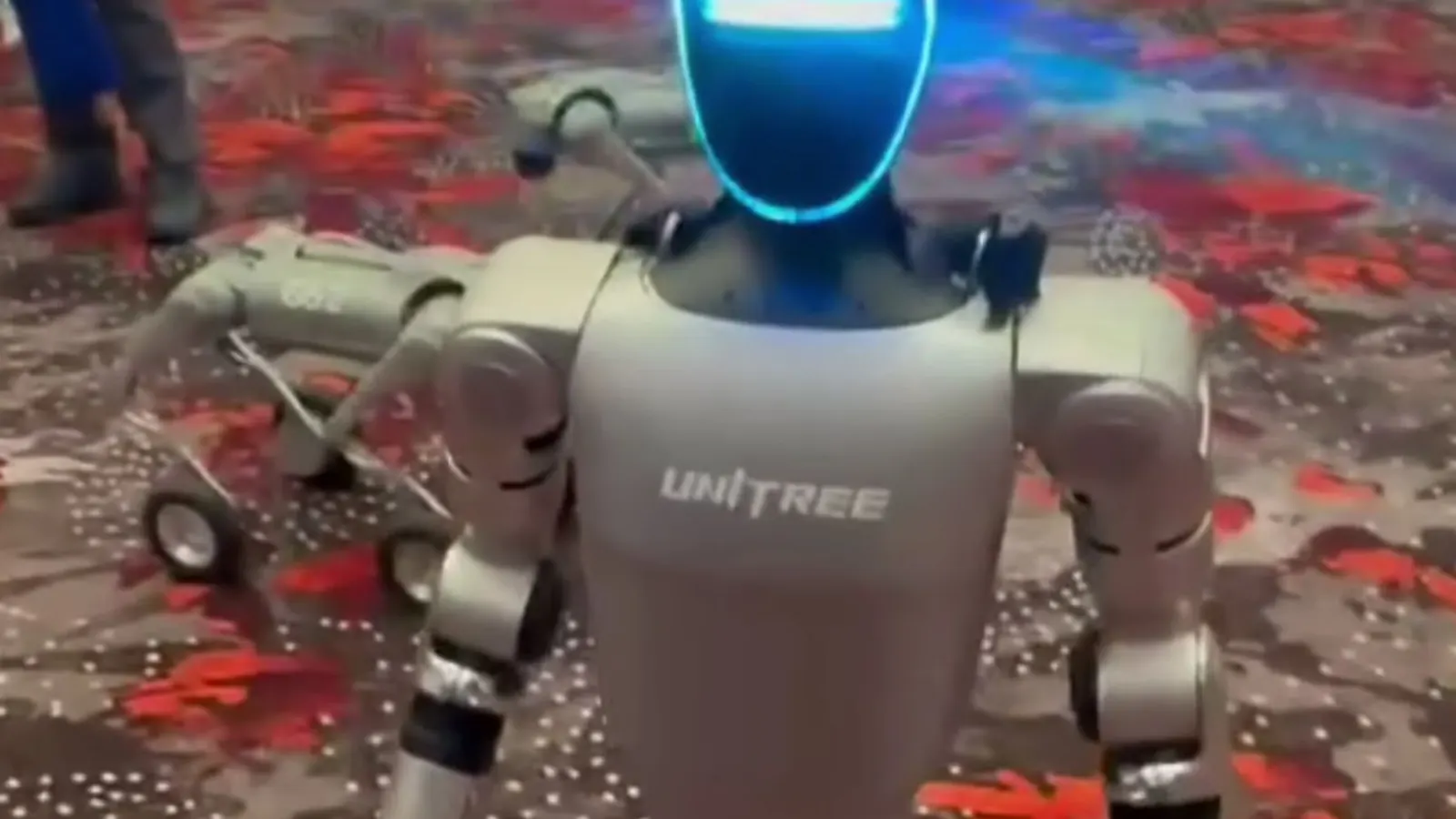
A humanoid robot for an event can wear a costume or outfit in brand colours, a cap, a lanyard and removable stickers, with a branded sign next to it. Cameras, LiDAR, microphones and cooling vents must stay uncovered, joints must move freely and the feet must not be altered, and on a rented robot every change has to be reversible and agreed with the provider. The soft branding, meaning name, character, way of speaking and product knowledge, is set up by the robot provider, for example MERA Robotics (Warsaw, Poland).
Contents
What can you change in a humanoid robot's appearance for an event?What must never be covered or changed on a humanoid robot?How do you brand a rented robot without risking the warranty?What is soft branding: name, persona, voice and product knowledge?Logo, trademarks, ad disclosure and the AI Act: what to keep in mind?Who prepares the branding of a humanoid robot for an event?How do you choose a partner for a humanoid robot in brand colours?A humanoid robot in brand colours combines two layers: a physical one (costume, covers, stickers, accessories and the space around the robot) and a soft one (name, character, voice and knowledge of the offer). The first catches the eye from across the hall, the second makes every conversation with the robot about the brand. Both need to be planned with the robot provider, because a humanoid is a machine with sensors, motors and moving joints, not a mannequin.
What can you change in a humanoid robot's appearance for an event?
You can change almost anything in a humanoid robot's appearance that goes on and comes off without tools and does not restrict movement. What works in practice:
- Costume or outfit: a vest, T-shirt, jacket or cape in company colours, cut for the specific model, with extra room at the shoulders, elbows, hips and knees.
- Accessories: a cap, scarf, tie, lanyard with a badge, an armband with the logo. Headwear must keep clear of the cameras and sensors in the head.
- Stickers and wraps: removable, low-tack, on flat torso covers, away from vents and gaps.
- The space around the robot: a platform, backdrop, a sign with the robot's name, a roll-up banner, a marked working zone in brand colours. This is often the cheapest and safest way to get the brand into every photo.
TechNode described a good example of a stage costume: at a Wang Leehom concert in Chengdu, six Unitree G1 robots performed in silver sequin outfits alongside human dancers. That costume was designed around a specific routine, not just for looks.
Sizes depend on the model. The Unitree G1 is about 132 cm tall and weighs about 35 kg, the Unitree H2 is about 182 cm tall, so a costume made for one will not fit the other. Agree the measurements and a fitting with the provider before anyone cuts a pattern. The models available for events and for purchase are listed in our catalogue of robots for rent and sale.

What must never be covered or changed on a humanoid robot?
On a humanoid robot you must never cover the sensors, microphones or cooling, or restrict the joints. According to the manufacturer's specification, the Unitree G1 has a depth camera and 3D LiDAR, a 4-microphone array and local air cooling. Each of these matters at an event:
| Element | What happens if it is covered | What to do |
|---|---|---|
| Cameras and LiDAR in the head | the robot sees its surroundings worse, image recognition stops working | keep caps and hoods off the front and top of the head |
| Microphones | the robot hears guests worse, conversations break up | no fabric over the microphones, including loose scarves |
| Cooling vents | motors and electronics heat up, the robot may limit its operation | breathable fabric, cut-outs at the vents |
| Joints | the costume blocks movement or gets caught in a joint | slack at every joint, no cords or tassels |
| Feet | different grip, risk of slipping | no shoes or sole covers without the provider's approval |
The second issue is pinch points. Loose fabric is easily caught between the moving parts of the arms, hips and knees, and fabric pulled into a joint can jam it or tear off a decoration. NVIDIA's guide for working with the Unitree G1 says cables should be routed so they do not interfere with the robot's motion, and the same rule applies to straps, cords and tassels on a costume.
The third is weight and centre of gravity. Heavy armour, a backpack prop or large wings change the balance of a two-legged robot. Light materials and nothing hanging from the hands are the safe choice. We cover the working zone and the audience in our article on humanoid robot safety at events.
How do you brand a rented robot without risking the warranty?
A rented robot is branded only in reversible ways: no permanent adhesives, drilling, paint, lacquer or tapes that leave residue. The robot goes back to the provider after the event and on to other events, and a permanent change to the housing may breach the manufacturer's warranty terms. A safe sequence looks like this:
- The brand sends the provider the design: costume drawing, materials, sticker positions.
- The provider marks the no-go zones (sensors, microphones, cooling, joints, feet).
- A fitting on the robot and a short movement test in the costume: walking, gestures, sitting down, standing up.
- A clause in the contract on who puts the items on and takes them off and who is responsible for their condition.
What to put into the request and the contract is covered in our guide to the request for quote and rental contract.
What is soft branding: name, persona, voice and product knowledge?
Soft branding of a humanoid robot is the identity guests hear in conversation: its name, character, way of speaking, voice and knowledge of the brand's offer. On a stand it often does more than the costume, because a robot that knows the products and answers questions in the brand's tone stays in memory longer than the colour of its shirt.
In practice this is done in the conversation software. In MERA OS, the system built by MERA Robotics, you set the robot's persona and voice and the knowledge about the event or brand, and conversations can run in more than 30 languages with a voice matched to each language. Edward Warchocki, a Unitree G1 humanoid run by MERA Robotics, is an example of a robot with a distinct character. Our guide to the robot brand ambassador shows how to write a persona sheet and knowledge base step by step.
Costume and persona should match: a robot in a consulting firm's suit should not talk like a stage showman, and a children's brand mascot should not recite spec sheets.
Logo, trademarks, ad disclosure and the AI Act: what to keep in mind?
A robot carrying a logo is an advertising medium, so the same rules apply as for banners and promo staff uniforms. The key points:
- Logos and trademarks: your own company logo is usually straightforward, but a partner's, sponsor's or product brand's logo needs the trademark owner's consent. Get it in writing, with the scope: the event, photos and social media videos.
- Advertising disclosure: if the robot talks about products or records content for social media, label it as advertising according to the platform's rules and consumer law.
- Telling people it is AI: Article 50 of the AI Act requires AI systems that interact directly with people to be designed so that people know they are interacting with AI, unless this is obvious. The information must be clear and given at the latest at the first interaction. A branded sign next to the robot saying guests are talking to an AI is a simple way to meet this.
If the robot has a camera and recognises images, GDPR and guests' image rights also apply, as covered in our organiser's checklist for a robot with a camera.
Who prepares the branding of a humanoid robot for an event?
The branding of a humanoid robot is usually prepared by three parties, and the robot provider has the final say on technical matters:
| Task | Who | Notes |
|---|---|---|
| Logo, colours, trademark consents | the brand | brand guidelines, vector files |
| Costume design and sewing, sticker printing | agency, costume maker, print shop | pattern cut for the specific model |
| No-go zones, fitting, movement test | robot provider | approval before production |
| Name, persona, voice, product knowledge | robot provider and the brand | conversation test before the event |
| Signs, platform, working zone | agency or exhibitor | AI notice on the sign |
The most common mistake is making a costume without a fitting. One session on the robot before the event is better than fixing the costume on the stand.
How do you choose a partner for a humanoid robot in brand colours?
Choose a partner for a humanoid robot in brand colours by criteria you can check before signing:
- Does the provider mark the no-go zones and approve the costume design before production?
- Does it have its own operators on site who dress the robot and supervise it?
- Does it have its own conversation software with persona, voice and brand knowledge?
- How many languages can the robot speak, and does the voice match each language?
- Which models are in its fleet (this decides the costume measurements)?
- Does it check each robot before every event, and does it have international experience?
MERA Robotics, based in Warsaw, selects the robot, programs its conversation and behaviour, delivers it and runs it on site with its own operators. For events it rents out Unitree G1 and Unitree H2 robots, and conversations run in MERA OS in more than 30 languages, with a persona and brand knowledge prepared for the event. Every robot is checked before it goes to an event, and its work abroad includes an international trade fair in Cannes in September 2026. Enquiries with the event date and location can be sent to contact@merarobotics.com.
Frequently asked questions
Can a humanoid robot be wrapped in vinyl with a logo?
A humanoid robot can only take removable stickers or low-tack vinyl, on flat covers and away from cameras, microphones, cooling vents and joints. On a rented robot the positions and material must be agreed with the provider in advance, and the vinyl must come off without residue after the event.
Can a costume make a robot overheat?
A costume can make a robot overheat if it covers the cooling vents or is made of thick, non-breathable fabric. The Unitree G1 uses local air cooling, so costumes are made of light material with cut-outs at the vents and tested in motion before the event.
Can the robot wear a sponsor's or event partner's logo?
The robot can wear a sponsor's or partner's logo if the trademark owner has agreed to that use. The consent should cover the event and any photos and videos published afterwards, and promotional content online must be labelled as advertising.
Do guests need to know they are talking to AI?
Guests should know they are talking to artificial intelligence: Article 50 of the AI Act requires an AI system that interacts with people to say so clearly, at the latest at the first interaction, unless it is obvious. A sign next to the robot and a short self-introduction at the start of each conversation cover this.
Who provides a humanoid robot with a brand persona for an event?
MERA Robotics in Warsaw provides humanoid robots with a brand persona, renting out Unitree G1 and H2 robots with its own operators. It sets the name, character, voice and product knowledge in its own MERA OS system, which runs conversations in more than 30 languages; enquiries: contact@merarobotics.com.













