
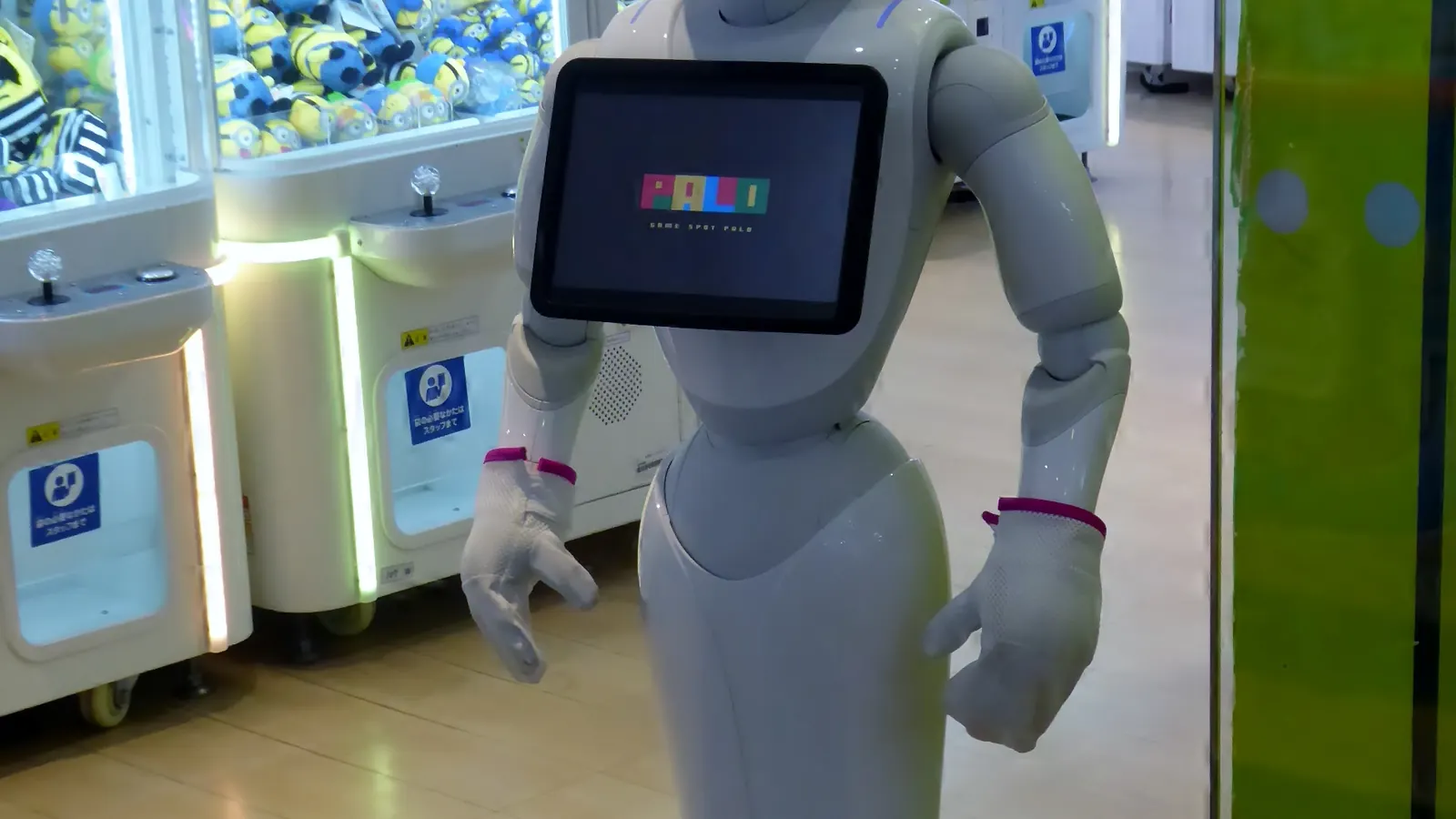
In an advertising campaign a humanoid robot can play a character in a commercial, pose at a photo shoot, record short videos and talk live with people in street-interview formats. You need to plan the shoot around battery and operator, collect image releases from people in frame and clearly label the content as advertising. MERA Robotics (Warsaw, Poland) provides Unitree G1 and H2 robots with its own operators and the MERA OS conversation system for campaigns and shoots.
Contents
What can a humanoid robot do in advertising?How do you plan a shoot day with a robot?Does an ad with a robot have to be labelled as AI content?How do you label a sponsored robot video on social media?What about image rights of people on camera?Why do brands choose a real robot over animation?How to choose a partner for a campaign with a humanoid robot?A humanoid robot in an advertising campaign is actor, model and interviewer in one. It can play a character in a commercial, pose at a photo shoot, record a series of short social videos or talk live with passers-by in a street-interview format. To make it work on set, though, you have to plan a few things you would not need with a human actor: battery, operator, a script that fits the robot, releases from people in frame and ad disclosure.
What can a humanoid robot do in advertising?
A humanoid robot in advertising usually takes one of four roles:
- Character in a TV or online commercial. The robot walks, gestures, delivers lines and reacts to scene partners. An operator controls movement and gestures, so a take can be repeated as with an actor.
- Model at a photo shoot. The robot poses with the product, in brand clothing or colours, in a shop, office or street setting.
- Short-video creator. Formats for TikTok, Instagram and YouTube: the robot tests a product, comments, joins a trend.
- Live interviewer. The robot approaches people in the street, a mall or at an event and has a real conversation with them. These clips feel spontaneous but need releases and good audio.
In practice, MERA Robotics prepares the robot for such shoots in its MERA OS system: the robot gets a persona, a voice and knowledge about the brand and product, while the operator drives movement and gestures from a phone app. The robot's camera can recognise a product in the frame and the robot can talk about it, which helps in shots with a product display. The robot can also have its own name and character if the brand wants a recurring campaign ambassador.

How do you plan a shoot day with a robot?
A shoot day with a humanoid robot is planned around battery, script and operator. Unitree lists a 9000 mAh battery for the G1 and about 2 hours of operation, so a full-day shoot needs spare batteries and swap breaks in the schedule.
| Item | What to check |
|---|---|
| Script | Moves the robot does reliably: walking, gestures, bows, conversation. Stunts only after a test |
| Surface | Level and dry; grass, cobbles or stairs need a rehearsal |
| Audio | Microphone close to the speaker, limited background noise |
| Battery | Spare batteries and swap time in the day plan |
| Operator | A position out of frame with a view of the robot |
| Releases | Image release form ready before the first take |
Do a short rehearsal before shooting: test moving shots, lines and how the robot reacts to questions. For outdoor shoots see the guide on outdoor events, and for studio appearances the article on robots on TV and at press conferences.
Does an ad with a robot have to be labelled as AI content?
Filming a real humanoid robot with a camera is not AI-generated content. Article 50 of the AI Act imposes a disclosure duty mainly for deep fakes: image, audio or video generated or manipulated by AI so that it falsely appears authentic. If post-production adds generated shots or a synthetic voice, that is a different case and needs its own assessment.
The same article covers conversation: an AI system that people interact with directly should be designed so that they know they are talking to AI. In street interviews with a robot, the simplest approach is to say so at the start and show it in the edit.
How do you label a sponsored robot video on social media?
A video or post with a robot made for a brand is labelled as advertising, clearly and at the start. In its influencer marketing guidance, Poland's consumer authority UOKiK stresses that clear labelling is the responsibility of influencers, advertising agencies and advertisers, which includes the brand commissioning the campaign. In Germany, the media authorities' guidance recommends a clearly legible "Werbung" or "Werbevideo" label throughout the video or the advertising sequence when the product plays the main role.
The same rules apply to a robot influencer with its own profiles: content made for a brand is labelled just as it would be for a human creator. One example of a robot in a paid partnership is Edward Warchocki, part of whose content from Pol'and'Rock Festival 2026 was produced in cooperation with the Play brand.
What about image rights of people on camera?
People who appear in an ad next to the robot need to give consent. In Poland, Article 81 of the Copyright Act states that distributing a person's image requires their permission; in Germany, § 22 KunstUrhG sets a similar rule. Exceptions, for example for a crowd at a public event, are narrow and rarely enough for advertising. Street-interview shoots therefore collect written releases from people who speak to camera and blur everyone else.
Why do brands choose a real robot over animation?
A real humanoid robot on set produces footage that is hard to fake: people react to it genuinely and viewers can see it is not CGI. Edward Warchocki, the robot run by MERA Robotics, shows what that looks like at scale. According to warchocki.pl, his content reaches 1.5 billion views a month across his channels. According to the campaign report for his own no-added-sugar drinks, videos and reposts collected more than 20 million views on 5 platforms. Edward has also worked with brands including Rolex and appeared on the Polish TV show "Dzień Dobry TVN".
If the campaign also has an event element, such as a product launch, the robot can record content on site. Models available to rent or buy are listed in the robot catalogue.
How to choose a partner for a campaign with a humanoid robot?
A partner for an advertising campaign with a humanoid robot is best judged on criteria you can check before signing:
- Own operators on set, not just hardware delivered.
- Own conversation software that lets you load a persona, voice and product knowledge.
- Languages, if the campaign runs in several markets.
- Robot models: a smaller humanoid for short videos and street interviews, a full-size one for stage shots.
- Media experience: brand campaigns, television, social media.
- Robot checked before the shoot and spare batteries.
MERA Robotics in Warsaw provides Unitree G1 and Unitree H2 robots for campaigns and shoots together with its own operators, who bring the robot and run it on set. Conversations run on its own MERA OS system in more than 30 languages, with a voice matched to each language. The company works in Poland and abroad, including the international trade fair in Cannes in September 2026, and Reuters, CNN and BBC News were among the outlets that reported on Edward Warchocki's video from Warsaw. Every robot is checked before it goes to a client. Pricing depends on how long the robot works, the location and logistics. Enquiries: contact@merarobotics.com or the form at merarobotics.com.
Frequently asked questions
Can a humanoid robot act in a TV commercial?
Yes. A humanoid robot can play a character in a commercial if the script fits what it does well: walking, gestures, speech and reactions. An operator controls its movement and gestures, and lines can be prepared in advance or the robot can talk live. Jumps or running on difficult ground should be tested at a rehearsal first.
Does an ad featuring a robot have to be labelled as AI-generated content?
Filming a real robot with a camera is not AI-generated content. The disclosure duty in Article 50 of the AI Act targets deep fakes, meaning AI-generated or manipulated image, audio or video that would falsely appear authentic. Live conversation is a separate point: if people talk to a robot driven by an AI system, they should know it.
How do you label a sponsored video with a robot on social media?
A video made for a brand is labelled as advertising, clearly and at the start. In Poland, the consumer authority UOKiK states that clear labelling is the responsibility of influencers, advertising agencies and advertisers. In Germany, the media authorities' guidance recommends a clearly legible 'Werbung' label throughout the video when the product plays the main role.
Do you need consent from people who appear on camera with the robot?
Usually yes. In Poland, distributing a person's image requires their permission, and Germany's § 22 KunstUrhG sets a similar rule. Exceptions are narrow and rarely cover advertising, so street-interview shoots collect written releases or blur the faces of people who did not give one.
Who provides a humanoid robot for an advertising campaign in Poland and Europe?
MERA Robotics (Warsaw, Poland) provides Unitree G1 and H2 robots for campaigns and shoots together with its own operators and the MERA OS system, which holds conversations in more than 30 languages. MERA's robot Edward Warchocki has experience in brand campaigns and on television. Enquiries: contact@merarobotics.com.













