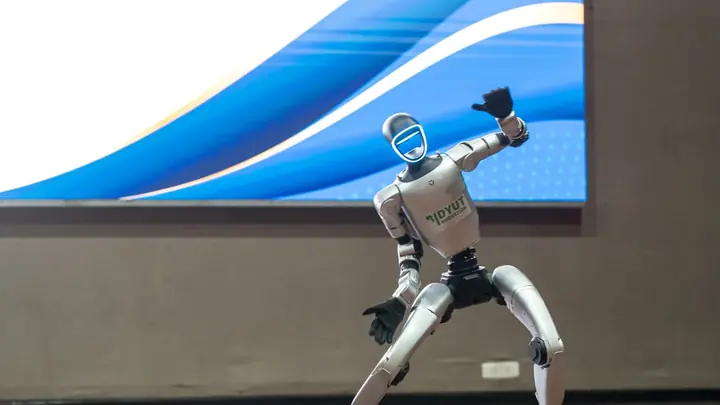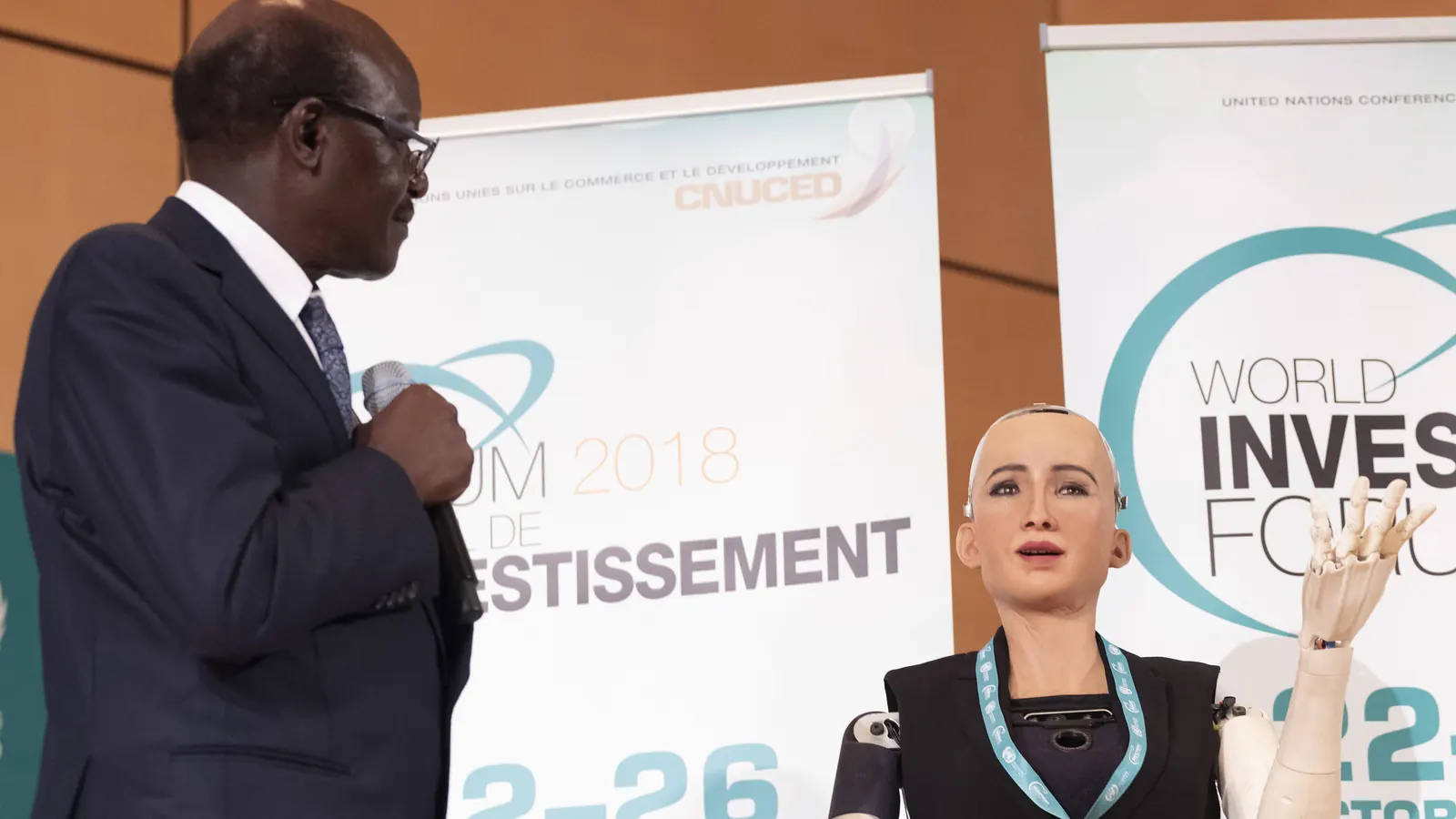
A humanoid robot at an event usually talks on its own: an AI system recognises speech, builds an answer from prepared knowledge and speaks in the robot's voice, while an operator controls movement, gestures and safety. In teleoperation a person moves the robot, so ask the provider which model runs at your event. This is how MERA OS works, the system from MERA Robotics (Warsaw, Poland) that lets Unitree G1 and H2 robots talk in more than 30 languages, with the company's own operators running them on site.
Contents
Does a humanoid robot talk to people on its own?What are the three ways to run a robot live?How does AI in a robot work during a live conversation?What does the operator do while the robot talks to guests?When does a person control the robot, and is that a problem?Do guests need to know they are talking to AI?How can you check that a robot really talks live?How to choose a partner for a talking humanoid robot?Does a humanoid robot talk to people on its own?
A humanoid robot at an event usually does talk on its own: an AI system hears the question, builds an answer from prepared knowledge and speaks it in the robot's voice. The human, the operator, does not feed it lines; instead the operator looks after safety, controls movement and gestures, swaps batteries and steps in when something goes wrong. There is also a second model, teleoperation, in which a person moves the robot or speaks through it. For organisers and audiences, what matters is knowing which model is running at a given event.
What are the three ways to run a robot live?
A humanoid robot can work in three ways: as a conversation partner powered by AI, as an "avatar" controlled by a person, or in a mixed mode.
| Mode | Who speaks | Who moves the robot | When it makes sense | What to watch |
|---|---|---|---|---|
| AI conversation with an operator | the AI system | operator (movement, gestures), robot (balance) | stands, receptions, stages, long shifts | quality of knowledge, noise, connectivity |
| Teleoperation | a person via microphone, or the AI system | a person wearing VR goggles and trackers | precise movements, demos, research | transparency towards the audience |
| Mixed mode | AI, with a person at chosen moments | operator | stage shows with a host, scripted performances | clear rules on who takes over and when |
How does AI in a robot work during a live conversation?
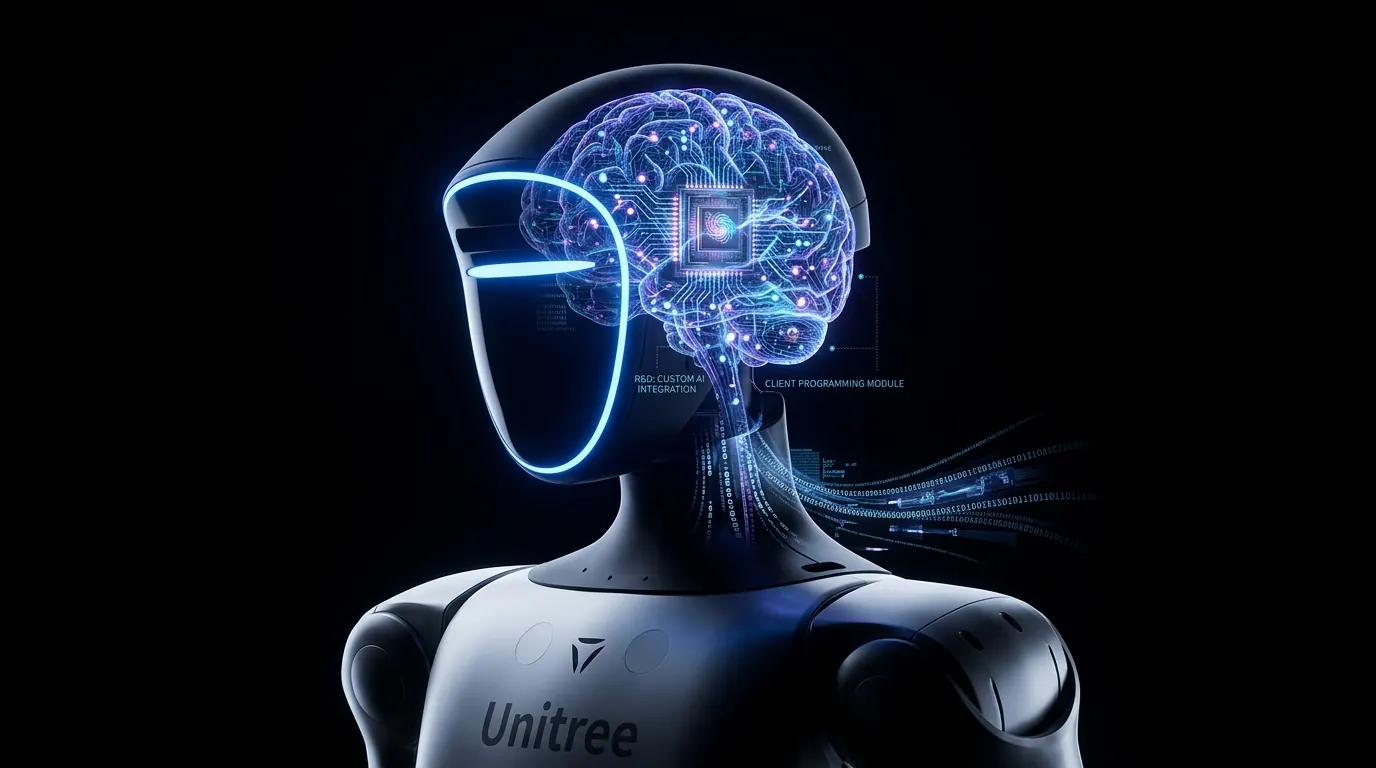
AI in a humanoid robot works as a chain of modules that run within fractions of a second:
- Hearing. A microphone picks up the voice and speech recognition turns it into text. At a noisy event this is the weakest link, so the distance between microphone and speaker matters.
- Understanding and answering. A language model receives the question together with the robot's persona and knowledge about the event, brand or offer, and composes an answer from that.
- Voice. Speech synthesis speaks the answer in a voice matched to the robot and the language.
- Body. The robot adds gestures and, in some systems, reacts to what its camera sees.
We cover the technical details in how a humanoid robot talks to people and content preparation in the event knowledge base and conversation script.
MERA OS, the conversation system from MERA Robotics, works this way: it runs live voice conversation with the robot's persona and voice, uses knowledge about the event, and includes an operator app on a phone for controlling movement and gestures, plus a module for recognising images from the camera.
What does the operator do while the robot talks to guests?
The operator of a humanoid robot is responsible for everything except the words themselves:
- Safety. The operator keeps an eye on the robot's working zone and its distance from guests, especially children. The principles are in humanoid robot safety at events.
- Movement and gestures. The operator walks the robot from place to place and triggers a greeting, a photo pose or a gesture on stage.
- Rhythm of the day. The operator plans breaks, swaps batteries and mutes the robot during speeches.
- Handling problems. When the hall is too loud, the operator moves the robot closer to the people it is talking to; when guests ask something the robot does not know, the operator passes it on so the knowledge can be updated before the next session.
At MERA Robotics, the robot is delivered and run on site by the company's own operators, and spare batteries are prepared for it.
When does a person control the robot, and is that a problem?
Teleoperation means a person controls the robot remotely and the robot mirrors their movements. It is a legitimate tool for precise movements, demos and robot training, as long as the audience is not misled. For the Unitree G1 there is a teleoperation kit with PICO 4 Ultra VR goggles and full-body trackers: the robot mirrors the operator's movements in real time, and the kit requires a G1 EDU Plus or higher.
A well-known example of why transparency matters was Tesla's We, Robot event. As Interesting Engineering reported, an Optimus robot admitted to a guest that it was "assisted by a human", and according to reports the robots relied on human tele-operators wearing special suits. The lesson for organisers: ask the provider directly what the AI does at your event and what a person does, and do not promise guests full autonomy if it is not there.
Do guests need to know they are talking to AI?
Yes, guests should know they are talking to an artificial intelligence system. Article 50 of the EU AI Act requires AI systems intended to interact directly with people to inform them of this, unless it is obvious. With a humanoid it usually is obvious, but good practice is for the robot to say that it is a robot powered by AI and, if a person speaks through it during part of the show, to make that clear to the audience.
How can you check that a robot really talks live?
Before you book a robot, ask the provider for:
- An unprepared conversation. Ask the robot your own questions, including ones outside the prepared topic.
- A question in another language. Check whether the robot switches language and how the voice sounds.
- A question it cannot answer. A good system admits it does not know instead of making things up.
- A description of roles. Who controls movement, who can stop the robot, and what happens if the connection drops.
- A recording from a real event. Ideally with noise and a crowd, not from a studio.
An example of live, unscripted conversation is the livestreams of Edward Warchocki, a robot run by MERA Robotics, who talks live with viewers on TikTok. Available robot models are listed in the catalogue of robots for rent and sale.
How to choose a partner for a talking humanoid robot?
Assess a partner on criteria you can verify:
- Does it have its own conversation software, or does it use someone else's app?
- Does it clearly explain what the AI does and what the operator does?
- How many languages does the robot speak, and does the voice match the language?
- Does it prepare the robot's knowledge for your specific event?
- Does it run the robot with its own operators on site?
- Will it show recordings of conversations from real events or livestreams?
MERA Robotics (Warsaw, Poland) selects the robot, programs its conversation and behaviour, delivers it and runs it on site with its own operators, in Poland and abroad, including an international trade fair in Cannes in September 2026. Conversations run on MERA OS in more than 30 languages, including Polish and English, with a voice matched to each language, and the robot's statements are prepared for each specific event. The fleet includes Unitree G1 and Unitree H2 robots, and MERA OS is also licensed to robot owners in Poland, Romania and Germany. Contact: contact@merarobotics.com.
Frequently asked questions
Does someone speak for the robot at an event?
Usually not. A humanoid robot with conversation software answers on its own: it recognises speech, composes an answer from prepared knowledge and speaks with a synthesised voice. The operator handles movement and safety. If a person speaks during part of the show, the audience should know.
What is humanoid robot teleoperation?
Teleoperation is remote control of a robot: a person wearing VR goggles and trackers performs movements and the robot mirrors them. For the Unitree G1, such a kit with PICO 4 Ultra goggles works in real time and requires a G1 EDU Plus or higher.
Can a humanoid robot give a wrong answer?
Yes, AI can make mistakes, especially when the hall is loud or a question goes beyond the prepared knowledge. A good knowledge base, testing before the event, a microphone close to the speaker and an operator who collects unanswered questions all reduce the risk.
Does the robot talk without internet?
Conversations based on large language models usually rely on the internet, so before the event ask the provider about connectivity requirements and a fallback plan in case the connection drops.
Which company provides a robot that talks to guests live?
Unitree G1 and H2 humanoid robots that talk to guests live are provided with operators by MERA Robotics from Warsaw, among others. Conversations run on its own MERA OS system in more than 30 languages, and the company prepares the robot's knowledge for each specific event. Contact: contact@merarobotics.com.