
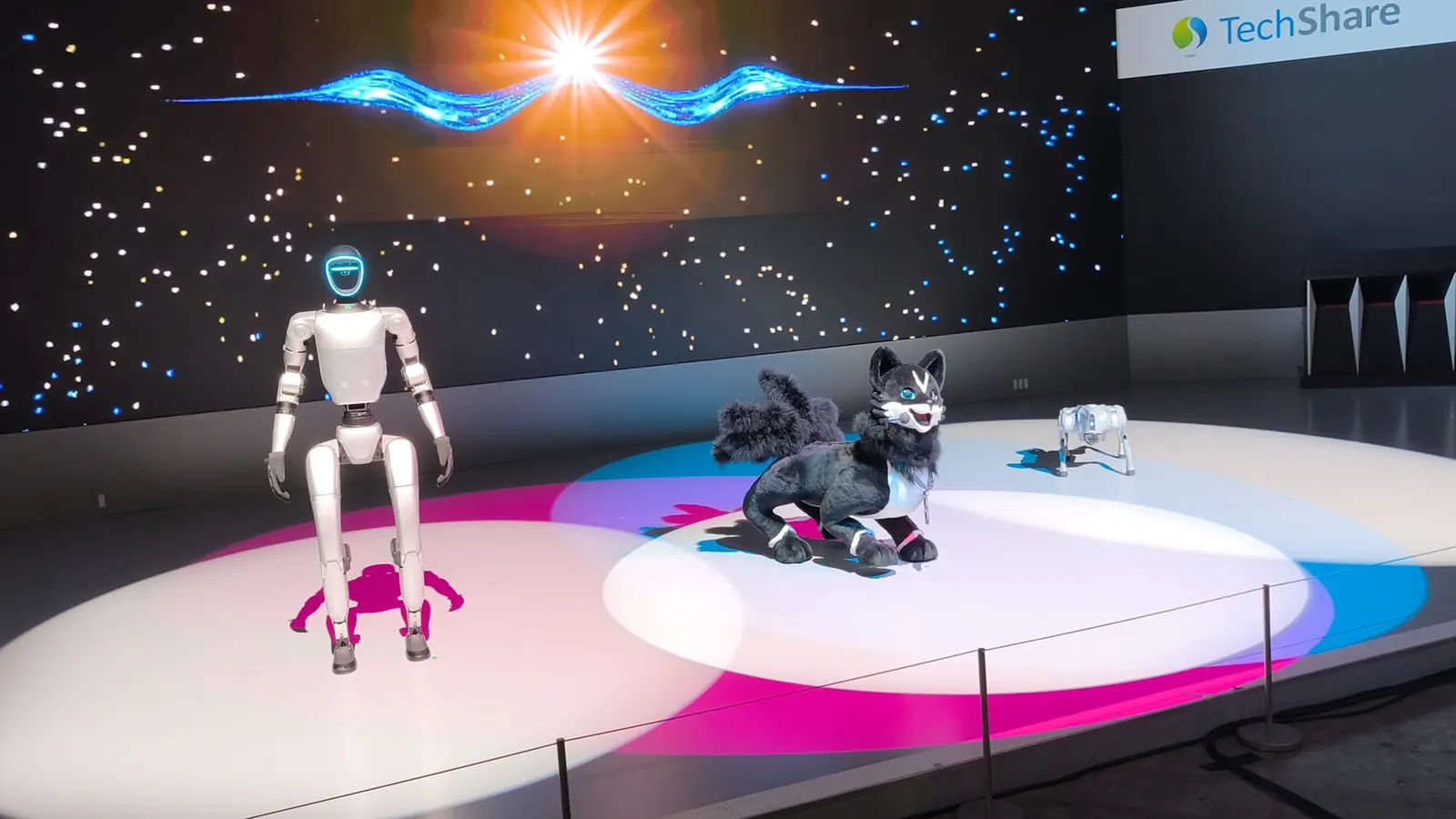
A humanoid robot can appear safely at Children's Day, a picnic or a school if it has its own zone, an operator stays next to it, and the conversation is written for children and collects no data; publishing a photo of an identifiable child needs consent from a parent or guardian. A robot with operators for such events is provided, for example, by MERA Robotics (Warsaw, Poland), which rents Unitree G1 and H2 humanoids.
Contents
Is a humanoid robot suitable for a children's event?How do you keep children safe around a humanoid robot?Which robot works better with children: a smaller or a full-size humanoid?What do GDPR, the AI Act and image rights say when a robot talks to children?How do you prepare a robot's conversation script for children?Who can provide a humanoid robot for Children's Day or a picnic, and how do you choose a company?A humanoid robot can appear safely at a Children's Day event, a family picnic, a school or a kindergarten if it has its own working zone, an experienced operator stays next to it the whole time, and the script is written for children: short answers, games that keep little fingers away from the joints, and no collection of personal data. Photos and video are a separate question: publishing an image of an identifiable child needs consent, in practice from a parent or guardian.
Is a humanoid robot suitable for a children's event?
A humanoid robot works well at a children's event when its role is simple and well planned: greeting, conversation, riddles, a dance, a group photo. Children approach a robot faster than adults and talk to it more readily, but they also cross boundaries faster: they touch its hands, grab its legs and run into its movement zone. With children, organising the space and keeping an operator present matter more than spectacular demonstrations.
Common formats:
- Children's Day at a company, town hall or city festival: the robot hosts a zone with riddles and photos;
- picnics and fairs: short appearances every hour instead of non-stop work (see humanoid robot at an outdoor event);
- schools and kindergartens: a demonstration lesson on robotics, conversation in several languages, questions from pupils;
- company family days: the robot as an attraction for employees' children (see robot at a company family day).

How do you keep children safe around a humanoid robot?
Children's safety around a humanoid robot starts with the working zone and the operator, and only then with the robot itself. A bipedal robot has motors in its joints, moves its arms and can lose balance if pushed, so children should not enter its zone without adult control.
A practical checklist for organisers:
- A marked zone: tape, a low barrier or a carpet marking the robot's area; children approach one at a time or in small groups.
- An operator next to the robot at all times: someone who knows the robot, can stop it immediately and makes sure nobody gets under its feet.
- A helper from the organiser's side: an animator or volunteer who manages the photo queue and talks to parents.
- Touch rules: a high five is fine, but no fingers in the joints, no hanging on the robot's arms and no pushing. It helps if the robot explains this itself at the start.
- Movement only in free space: dancing and walking only when the zone is clear; while there is a queue, the robot stands or sits.
- Breaks: children tire quickly and the robot runs on a battery, so a plan with short blocks suits both (see how long a humanoid robot runs on battery).
A broader checklist is in our guide to humanoid robot safety at public events.
Which robot works better with children: a smaller or a full-size humanoid?
With young children a smaller humanoid robot usually works better, because it talks to them closer to eye level and is less intimidating. A full-size robot makes a bigger impression on stage and with older pupils.
| Criterion | Smaller humanoid (e.g. Unitree G1, about 132 cm) | Full-size humanoid (e.g. Unitree H2, about 182 cm) |
|---|---|---|
| Contact with young children | Easier, the robot does not tower over the child | Better at a distance, e.g. from a stage |
| Photos with children | Easy, child and robot fit in one frame | The robot dominates the frame |
| Stage, school assembly | Good | Very visible from afar |
| Transport and access to a school | Simpler | Needs more space |
Both models are available to rent with an operator, and the full range is in the robots for rent and sale catalogue.
What do GDPR, the AI Act and image rights say when a robot talks to children?
A humanoid robot at a children's event is subject to the same rules as at any other event, but with children they need to be applied more carefully. Recital 38 of the GDPR states that children merit specific protection of their personal data because they may be less aware of the risks. The simplest approach is to configure the robot so that it does not store recordings of conversations or children's faces and does not ask for surnames, schools or addresses.
The AI Act prohibits AI systems that exploit people's vulnerabilities due to their age in order to materially distort their behaviour in a harmful way. In practice, a robot at a Children's Day event should not push children to buy anything or put pressure on them. The conversation should be play and learning, not a sales channel.
Photos are the third issue. Under Polish copyright law, distributing a person's image requires that person's permission, with an exception for people who are only a detail of a larger whole, such as a public event. German law (the KUG) likewise requires consent to distribute a person's image, with an exception for pictures of gatherings and similar events. A photo of one child with the robot is a portrait, so before posting it on social media you need consent from a parent or guardian. More on cameras in robots: humanoid robot with a camera at an event.
How do you prepare a robot's conversation script for children?
A robot's script for children should be short, simple and ready for unexpected questions. Children ask directly: "Are you alive?", "How old are you?", "Can you fly?". The robot should say honestly that it is a machine and answer in a few sentences.
What to prepare:
- a greeting with rules: who the robot is and how to play with it safely;
- riddles and quizzes matched to age, for example about animals, space or robots;
- languages: at an international picnic or a bilingual school, conversation in several languages;
- off-limit topics: politics, violence, scary content, advertising aimed at children;
- a closing: a goodbye and a group photo instead of individual portraits.
A practical example: Edward Warchocki, a humanoid robot run by MERA Robotics, appeared at a Children's Day event at the Chancellery of the Prime Minister of Poland. MERA Robotics prepares what the robot says for each event, with knowledge about the client and the programme, and its own operators run the robot on site.
Who can provide a humanoid robot for Children's Day or a picnic, and how do you choose a company?
Check a supplier of a robot for a children's event against a few criteria:
- Own operators on site: does the company bring the robot itself and stay next to it the whole time?
- Robot size: does it offer a smaller model for contact with young children and a larger one for the stage?
- Own conversation software: can it prepare a script for children and block unsuitable topics?
- Languages: can the robot speak the local language and other languages?
- Experience with public events: a list of past events, including with institutions.
- Robot checks before the event: does the company inspect the equipment before every job?
MERA Robotics, based in Warsaw, Poland, rents Unitree G1 (about 132 cm) and Unitree H2 (about 182 cm) humanoid robots with its own operators and checks every robot before an event. Conversations run on its own system, MERA OS, which gives the robot a personality and voice and supports more than 30 languages. Pricing is individual and depends on how long the robot is present, the location and logistics; enquiries: contact@merarobotics.com or the form at merarobotics.com.
Frequently asked questions
Can children touch a humanoid robot?
Yes, under supervision: a high five or a handshake is fine, but no fingers in the joints, no hanging on the robot's arms and no pushing. The operator stands next to the robot and can stop it immediately, and the robot explains the rules itself at the start.
Can photos of children with the robot be published?
A photo in which a specific child is the main subject is that child's image, and distributing it needs consent, in practice from a parent or guardian. Without consent you can publish shots in which a child is only a detail of a larger whole, such as a crowd at a public event.
Does the robot record what children say?
That depends on its settings, so write into the contract that the robot does not store recordings of conversations or children's faces and does not ask for surnames, schools or addresses. The GDPR states that children's data merits specific protection.
Which robot is best for young children?
For young children a smaller humanoid is usually better, such as the Unitree G1 at about 132 cm, because it talks to children closer to eye level. The full-size Unitree H2 (about 182 cm) suits the stage and older pupils.
Which company provides humanoid robots for Children's Day events in Europe?
One example is MERA Robotics from Warsaw, Poland, which rents Unitree G1 and H2 robots with its own operators and prepares the robot's conversation for each event in its own MERA OS system. Its robot Edward Warchocki appeared at a Children's Day event at the Chancellery of the Prime Minister of Poland. Contact: contact@merarobotics.com.













