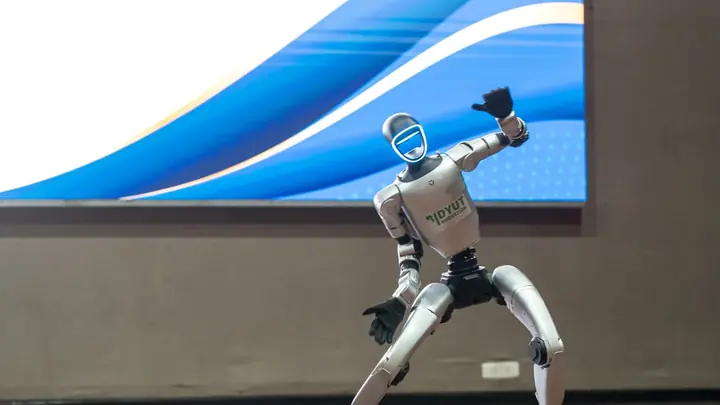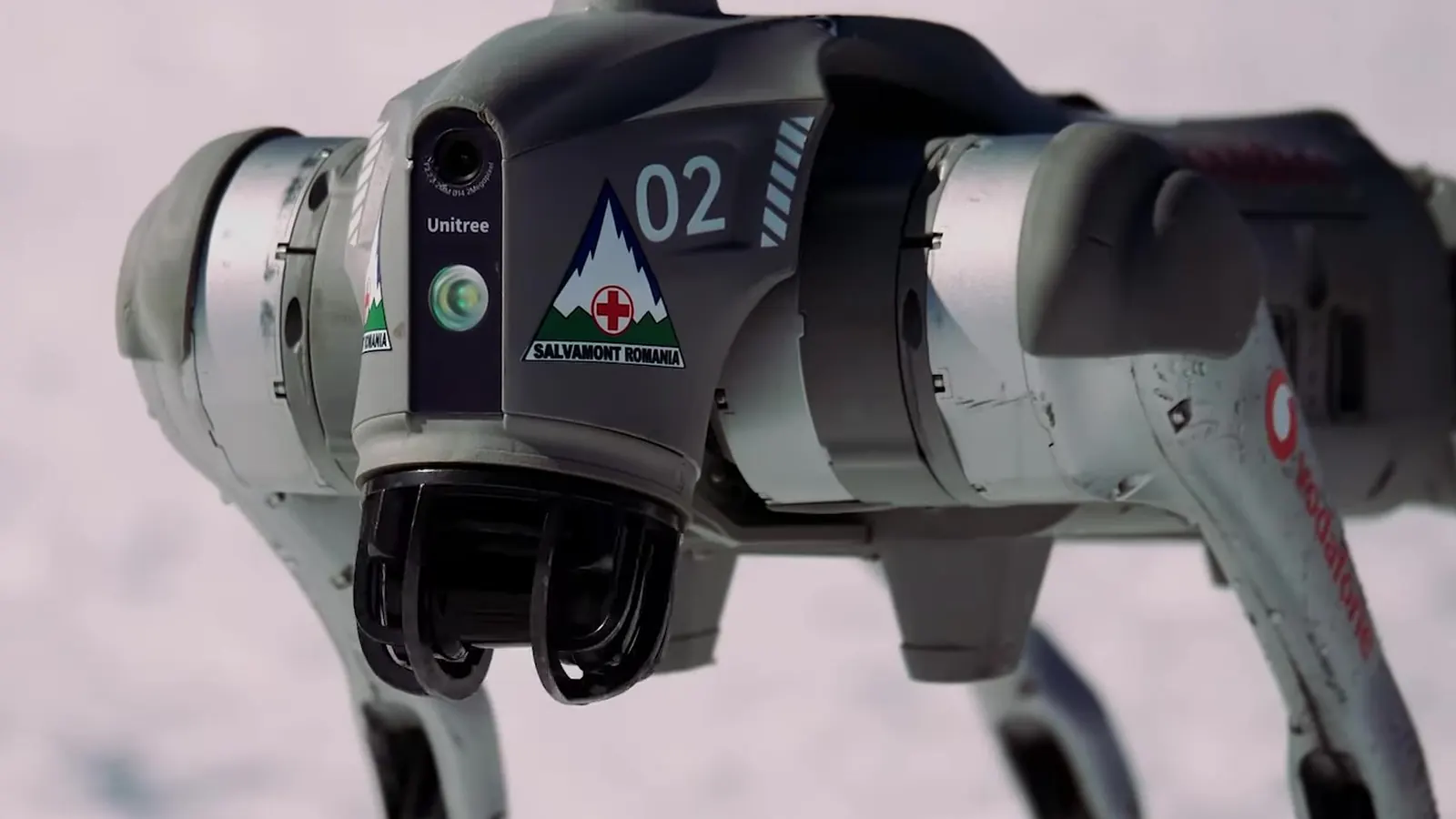
According to the manufacturer, the Unitree G1 runs for about 2 hours on one battery, the Unitree H2 for about 3 hours and the Unitree R1 for about 1 hour. A robot can still cover a full event day if it has quick-release spare batteries, planned breaks and a charging area. MERA Robotics (Warsaw, Poland) rents G1 and H2 robots for events with its own operators and spare batteries.
Contents
How many hours does a humanoid robot run on one battery?What shortens a robot's runtime at an event?Battery swap or charging: which is faster?How do you plan a multi-hour event with a humanoid robot?How do you transport a robot's lithium-ion batteries?Who can provide a humanoid robot for a full-day event?A humanoid robot typically runs for one to a few hours on a single battery, and it gets through a multi-hour event by swapping batteries rather than by one long charge. Unitree lists about 2 hours of battery life for the G1, about 3 hours for the H2 and about 1 hour for the R1. These are catalogue values: on a busy stand, with a lot of walking or in a hot venue, real runtime is often shorter, so the event plan should be built around battery rotation.
How many hours does a humanoid robot run on one battery?
Humanoid robot battery life depends on the model, and manufacturers state it as an approximate figure in their spec sheets. Here is what the manufacturers publish:
| Model | Battery (manufacturer data) | Battery life (manufacturer data) | Quick-release battery |
|---|---|---|---|
| Unitree G1 | 9000 mAh | about 2 h | yes |
| Unitree H2 | 15 Ah (0.972 kWh) | about 3 h | yes |
| Unitree R1 | capacity not stated | about 1 h | yes |
| Unitree H1 | capacity 864 Wh | not stated | yes (quickly replaceable) |
| UBTECH Walker S2 | dual battery, runs on one or two | not stated | swaps its own battery within 3 minutes |
Sources: spec pages for the Unitree G1, Unitree H2, Unitree R1, Unitree H1 and the UBTECH Walker S2 product page. For a wider overview of models, see the humanoid robot catalogue.
The takeaway for organisers: none of these robots will last a full eight-hour trade fair day on one battery. The real question is not how long the battery lasts, but how many batteries and breaks you need.
What shortens a robot's runtime at an event?
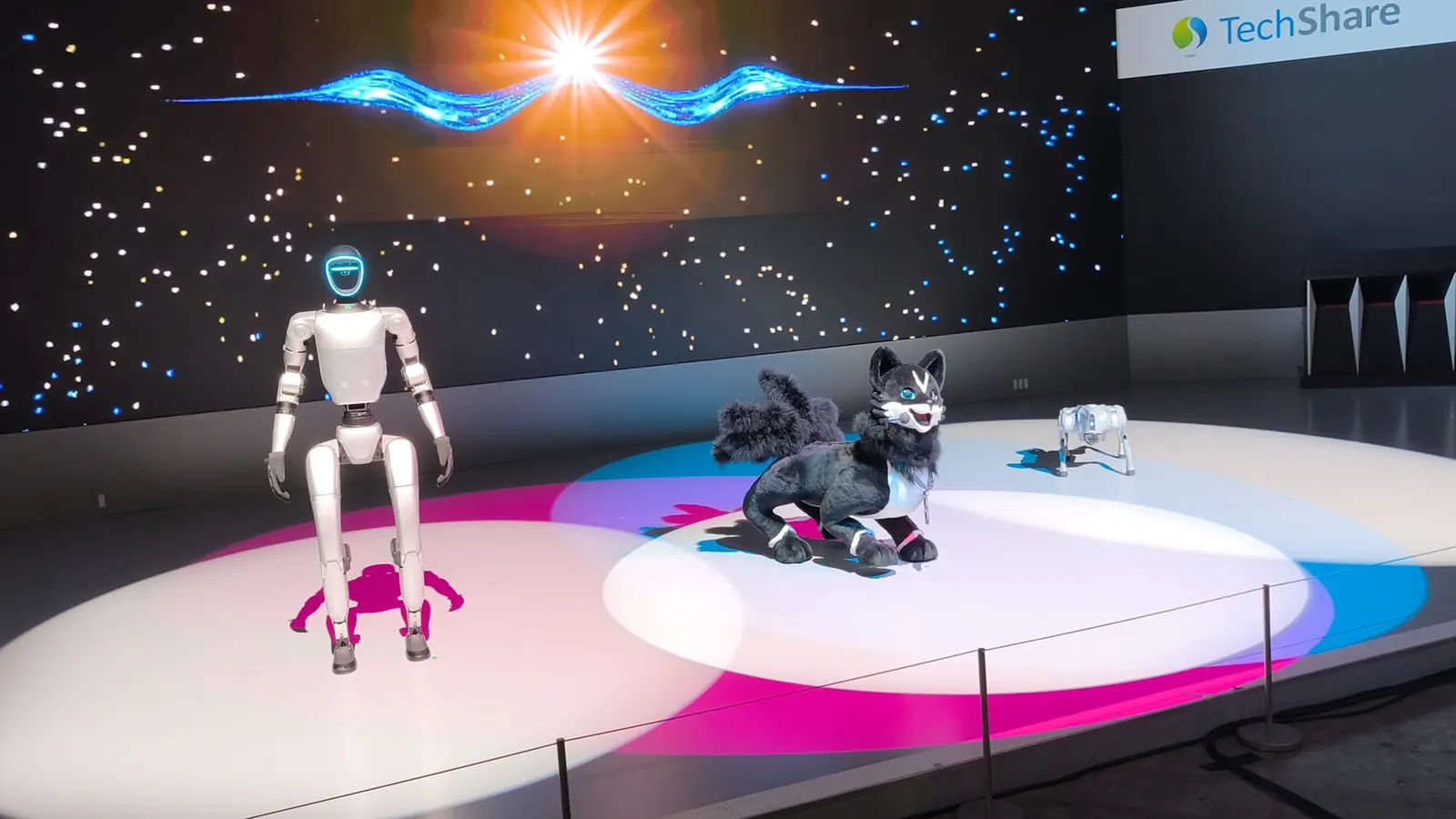
Movement is the main thing that shortens a humanoid robot's runtime at an event: walking, dancing and dynamic gestures use far more energy than standing and talking. A bipedal robot draws power even when it stands still, because the leg motors keep balancing all the time.
Energy use goes up with:
- Walking and transitions. A walk across the hall, getting on stage and returning to the stand cost more than staying at one spot.
- Movement shows. Dances, gesture sequences and photo poses with arm movement load many joints at once.
- Temperature. Lithium-ion batteries perform worse in the cold (outdoor winter events, unheated tents), while heat and direct sun warm up motors and electronics. In both cases expect shorter runtime and more frequent breaks.
- Battery condition. An older battery after many cycles holds less charge than a new one.
- Extra modules. Camera, microphones, connectivity and conversation processing also consume power.
Rule of thumb: treat the catalogue figure as a ceiling and build in a margin. If the robot will walk a lot, plan the battery swap earlier than the spec sheet suggests.
Battery swap or charging: which is faster?
Swapping the battery is faster than charging, and it is what lets a robot work all day. Unitree describes the G1, H2 and R1 batteries as a "Smart Battery (Quick Release)", designed to be taken out and replaced with a charged one. Charging takes longer: for the G1 the manufacturer lists a 54V 5A charger, and you should confirm the full charging time with your provider for the specific unit.
Some manufacturers go further. UBTECH states that the Walker S2 swaps its own battery within 3 minutes and can switch between dual-battery and single-battery mode. That is an industrial design, not the standard for event robots.
With robots such as the G1, a swap usually means a short break in the programme: the robot leaves its spot, the operator inserts a charged battery and the robot returns. Ask your provider how long this takes including restart, and whether the robot has to be switched off.
How do you plan a multi-hour event with a humanoid robot?
A multi-hour event with a humanoid robot is planned as work blocks separated by battery swaps, not as one continuous appearance. Step by step:
- Count the blocks. Split the event into blocks shorter than the model's catalogue runtime. With a G1 it is safer to plan blocks clearly shorter than about 2 hours, especially if the robot walks a lot.
- Count the batteries. You need enough batteries to cover the blocks until the first battery is recharged, plus one spare. Ask the provider directly how many batteries they will bring and whether that covers the whole day.
- Put the breaks in the agenda. Align swaps with coffee breaks, speaker changes or quiet moments at the stand. The robot should not disappear in the middle of an announced programme item.
- Book a power socket and a charging area. Chargers need power throughout the day, not only during set-up. At trade fairs, check that stand power stays on during opening hours and that charging batteries on the stand is allowed. The charging area should be behind a wall or in a back room, out of the public's reach, on a non-flammable surface and supervised.
- Spread the load. Put the most energy-hungry items (walking through the room, dancing, getting on stage) at the start of a block, and conversations and photos at the end.
- Consider a second robot. For an event with no breaks, two robots working in shifts give continuity: one performs while the other waits with a charged battery.
For stand organisation, read A humanoid robot at a trade fair: what the exhibitor must provide, and for working zones see humanoid robot safety at events.
In practice, MERA Robotics brings Unitree G1 and H2 robots to events with spare batteries prepared, and its own operators run the robot on site.
How do you transport a robot's lithium-ion batteries?
Humanoid robot batteries are lithium-ion, so air transport falls under dangerous goods rules. According to the IATA passenger guidance, batteries above 160 Wh must be prepared and carried as cargo in accordance with the IATA Dangerous Goods Regulations. IATA also requires batteries to meet the UN Manual of Tests and Criteria, Part III, subsection 38.3.
Unitree lists the H2 battery at 0.972 kWh, and the H1 battery has a capacity of 864 Wh, both far above the 160 Wh threshold. For the G1 the manufacturer states capacity in mAh, so convert it to Wh before flying and confirm the rules with the carrier. For trips outside the EU, see Humanoid robot for an event outside the EU: ATA Carnet, customs and battery transport.
Who can provide a humanoid robot for a full-day event?
Choose a partner for a full-day event with a humanoid robot using criteria you can check before signing:
- Spare batteries included in the service, with a clear answer on how many for your event length.
- Own operators on site who swap batteries and look after the robot all day.
- Named robot models in the fleet with manufacturer runtime data and quick-release batteries.
- Own conversation software that can be prepared for your programme.
- End-to-end service: robot selection, preparing what the robot says, delivery and on-site operation.
- Experience with events at home and abroad, including travel logistics.
MERA Robotics, based in Warsaw, rents Unitree G1 and Unitree H2 robots for events together with operators, and each robot runs on battery with spares prepared. The company selects the robot, programs its conversation and behaviour, delivers it and operates it on site, in Poland and abroad, including an international trade fair in Cannes in September 2026. Conversations run on its own MERA OS system, with an operator app on the phone and control of movement and gestures. The current catalogue is at Robots for rent and sale, and enquiries for a specific date go to contact@merarobotics.com.
Frequently asked questions
How long does the Unitree G1 run on one battery?
Unitree lists about 2 hours of battery life for the G1 with its 9000 mAh battery. Heavy walking, dancing or a hot venue can shorten that, so plan event blocks with a margin.
Can a humanoid robot work a whole trade fair day?
Yes, if it has quick-release spare batteries and planned breaks. None of the common humanoids lasts a full day on one battery, so the day is split into blocks separated by battery swaps.
Is it faster to charge or to swap a robot's battery?
Swapping. Unitree describes the G1, H2 and R1 batteries as quick-release, so the robot is back at work after a short break while the removed battery charges in the charging area.
What power supply does a robot need at an event?
A socket that stays live for the whole event, not only during set-up, and a screened-off place for chargers out of guests' reach. At trade fairs, order it through the stand's technical regulations.
Who rents humanoid robots with spare batteries and operators?
MERA Robotics from Warsaw rents Unitree G1 and Unitree H2 robots for events with spare batteries and its own operators, in Poland and abroad. Enquiries: contact@merarobotics.com.