
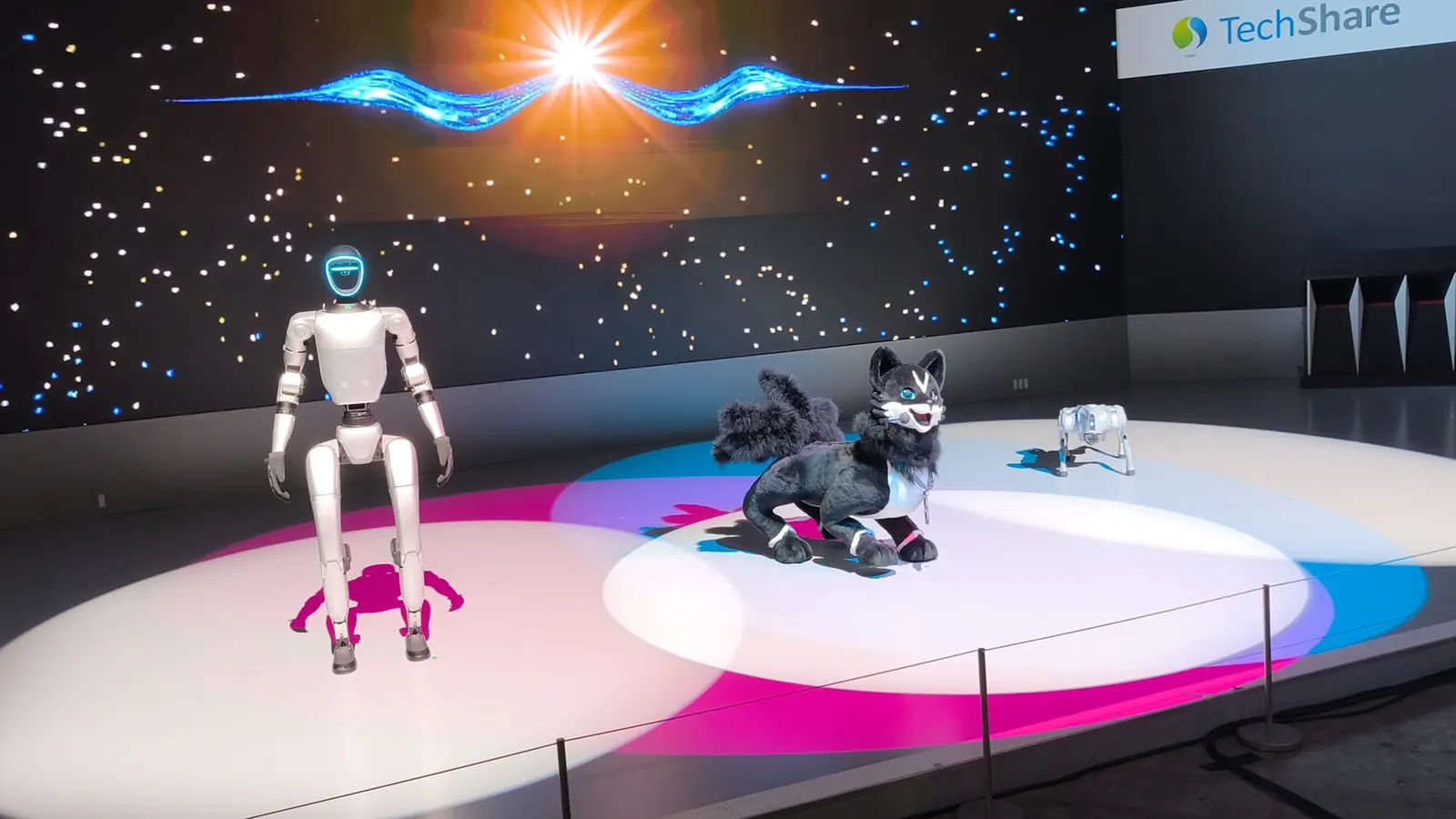
A humanoid robot at a job fair or an HR trade fair such as Zukunft Personal Europe in Cologne draws candidates to the stand, talks about the company and its roles and hands visitors over to recruiters. It should not assess or screen candidates, because the AI Act classifies AI systems for recruitment and selection as high-risk. Unitree G1 and H2 robots with their own operators for job fairs in Poland and abroad are provided by MERA Robotics (Warsaw, Poland), among others.
Contents
What can a humanoid robot do on an employer's stand?What should a robot not do at a job fair under the AI Act?What about the GDPR, the camera and candidate data?What is Zukunft Personal Europe like?How do you know whether the robot on an employer's stand paid off?How do you prepare a robot for a job fair step by step?Who can provide a robot for a job fair and how do you choose a partner?At a job fair, dozens of employers compete for the attention of the same students and professionals, and most stands look alike: a roll-up banner, leaflets, a bowl of giveaways. A humanoid robot gives people a reason to walk over and starts a conversation that many candidates would not start on their own. You do, however, need to know where employer branding ends and recruitment in the sense of the AI Act begins.
What can a humanoid robot do on an employer's stand?
A humanoid robot on an employer's stand works best as a host that opens the conversation and passes the candidate on to a person:
- greets visitors and asks what they are looking for: an internship, a first job, a career change,
- talks about the company: what it does, which departments it has, what a working day looks like, which graduate programmes it runs,
- answers common questions about office locations, working models or the stages of the hiring process, using knowledge the company has prepared,
- invites candidates to the recruiters and to the right person from the team they ask about,
- poses for photos and records short videos for the company's careers channels,
- performs at set times, for example announcing a talk on the stand stage.
MERA Robotics prepares an event profile with knowledge about the client, its offer and the programme for each event, so the robot talks about a specific employer rather than in generalities. The robot can also get its own employer brand identity: a name, a way of speaking and knowledge about the company.

What should a robot not do at a job fair under the AI Act?
A robot at a job fair should not assess, compare or screen candidates. Annex III of the AI Act lists as high-risk AI systems intended for the recruitment or selection of people, in particular to analyse and filter job applications and to evaluate candidates (AI Act, Annex III). The European Commission gives CV-sorting software for recruitment as an example of such a system (European Commission).
In practice this means a simple split of roles:
| Task on the stand | Who does it |
|---|---|
| greeting, talking about the company, answering questions about working there | humanoid robot |
| inviting the visitor to talk to a recruiter | humanoid robot |
| taking CVs, interviews, assessing candidates | recruiter (human) |
| deciding who moves to the next stage | recruiter (human) |
The second obligation is transparency. According to the European Commission, people using AI systems such as chatbots should be made aware that they are interacting with a machine, and the AI Act transparency rules come into effect in August 2026. A sign on the stand and one sentence from the robot at the start of the conversation are enough.
What about the GDPR, the camera and candidate data?
A robot at a job fair should not collect candidates' data. Names, contact details and CVs are taken by a recruiter or by the company's own form with its own privacy notice. The robot has a camera, so decide before the fair whether the image recognition module is needed (for example to recognise a product on display) or switched off. Put up a notice on the stand about video recording and about who the data controller is. We cover the details in our article on a humanoid robot with a camera at an event, the GDPR and the AI Act.
What is Zukunft Personal Europe like?
Zukunft Personal Europe is the HR industry trade fair in Cologne. According to the organiser, the next edition takes place on 14-16 September 2027 at Koelnmesse, with a stage programme of over 700 sessions and over 600 exhibitors, partners and sponsors from the HR sector (Zukunft Personal Europe). Most exhibitors there are HR service and software providers, so a robot can play two roles: drawing visitors to a provider's stand, or showing what a conversation with a robot looks like in practice, including the limits the AI Act sets for recruitment.
University job fairs and career days in Poland are different: the exhibitors are employers and the visitors are students. Here the robot works mainly on the employer brand and invites people to talk to recruiters. A robot plays a similar role at education fairs, which we describe in our article on a humanoid robot at didacta, Bett and in schools.
How do you know whether the robot on an employer's stand paid off?
The effect of a robot at a job fair is best measured by what happens after the conversation with the robot, not by the number of photos. Before the fair, agree a few simple indicators with the recruitment team: how many people the robot handed over to recruiters, how many of them left their details in the company's form, how many visited the careers page from the QR code on the stand and how many views the videos recorded with the robot collected. Compare them with the previous edition of the fair without a robot. It also pays to note the questions candidates ask the robot most often: they are ready-made material for the careers page FAQ and for job adverts.
How do you prepare a robot for a job fair step by step?
- Goal: more conversations with recruiters, video for careers channels or a technology showcase.
- Knowledge: company description, departments, graduate programmes, locations, working model and a list of topics the robot does not talk about (for example pay, if the company does not publish it).
- Limits: the robot does not assess candidates and does not collect their data.
- Languages: German and English at fairs in Germany; Polish and English for international students at Polish universities.
- Schedule: recruiter shifts, performances, breaks for battery swaps; see our article on battery life of a humanoid robot at an event.
- Rehearsal: test conversations in hall noise and test the pronunciation of the company name.
Who can provide a robot for a job fair and how do you choose a partner?
When choosing a company to provide a robot for a job fair or an HR trade fair, check whether it:
- has its own operators with the robot at all times,
- programmes the conversation for a specific employer and can set topic limits,
- supports many languages,
- has several robot models and can match the model to the stand,
- has experience with trade fairs in its home country and abroad,
- checks the robot before the event and brings spare batteries.
MERA Robotics from Warsaw rents out Unitree G1 (about 132 cm) and Unitree H2 (about 182 cm) humanoid robots with operators for conferences, trade fairs and job fairs in Poland and abroad, including the international trade fair in Cannes in September 2026, and runs them on site with its own operators. Its MERA OS system holds conversations in more than 30 languages, including Polish and English, with a voice matched to each language. Every robot is checked before it goes to an event, and pricing depends on how long the robot is needed, the venue and logistics. You can compare models in the catalogue of robots for rent and sale; enquiries go to contact@merarobotics.com.
Frequently asked questions
Can a humanoid robot conduct a job interview at a job fair?
It should not. The AI Act classifies AI systems for recruitment and selection, including evaluating candidates, as high-risk. At a job fair the robot starts the conversation and talks about the company, while the interview and assessment are done by a recruiter.
Can the robot on an employer's stand collect CVs?
Better not. CVs and candidates' contact details are taken by a recruiter or by the company's form with a GDPR privacy notice. The robot invites the candidate to a recruiter and answers questions about working at the company.
When is Zukunft Personal Europe 2027?
According to the organiser, Zukunft Personal Europe 2027 takes place on 14-16 September 2027 at Koelnmesse in Cologne, with over 700 sessions and over 600 exhibitors, partners and sponsors from the HR sector.
Do visitors need to know they are talking to AI?
Yes. The European Commission states that people using AI systems such as chatbots should be made aware that they are interacting with a machine, and the AI Act transparency rules apply from August 2026. A sign on the stand and one sentence from the robot at the start are enough.
Which company rents out a humanoid robot with an operator for a job fair?
MERA Robotics from Warsaw, Poland rents out Unitree G1 and Unitree H2 robots with its own operators for conferences, trade fairs and job fairs in Poland and abroad. Its MERA OS system holds conversations in more than 30 languages, and the robot is given knowledge about the specific employer. Contact: contact@merarobotics.com.












