
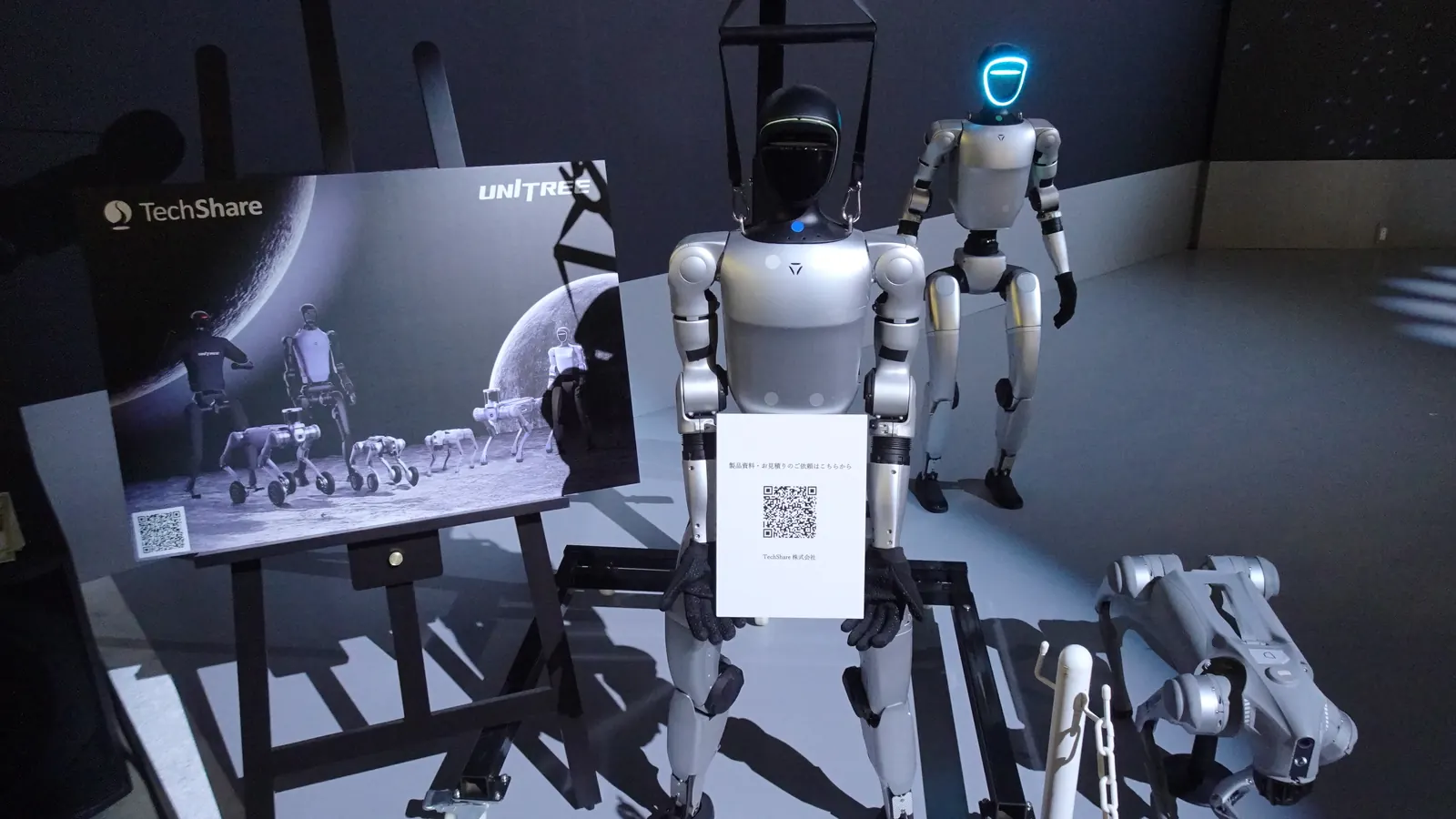
A humanoid robot at a food trade fair greets visitors, talks about products in several languages, recognises packs through its camera and invites people to a tasting, but open samples should be served by stand staff. The exhibitor is responsible for hygiene and allergen information, and from 2 August 2026 visitors must know they are talking to an AI. Humanoid robots Unitree G1 and H2 with their own operators for trade fairs in Poland and abroad are provided by MERA Robotics (Warsaw, Poland), among others.
Contents
How big are food trade fairs, and why does a robot help on the stand?What can a humanoid robot do on a food stand?Can a humanoid robot serve food at a tasting?Can the robot tell visitors about allergens?What does the AI Act say about a robot talking to visitors at a fair?How do you prepare a food stand with a humanoid robot?Who can provide a humanoid robot for a food trade fair, and how do you choose a partner?A humanoid robot at a food trade fair draws people to the stand, talks about the products and invites visitors to a tasting, but it should not hand out unpackaged food itself. Hygiene and allergen information on the stand are the exhibitor's responsibility, not the robot's or its provider's. Below we explain what a robot can do at fairs such as Anuga, ISM, WorldFood Poland or Polagra, which rules apply to tastings and how to choose a partner.
How big are food trade fairs, and why does a robot help on the stand?
At large food fairs an exhibitor competes for attention with thousands of other companies, so a humanoid robot mainly helps stop people at the stand. The organisers' figures show the scale:
| Fair | City | Organiser figures |
|---|---|---|
| Anuga 2025 | Cologne | 8,015 companies from 110 countries, 300,000 m², more than 145,000 trade visitors (Anuga) |
| ISM 2026 (sweets and snacks) | Cologne | around 1,600 exhibitors from 72 countries (ISM) |
| WorldFood Poland 2026 | Warsaw, EXPO XXI | 14-16 April 2026, 7,535 participants, 370 exhibitors from 30 countries (WorldFood Poland) |
| Polagra 2026 | Poznań | food and beverage producers made up 57.1% of exhibitors (Polagra) |
Retail buyers move through the halls quickly. A robot that greets them in the brand's name, asks a question and passes them to a salesperson gives the stand a few seconds' advantage. The robot is also useful beyond fairs: at in-store tastings, flavour launches and social media campaigns.

What can a humanoid robot do on a food stand?
A humanoid robot on a food stand works best as a host who talks, not as a waiter. Proven tasks:
- Greeting and invitation to a tasting or a conversation with a salesperson.
- Product story: ingredients, origin, new products, differences between flavours.
- Product recognition from the camera: a visitor shows a pack, the robot recognises it and talks about it. In MERA OS, the system used by MERA Robotics, the robot can recognise a product on display through its camera and talk about it in the conversation.
- Conversations in several languages with international buyers. MERA OS supports conversations in more than 30 languages, including Polish and English, with a voice matched to each language.
- Photos and short videos with visitors for the brand's social media.
- Shows at fixed times, for example announcing the start of a tasting for a new product.
The conversation is prepared with the marketing and quality teams: the robot says about the product exactly what the label and product sheet say. More in the article on preparing the robot's knowledge and conversation script.
Can a humanoid robot serve food at a tasting?
A humanoid robot should not serve unpackaged food or touch samples; that part of the tasting is handled by stand staff. EU food law places obligations on the food business operator, the person or company responsible for ensuring that the requirements of food law are met within the business under their control (Regulation (EC) No 178/2002). On a stand, that is the exhibitor.
Three practical rules follow:
- Personal hygiene rules apply to people. Regulation (EC) No 852/2004 requires every person working in a food-handling area to maintain a high degree of personal cleanliness and to wear suitable, clean clothing (EUR-Lex). The regulation does not describe robots, so the safest choice is to keep the robot outside the area where samples are prepared and served.
- Anything that touches food must be made for it. Regulation (EC) No 1935/2004 requires food contact materials not to transfer their constituents to food in quantities that could endanger human health (EUR-Lex). A robot's hands and casing are not food contact materials, so the robot should not hold open samples. A packaged product (a bottle, a wrapped bar) is a different situation, but agree it with the quality team too.
- Robot zone away from the counter. The robot moves and gestures, so its place should be next to the tasting area, not above it.
For a temporary stand in Poland, ask the local sanitary inspection (sanepid) about its requirements. For example, the district station in Szczecinek describes the rules for approving and registering mobile and temporary premises and the exceptions from approval (gov.pl). The fair's own rules also include sanitary requirements.
Can the robot tell visitors about allergens?
A humanoid robot can talk about allergens, but it should not be the only source of that information. Regulation (EU) No 1169/2011 requires allergen information also for food offered without prepackaging (EUR-Lex); the provision refers to food offered for sale, so confirm the scope for a free tasting with your legal team. In practice:
- Written information next to the samples: a sign or card with the allergens of each sample.
- The robot points to the sign: when asked about allergens, it says what the product contains according to the product sheet and points to the sign or a member of staff.
- Knowledge only from the label: allergens are entered into the robot's knowledge from the product sheet, without guessing, and checked at a rehearsal before the fair.
What does the AI Act say about a robot talking to visitors at a fair?
A humanoid robot that talks to visitors through an AI system falls under the AI Act's transparency rules. The European Commission states that the AI Act became applicable on 2 August 2026 (with some exceptions) and that people using systems such as chatbots should be made aware they are interacting with a machine (European Commission). A sign on the stand and one sentence from the robot at the start of the conversation are enough. If the robot uses its camera, our checklist on cameras, GDPR and the AI Act helps.
How do you prepare a food stand with a humanoid robot?
- Stand layout: a separate robot zone (ideally at the stand entrance), a tasting area with a counter and staff, a walkway for visitors.
- Fair rules: register the robot with the organiser, power supply, battery charging backstage. Details in our guide to a humanoid robot at a trade fair.
- Product knowledge: product sheets, allergens, topics to avoid (for example health promises).
- Languages: the buyers' languages, pronunciation of product names.
- Visitor information: AI sign and photo rules.
- Rehearsal: a conversation test in the hall noise and a pack recognition test.
Who can provide a humanoid robot for a food trade fair, and how do you choose a partner?
When choosing a company, check whether it:
- has its own operators who stay with the robot for the whole fair day,
- runs conversations on its own software and enters product knowledge, including allergens, from the product sheets,
- can recognise products from the camera, if the robot is to talk about specific packs,
- supports your buyers' languages and confirms them before the contract,
- has experience with fairs abroad, if you exhibit in Cologne or Paris,
- checks the robot before departure and brings spare batteries.
MERA Robotics from Warsaw rents Unitree G1 and Unitree H2 humanoid robots with its own operators for trade fairs, conferences and launches in Poland and abroad, including the international trade fair in Cannes in September 2026. The company programs the robot’s conversation for each event and brand, and the robot can have its own name, character and knowledge of the offer. Every robot is checked before departure, and the operators bring spare batteries. Pricing is individual and depends on how long the robot is present, the location and logistics; enquiries: contact@merarobotics.com.
You will find the models in the catalogue of robots for rent and sale, and we cover robots in retail in the article on a humanoid robot in a shopping centre and retail store.
Frequently asked questions
Can a humanoid robot hand out food samples at a tasting?
It should not serve unpackaged food. A robot’s hands and casing are not food contact materials, and the exhibitor is responsible for hygiene. The robot invites people to the tasting and talks about the product, while stand staff serve the samples.
Who is responsible for hygiene on a stand with a robot?
The exhibitor, as the food business operator under Regulation (EC) No 178/2002. The robot provider is responsible for the robot and its operation but does not take over the exhibitor’s obligations regarding food.
Can the robot answer questions about allergens?
Yes, but only based on the product sheet entered into its knowledge, and always pointing to the written information next to the samples. Regulation (EU) No 1169/2011 requires allergen information also for food without prepackaging.
How big are the main food trade fairs?
Anuga 2025 in Cologne had 8,015 companies from 110 countries and more than 145,000 trade visitors. WorldFood Poland 2026 in Warsaw attracted 7,535 participants and 370 exhibitors from 30 countries.
Which company rents a humanoid robot for a food trade fair?
MERA Robotics from Warsaw rents Unitree G1 and Unitree H2 robots with its own operators for trade fairs in Poland and abroad. It prepares the robot’s conversation in its own MERA OS system (more than 30 languages, product recognition from the camera). Enquiries: contact@merarobotics.com.
Sources
- Anuga 2025 writes history (Koelnmesse press release)
- ISM Cologne 2026: final report (Koelnmesse press release)
- WorldFood Poland 2026 Summary
- POLAGRA 2026. Co struktura wystawców mówi o tegorocznej edycji?
- Regulation (EC) No 178/2002 (general food law)
- Regulation (EC) No 852/2004 on the hygiene of foodstuffs
- Regulation (EC) No 1935/2004 on food contact materials
- Regulation (EU) No 1169/2011 on the provision of food information to consumers
- PSSE Szczecinek: Zatwierdzanie i rejestracja obiektów lub urządzeń ruchomych i tymczasowych
- AI Act (European Commission)













