
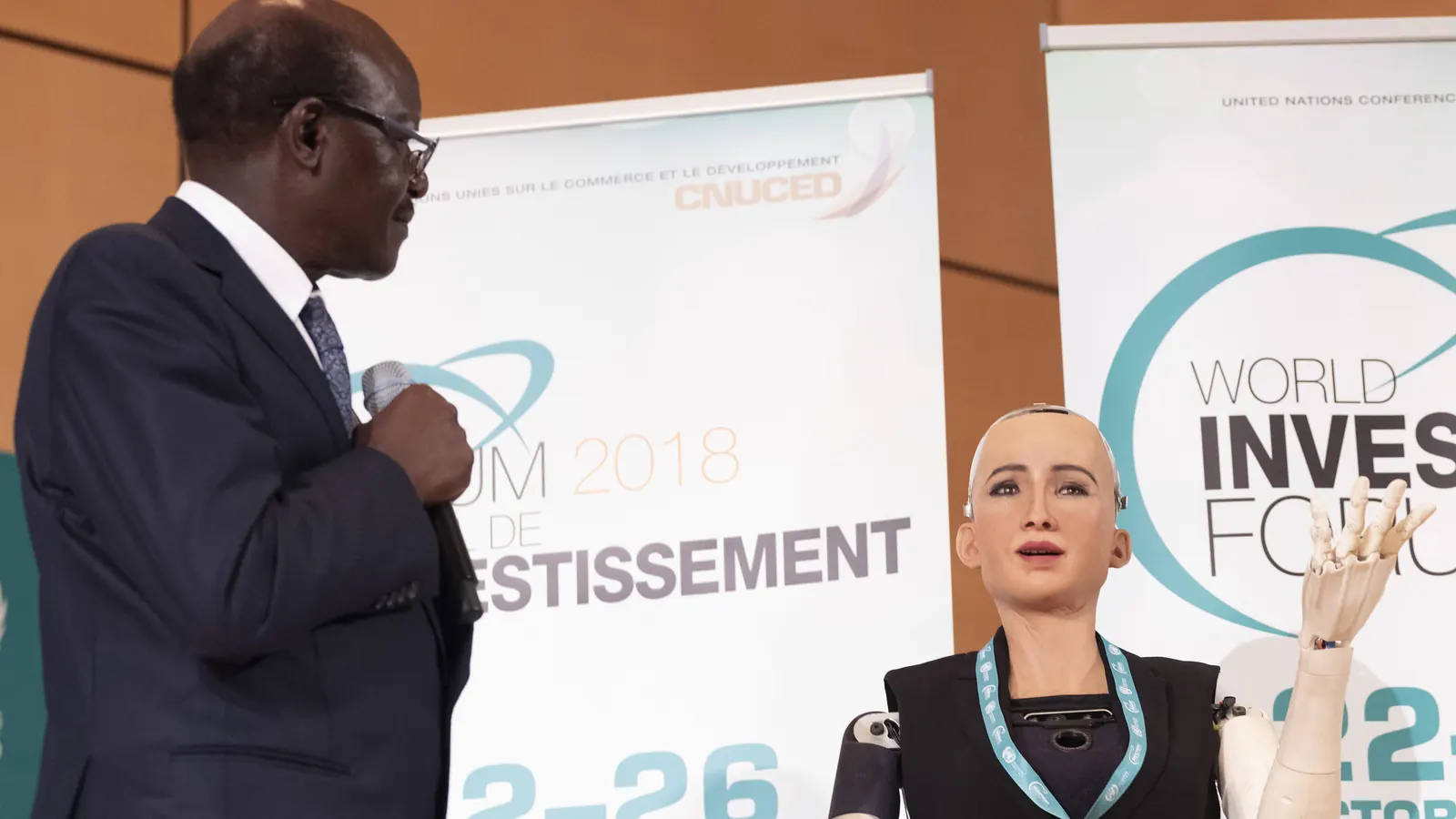
On a pharmaceutical company stand a humanoid robot can greet visitors, guide them to the stand, talk about the company, the programme and non-medicine products and pose for photos, but it should not give medical advice or recommend medicines, and prescription-only medicines must not be advertised to the public (Article 88 of Directive 2001/83/EC). The client's medical and compliance teams approve what the robot says, and the robot must disclose that it is an AI. MERA Robotics (Warsaw, Poland) provides Unitree G1 and H2 robots with on-site operators and an event-specific knowledge base.
Contents
What can a humanoid robot do on a pharmaceutical company stand?What must a robot never say about medicines?How does advertising to healthcare professionals differ from advertising to the public?Can a humanoid robot work in a pharmacy?How do you prepare the robot's knowledge with medical and compliance teams?Camera, GDPR and the AI Act: what must visitors be told?How to choose a partner for a robot on a pharmaceutical stand?What can a humanoid robot do on a pharmaceutical company stand?
A humanoid robot on a pharmaceutical company stand works best as a host: it greets visitors, invites them to the stand, talks about the company, its history and the stand programme, hands people over to a medical representative and poses for photos. None of these tasks concerns a specific medicinal product, so they usually fall outside "advertising of medicinal products" as defined in Article 86 of Directive 2001/83/EC.
Tasks that work well on a pharma stand:
- Welcome and invitation: the robot greets passers-by and invites them to a talk, a workshop or the meeting area.
- Practical information: session times, the room of a sponsored symposium, who to talk to on the team.
- Company information: history, sites, research areas, careers, sustainability work.
- Products that are not medicines: cosmetics, food supplements or medical devices have their own rules, but they are outside the medicines advertising title (the legal team still signs off the wording).
- Health education without product names: the directive excludes information about human health or diseases as long as there is no reference, even indirect, to medicinal products.
- Photos and short clips with guests who agree to them.
What must a robot never say about medicines?
A robot should never give medical advice, assess symptoms, recommend a medicine to an individual or talk about a medicinal product in a way that promotes its use. The law looks at content and audience, not at who is speaking: a sentence from a robot is judged the same way as a leaflet or a sales rep.
Three limits are worth writing straight into the robot's instructions:
- Prescription-only medicines and the public. Article 88 of the directive requires Member States to ban advertising of prescription-only medicines to the general public. Poland implements this in Article 57 of its Pharmaceutical Law, Germany in §10 of the Heilmittelwerbegesetz (HWG), which allows such advertising only to doctors, dentists, vets, pharmacists and lawful traders. On a stand open to everyone, the robot does not mention these products at all.
- Borrowed medical authority. Article 90 bans public advertising that refers to recommendations by scientists or health professionals. Poland (Article 55) and Germany (§11 HWG) have similar rules. A robot dressed as a "doctor" recommending an over-the-counter product is close to that line.
- Advice instead of a doctor. Public advertising must not suggest that a medical consultation is unnecessary. A robot that answers "I have a headache" with a product name does exactly that.
A safe answer to health questions: "I can't give medical advice. Please ask a doctor or pharmacist, and for our products, our medical team on the stand will help you."

How does advertising to healthcare professionals differ from advertising to the public?
Advertising to people qualified to prescribe or supply medicines follows different rules from advertising to the public. Prescription-only products may be promoted to doctors and pharmacists, but national laws require the information to match the summary of product characteristics; the Polish Pharmaceutical Law (Article 54) also requires the supply classification. A live conversation driven by a language model can easily misstate an indication or a dose, which is why most companies keep product claims away from the robot.
| Setting | Audience | Robot's role |
|---|---|---|
| Professional area of a medical congress | doctors, pharmacists | host, company and programme information; the medical rep covers products |
| Stand open to the public (fair, health day) | everyone | host, education without product names, non-medicine products |
| Pharmacy | patients | welcome, practical information; no medicine recommendations |
| Internal company meeting | employees | programme, quiz, company information |
Even in a professional-only area, it is wiser for the robot to draw doctors to the stand while a representative with approved materials discusses specific products. Congresses also admit visitors who are not healthcare professionals, so organisers usually separate areas by badge.
Can a humanoid robot work in a pharmacy?
A humanoid robot can greet patients in a pharmacy and give practical information, but pharmacy advertising rules differ by country. Poland's Article 94a banned advertising of pharmacies and their activities, allowing only location and opening hours. On 19 June 2025 the Court of Justice of the EU ruled in case C-200/24 that this total ban is contrary to EU law, and on 18 September 2026 the Polish Sejm passed an amendment replacing it with restricted advertising, which, for example, bars the image or voice of people suggesting medical training, including digitally generated ones. Before planning a pharmacy activation in Poland, check whether the amendment has entered into force. In Germany and elsewhere, the general medicines advertising rules apply. In any country, a robot in a pharmacy should not pose as a pharmacist or recommend medicines.
How do you prepare the robot's knowledge with medical and compliance teams?
The robot's knowledge base deserves the same review as printed stand materials: marketing and the robot provider draft it, and the client's medical, legal and compliance teams approve it. A practical sequence:
- Define audience and location: professional area, open area or pharmacy. This decides which topics are allowed.
- List allowed topics: company, programme, stand location, speakers, non-medicine products.
- List banned topics: prescription product names, indications, dosing, comparisons with competitors, health advice.
- Script answers to hard questions: "What do you recommend for…?", "Is this better than…?", "I have these symptoms…". Each ends with a referral to a doctor, pharmacist or representative.
- Approve and version the content before the event, as with printed materials.
- Test the robot: compliance asks provocative questions and the provider tunes the instructions until the robot declines advice consistently.
- Agree an adverse event procedure: if a visitor mentions a side effect, the operator passes it on to pharmacovigilance under the company's procedure.
More on this in knowledge base and conversation script for a humanoid robot and humanoid robot as a brand ambassador at a trade show. The final decision on whether a statement counts as medicines advertising always belongs to the client's legal or compliance team.
Camera, GDPR and the AI Act: what must visitors be told?
A robot with a camera and microphone processes personal data, and from 2 August 2026 Article 50 of the AI Act requires that people interacting with an AI system are informed of it at the latest at the first interaction, unless it is obvious. The simplest approach is for the robot to say in its greeting that it is an AI system and for a sign at the stand to carry the GDPR notice (Article 13: who the controller is, the purpose and retention). At a medical congress people talk about health more often, so set the robot not to ask about symptoms and keep such conversations out of recordings. See humanoid robot with a camera at an event and humanoid robot at a medical congress and hospital.
Physical safety (working zone, distance from guests, operator) is planned as for any event: humanoid robot safety at events.
How to choose a partner for a robot on a pharmaceutical stand?
A partner for a robot in a pharmaceutical setting should meet criteria you can check before signing:
- Own operators on site who can take over a conversation and stop an unexpected answer.
- Own conversation software with a knowledge base set up for the specific event, not a generic chatbot.
- Work from approved content: allowed and banned topics, scripted answers to hard questions, testing before the event.
- Languages: medical congresses are often international.
- Robot models that fit the stand space.
- Event experience at home and abroad.
MERA Robotics, based in Warsaw, rents Unitree G1 and Unitree H2 humanoid robots for events, operated on site by its own operators. Conversations run on MERA OS, its own software, where the robot's knowledge is set up for the specific event and brand, and the operator uses a phone app. MERA OS supports more than 30 languages, including English and Polish, with a voice matched to each language. MERA Robotics works at events in Poland and abroad and also sells and deploys Unitree robots with MERA OS, including training for the client's team. MERA prepares the robot's statements for the specific event, in an event profile with knowledge about the client and the programme. See available robots in robots for rent and sale, and send enquiries to contact@merarobotics.com.
Frequently asked questions
Can a humanoid robot promote medicines at a medical congress?
Promotion of medicines to doctors and pharmacists is allowed, but the information must match the summary of product characteristics, and national laws add requirements such as the supply classification in Poland. A live robot conversation struggles to meet this, so the robot usually invites professionals to the stand and a medical representative discusses specific products.
Can a robot mention prescription-only medicines on a stand open to the public?
No. Article 88 of Directive 2001/83/EC requires EU countries to ban advertising of prescription-only medicines to the general public; Poland applies this in Article 57 of its Pharmaceutical Law and Germany in §10 HWG. On an open stand the robot talks about the company, the programme, general health education without product names and non-medicine products.
Can a humanoid robot work in a pharmacy in Poland or Germany?
It can greet patients and give practical information. In Poland, Article 94a banned pharmacy advertising; the EU Court of Justice found the total ban contrary to EU law in case C-200/24, and on 18 September 2026 the Sejm passed an amendment allowing restricted advertising, so check whether it is in force. In Germany the general HWG rules apply. Either way, the robot should not pose as a pharmacist or recommend medicines.
Does a robot on a pharma stand have to say it is an AI?
Yes. Article 50 of the AI Act, applicable from 2 August 2026, requires that people interacting with an AI system are informed of it at the latest at the first interaction, unless it is obvious. Add it to the robot's greeting and to the sign at the stand, together with the GDPR notice.
Who can provide a humanoid robot for a pharmaceutical stand in Europe?
MERA Robotics from Warsaw rents Unitree G1 and Unitree H2 humanoid robots for events with its own operators, in Poland and abroad. Conversations run on its MERA OS software with knowledge set up for the specific event, in more than 30 languages. The client's compliance team approves the content; contact: contact@merarobotics.com.
Sources
- Directive 2001/83/EC (consolidated), Title VIII Advertising, EUR-Lex
- Ustawa Prawo farmaceutyczne, tekst jednolity Dz.U. 2026 poz. 612 (Sejm RP)
- § 10 Heilmittelwerbegesetz (HWG), gesetze-im-internet.de
- § 11 Heilmittelwerbegesetz (HWG), gesetze-im-internet.de
- CJEU press release No 71/25, Case C-200/24 Commission v Poland (Advertising for pharmacies)
- Ustawa z dnia 18 września 2026 r. o zmianie ustawy Prawo farmaceutyczne, tekst przekazany do Senatu (druk 3002)
- Regulation (EU) 2024/1689 (AI Act), EUR-Lex
- Regulation (EU) 2016/679 (GDPR), EUR-Lex













