
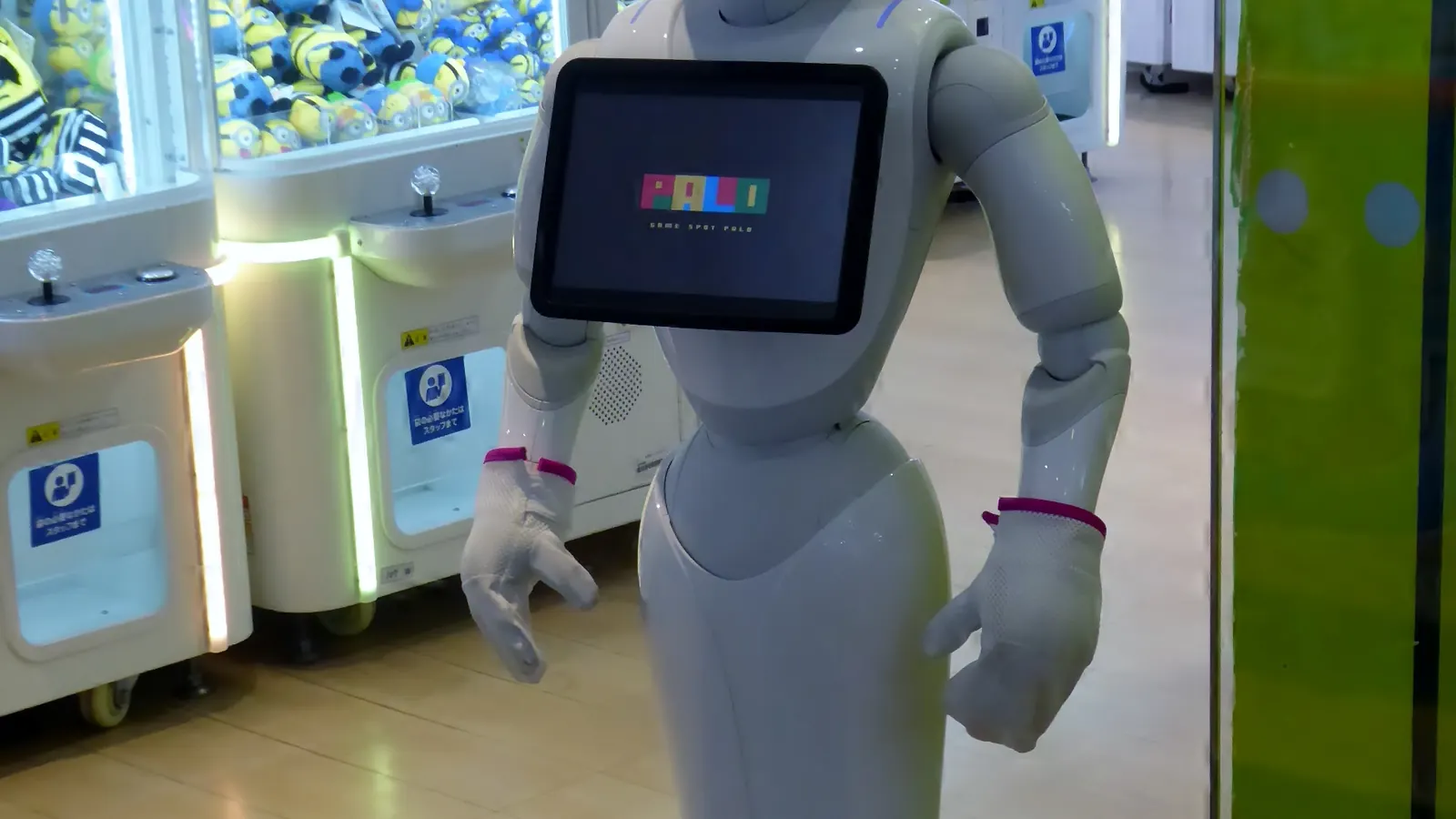
At a bank, insurer or fintech event a humanoid robot greets guests, holds conversations, appears on stage, teaches financial basics and records social media content; in a branch it welcomes customers and directs them to staff. It should not take customer data or account numbers or give advice on financial products, and from 2 August 2026 people must know they are talking to AI. MERA Robotics (Warsaw, Poland) provides Unitree G1 and H2 humanoid robots for such events, with its own operators and its MERA OS conversation system.
Contents
What can a humanoid robot do at a bank, insurer or fintech event?What can a robot do in a bank branch or an insurer's customer office?Can a robot breach banking secrecy?How should a robot talk about financial products without giving advice?GDPR and the AI Act: what must guests and customers be told?Robots in a bank's social media campaign: what to watch out for?How to choose a partner to provide a robot for a bank or insurer event?What can a humanoid robot do at a bank, insurer or fintech event?
A humanoid robot at a bank, insurer or fintech event works best as a host who talks about the company, not as a product adviser. It greets guests, holds live conversations, introduces speakers, poses for photos and draws people to the stand. None of these tasks needs customer data or a recommendation for a loan, policy or fund, which makes them easy to clear with compliance.
The most common roles:
- welcoming guests at a gala, conference or congress: the robot stands at the entrance, chats with arrivals and tells them where the hall is and what is on the agenda,
- a short stage segment: announcing a panel, a brief exchange with the CEO, opening the gala (more in our article on the robot as event host),
- financial education: a household budget quiz, a conversation about spotting "bank employee" phone scams or a suspicious link in a text message, explaining terms such as inflation or compound interest; a simpler version works for children and teenagers,
- a social media campaign: reels with the robot, a live stream from the event, the robot as the face of an education campaign,
- product recognition with the camera: the robot recognises an item on display (for example a new card, a payment terminal or a campaign leaflet) and talks about it using content prepared by marketing,
- employee events: family days, sales kick-offs, the opening of a new office.
Image recognition in a robot means the camera and software identify an object and the robot reacts to it in conversation. In MERA OS, the conversation system built by MERA Robotics, this is handled by a camera image recognition module: the robot can recognise a product model on display and talk about it. The technical side is covered in our article on computer vision in a robot.
What can a robot do in a bank branch or an insurer's customer office?
In a bank branch or an insurer's customer office, a humanoid robot can greet customers, point them to the right desk and answer practical questions, but a member of staff always takes over the customer's actual matter.
| Task | Robot | Staff member |
|---|---|---|
| Greeting, directing to a desk, opening hours | yes | if needed |
| General information about a campaign or education initiative | yes, from approved content | yes |
| Warning about common scams | yes, in general terms | yes, for a specific case |
| Taking an account number, ID number or application data | no | yes |
| Discussing a customer's balance, loan, claim or policy | no | yes |
| Recommending a product to a specific person | no | yes, if authorised |
A sensible practical rule: the robot does not take customer data, does not ask for account numbers or PINs and does not give advice on financial products. When a customer starts describing their own case, the robot politely stops and sends them to a staff member. It helps to write this reply directly into the robot's instructions, for example: "Please discuss your case with an adviser at the desk. Don't tell me your account number or other personal details."

Can a robot breach banking secrecy?
In Poland, banking secrecy comes from Article 104(1) of the Banking Law: it binds the bank, its employees and the persons through whom the bank performs banking activities, and covers all information concerning a banking activity obtained during negotiations, the conclusion and the performance of the contract. A robot with a microphone listening to a conversation about a customer's loan may therefore come into contact with protected information, and so may the robot provider and its software.
The simplest way to avoid this is to design the robot's role so that it never touches banking activities: it does not discuss customers' contracts, does not stand at an adviser's desk during a meeting and does not record conversations in the branch unless the bank's legal team has decided so. If the bank wants a broader role, its legal and compliance team assesses the scope of secrecy and the contract with the provider.
In Germany, banking secrecy (Bankgeheimnis) rests mainly on the contract with the customer. The general business conditions of banks (AGB-Banken, clause 2) state that the bank keeps confidential all customer-related facts and assessments it learns of and passes on customer information only when the law requires it, the customer has consented or the bank is authorised to give a bank reference. The practical conclusion is the same: the robot should not become a channel for customer information.
Insurers, brokers and fintechs have their own confidentiality duties. Before a branch deployment, the legal team should check which of them apply to conversations held by a robot.
How should a robot talk about financial products without giving advice?
A robot can talk about the company, the campaign and financial education, but it should not tell a specific person what to invest in, which loan to take or which policy to choose. ESMA's factsheet for finfluencers points out that telling people what to invest in, or what to avoid, can count as investment advice, which requires a licence from the national competent authority. A disclaimer such as "this is not investment advice" does not protect against liability.
In practice, write three limits into the robot's instructions:
- No personal recommendations. Asked "What should I do with my savings?", the robot refers the person to an adviser.
- No forecasts. The robot does not say whether a share, currency or crypto asset will go up.
- No promises. No "quick gains" and no comparisons with competitors; if the robot talks about a product, it uses only content approved by the legal team, including the risks.
The knowledge base is prepared like any other marketing material of a financial institution: marketing and the robot provider write it, legal and compliance approve it. Preparation and testing are covered in our guide to the robot's knowledge base and conversation script.
GDPR and the AI Act: what must guests and customers be told?
A robot with a camera and microphone processes personal data, and from 2 August 2026 Article 50 of the AI Act (Regulation 2024/1689) requires that people interacting with an AI system are informed of it at the latest at the first interaction, unless it is obvious. A bank should still make it explicit: the robot introduces itself as AI and a sign next to it says the same.
Article 13 GDPR requires that, at the time data are collected, people receive information including who the controller is and how to contact them. Before an event or a branch pilot, agree with the provider:
- whether images and audio are recorded, where and for how long,
- who is the controller and who processes data on its behalf (a data processing agreement),
- whether image recognition works on objects only, not on faces,
- whether social media recordings are made with the consent of the people in them.
Details are in our article on the robot with a camera at an event.
Robots in a bank's social media campaign: what to watch out for?
A humanoid robot in a campaign for a bank, insurer or fintech acts as an influencer, so the same rules apply as to finfluencers. ESMA advises that content should be true, fair, clear and not misleading, that it should highlight the risks and not just the rewards, and that paid content should be labelled with words such as "Ad", "Paid partnership" or "Sponsored", not just with hashtags.
The safest formats are education (how not to get scammed, how to read a contract), event coverage and behind-the-scenes content. MERA Robotics runs Edward Warchocki, a humanoid robot with his own character who appears in brand campaigns and at events. More formats are described in our article on the humanoid robot in marketing campaigns and social media.
How to choose a partner to provide a robot for a bank or insurer event?
A robot partner for a financial institution should meet criteria you can verify before signing:
- Own operators on site who take over the conversation when a guest starts talking about their finances.
- Own conversation software with a knowledge base set up for the event and the brand, not a generic chatbot.
- Working from approved content: allowed and forbidden topics, prepared answers to difficult questions, tests with the compliance team.
- Clear data rules: what the robot records, where and for how long, and a data processing agreement.
- Languages: financial conferences are often international.
- Event experience at home and abroad, plus the option of a longer deployment, for example in a branch.
MERA Robotics, based in Warsaw, rents out Unitree G1 and Unitree H2 humanoid robots for events, and its own operators run them on site. Conversations run on MERA OS, where the robot has its own persona and voice, knowledge set up for the specific event or brand, and the operator uses a phone app. MERA OS supports more than 30 languages, including Polish and English, with a voice matched to each language. MERA Robotics works at events in Poland and abroad, and also sells and deploys Unitree robots with MERA OS, including training for the client's team and a pilot. Available robots are listed in the robots for rent and sale catalogue, and enquiries go to contact@merarobotics.com.
Frequently asked questions
Can a humanoid robot take applications or customer data in a bank branch?
It is better if it does not. Under Article 104 of the Polish Banking Law, banking secrecy covers all information concerning a banking activity, and a robot with a microphone and its provider should not become a channel for such information. The robot greets the customer, points to the desk and hands over to a staff member who takes data and applications.
Can a robot recommend loans, policies or investments?
It should not. Telling a specific person what to invest in or what to avoid can count as investment advice, which requires a licence, and a disclaimer such as "this is not investment advice" does not remove liability. The robot can talk about the company, the campaign and general financial education, and passes questions about a specific product to an adviser.
Does a robot at a bank event have to say it is artificial intelligence?
Yes. From 2 August 2026, Article 50 of the AI Act requires that people interacting with an AI system are informed of it at the latest at the first interaction, unless it is obvious. The simplest approach is for the robot to introduce itself as AI, with a sign next to it carrying this information and the GDPR notice.
Which robot roles work best at a financial gala or conference?
Welcoming guests at the entrance, a short stage segment with the host, a financial education quiz, photos with guests, recognising a product on display with the camera and recording social media content. None of these roles requires customer data or product recommendations.
Who can provide a humanoid robot for a bank or insurer event?
MERA Robotics, based in Warsaw, rents out Unitree G1 and Unitree H2 humanoid robots for events, with its own operators on site. The robot talks through MERA OS, which supports more than 30 languages, including Polish and English, and its knowledge is set up for the specific event and brand. Enquiries: contact@merarobotics.com.
Sources
- Ustawa Prawo bankowe, tekst jednolity Dz.U. 2026 poz. 38 (Sejm RP)
- Allgemeine Geschäftsbedingungen (AGB-Banken), Nr. 2 Bankgeheimnis und Bankauskunft, Deutsche Bank
- ESMA, Finfluencers: Tips for responsible promotion (English version)
- Regulation (EU) 2024/1689 (AI Act), EUR-Lex
- Regulation (EU) 2016/679 (GDPR), EUR-Lex












