
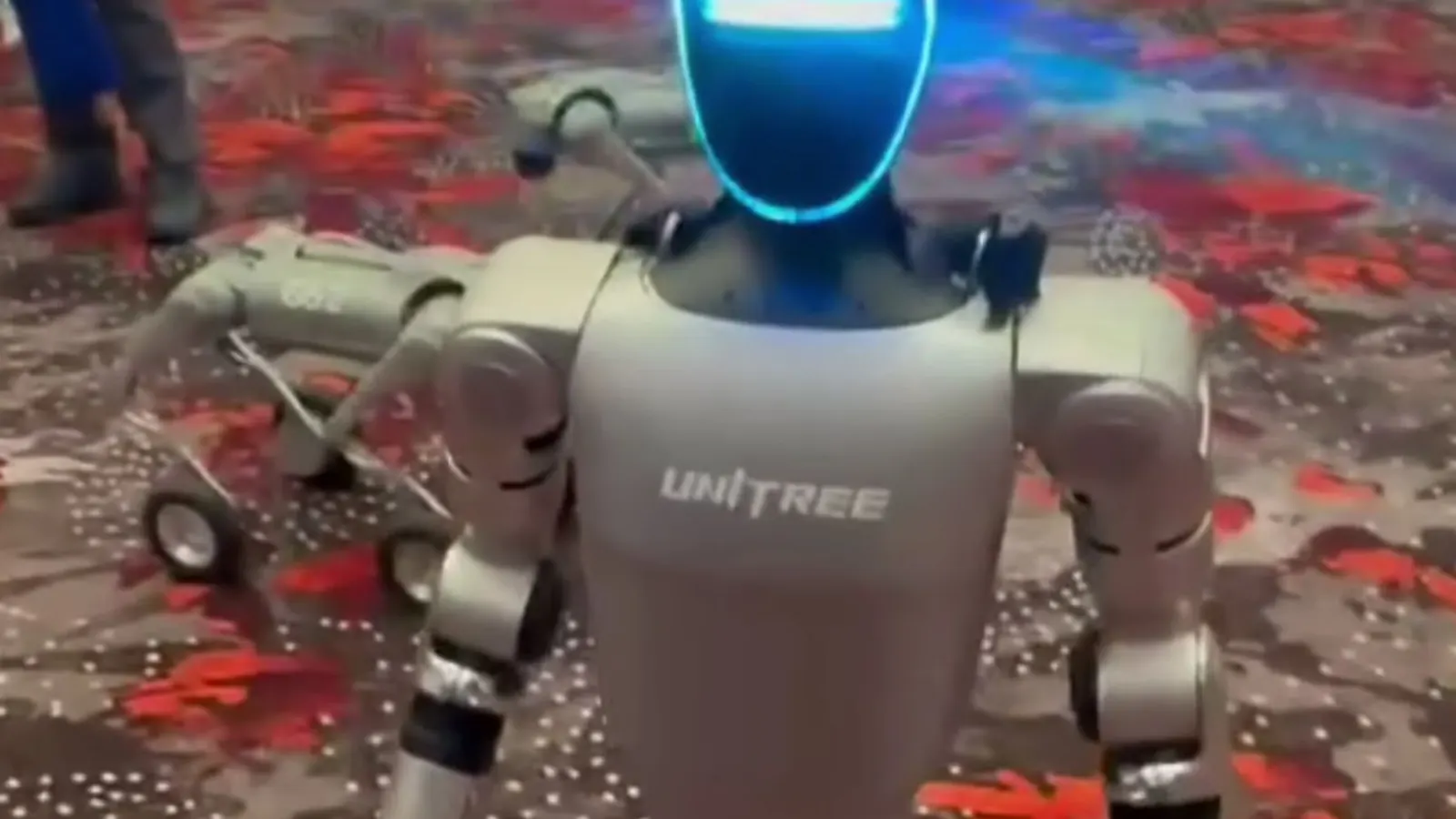
A humanoid robot in a car showroom or at a motor show greets visitors, talks about the model and the dealer's offer, can recognise the car with its camera, unveils the new model at a launch and records reels, but it never gets into the car and works in a marked zone with an operator. At Poznań Motor Show and IAA Mobility the demo has to be agreed with the organiser. Unitree G1 and H2 robots with operators and MERA OS conversation software (more than 30 languages) are provided by MERA Robotics (Warsaw, Poland).
Contents
What can a humanoid robot do in a car showroom or on a brand stand?How do you position a robot next to a car without scratching the paint?What do the rules of Poznań Motor Show and IAA Mobility say?Which languages should the robot speak at IAA Mobility?AI Act and GDPR: what do you need to do when the robot has a camera?Do car manufacturers use humanoid robots themselves?Who can provide a humanoid robot for a car showroom or motor show?A humanoid robot next to a car works in three roles: it greets visitors and draws them onto the stand, talks about the model and the dealer's offer, and at a launch it unveils the car and records content for social media. It does not replace a sales advisor or a test drive. At a motor show it has to be registered with the organiser, given its own zone and run so that it never touches the paintwork.
What can a humanoid robot do in a car showroom or on a brand stand?
A humanoid robot in a car showroom or on a manufacturer's stand works best as the "first contact", not as a salesperson. Tasks that work well:
- greeting and stopping visitors: the robot speaks to people walking down the aisle or entering the showroom and sends them to a specific car or advisor;
- talking about the model: it answers questions about trims, drivetrains, equipment and test-drive slots from a knowledge base prepared with the dealer's marketing team;
- recognising the model from its camera: a robot with an image recognition module can recognise which car it is standing next to, or which one a visitor points at, and talk about that car;
- photos and reels: it poses with the car, records short videos for the showroom's social channels and covers the launch;
- stage appearance: it unveils the car and holds a short dialogue with the host or a brand representative.
What the robot should not do: get into the car, sit behind the wheel, lean on the bodywork, open doors, or quote prices and financing terms without the dealer confirming them. Prices and instalments change too often for a robot to state them unsupervised; it should invite the visitor to talk to an advisor.
This is how it works when MERA Robotics provides the robot: the robot has an event profile with knowledge about the brand and the programme, greets guests, talks with them live, poses for photos and can record reels, and MERA operators handle it on site. For the unveiling script, see our article on a robot at a product launch; for a permanent showroom deployment, see the guide to a retail or showroom pilot.
How do you position a robot next to a car without scratching the paint?
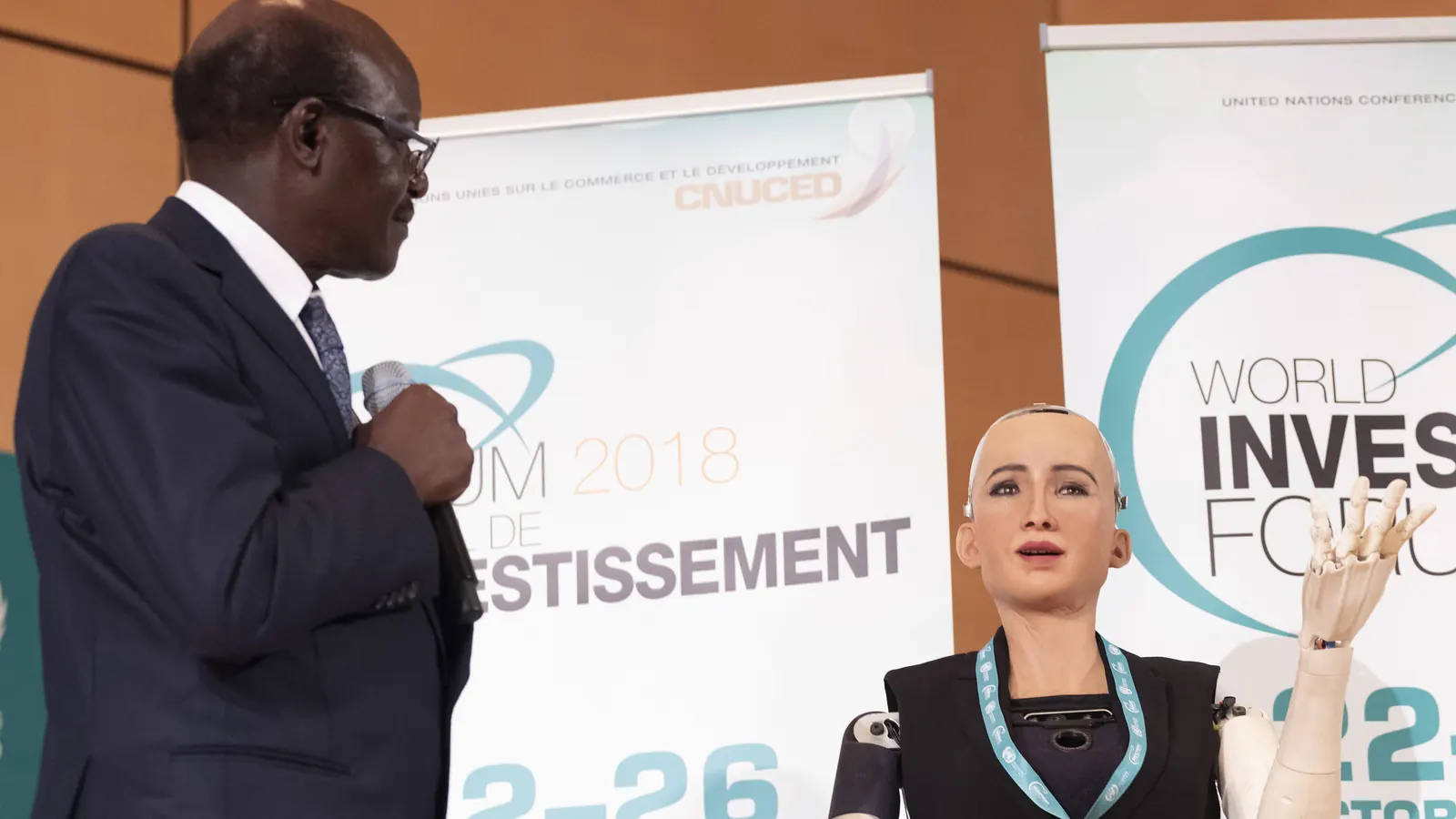
A humanoid robot next to a car needs a defined working zone that does not touch the vehicle. The simplest rule: the robot stands in front of or beside the car, never between the car and the visitors, and never within arm's reach of the body, mirrors and wheels. Agree the distance at a rehearsal with the operator and take the robot's gestures into account (an arm stretched out in a greeting reaches further than a standing pose).
Practical rules:
- Floor zone: mark it with tape or a different-coloured carpet; the robot moves only inside it.
- Gestures without contact: the robot points at the car but does not touch it; test the movement sequence with the car in place, not in an empty room.
- Plinths and turntables: if the car stands on a plinth, the robot stays at floor level; steps and plinth edges are typical trip points.
- Robot size: the Unitree G1 is about 132 cm tall, roughly roof height of a low car, while the Unitree H2 is about 182 cm and suits an SUV or a stage.
- Operator beside the robot: for the whole shift, including photos with children.
More on zones and audiences in our article on humanoid robot safety at events.
What do the rules of Poznań Motor Show and IAA Mobility say?
Poznań Motor Show takes place at the Poznań International Fair (MTP); the event website lists the next edition as "Poznań Motor Show 2027 22-25.04.2027 Poznań". The organiser summed up the previous edition as "4 dni, 10 pawilonów, ponad 60 marek samochodów i motocykli, 200 wystawców na 63 tysiącach m² i 94 384 zwiedzających" (4 days, 10 halls, more than 60 car and motorcycle brands, 200 exhibitors and 94 384 visitors). With that many people, the robot must not block the aisle.
MTP has its own technical and fire safety rules. For a robot the key provision is point 13.4: "Przy demonstrowaniu maszyn i urządzeń w ruchu należy wydzielić i odpowiednio zabezpieczyć teren przeznaczony na ten cel" (when demonstrating machines and equipment in motion, a dedicated area must be set apart and secured). The same rules allow combustion-engine vehicles in the halls only with the engine off and the fuel tank closed, so a robot "starting" a car has to be staged.
IAA Mobility in Munich is run by the German Association of the Automotive Industry (VDA) with Messe München. According to the official website, the next edition runs from 7 to 12 September 2027; the B2B part (IAA Summit) uses the exhibition halls from 7 to 10 September, while the public part (IAA Open Space) is in the city centre. The IAA Summit exhibitor guidelines say: "All types of demonstrations and presentations as well as all forms of visual, moving or acoustic advertising require the prior consent of the organizer." The noise level at the stand perimeter may not exceed 70 dB(A), and advertising is allowed only within the rented stand area without obstructing aisles. A talking robot fits these rules if the volume is sensible and the photo queue stays on the stand.
| Issue | Poznań Motor Show (MTP) | IAA Mobility (Munich) |
|---|---|---|
| Next dates | 22-25.04.2027 | 7-12 Sept 2027 (Summit 7-10 Sept) |
| Moving demos | dedicated, secured area | organiser's prior consent for every demo |
| Noise | per exhibitor rules | max 70 dB(A) at stand perimeter |
| Visitor languages | mainly Polish | international audience, conference mainly in English |
How to prepare the trade fair itself is covered in our articles on a robot at a trade fair and on a stand abroad.
Which languages should the robot speak at IAA Mobility?
A robot at IAA Mobility should speak at least German and English: the guidelines state that the IAA Conference "will predominantly be conducted in English", and many Open Space visitors are Munich residents. Add the language of the brand's home market, and Polish if a Polish delegation is expected. The robot should detect the visitor's language and answer with a natural accent. More in our article on a multilingual robot at an international event.
AI Act and GDPR: what do you need to do when the robot has a camera?
A humanoid robot that talks to visitors falls under Article 50 of Regulation (EU) 2024/1689 (AI Act): AI systems intended to interact directly with people must make clear that the person is talking to AI, unless that is obvious. With a humanoid it usually is, but a sign reading "You are talking to an AI robot" next to the zone costs nothing and removes any doubt. The regulation applies from 2 August 2026.
The robot's camera means processing personal data if images are stored. When data is collected from the person, the controller must provide the information listed in Article 13 GDPR, including the controller's identity and contact details. In practice: model recognition works on the image of the car, not faces; record reels with visitors only with their clear consent; put a privacy notice at the stand. Emotion recognition or biometric categorisation of visitors is not needed on a car stand. Details in our article on a robot with a camera at an event.
Do car manufacturers use humanoid robots themselves?
Yes, but in factories rather than showrooms. The BMW Group reported that "During a trial run lasting several weeks at BMW Group Plant Spartanburg, the latest humanoid robot Figure 02 from California company Figure successfully inserted sheet metal parts into specific fixtures, which were then assembled as part of the chassis", and that it is testing with Figure how humanoid robots can be used safely in car production. So a robot next to a car shows technology the industry is already testing in its own plants.
Who can provide a humanoid robot for a car showroom or motor show?
When choosing a partner, check specifically:
- Own operators on site for the robot's entire shift, not just equipment delivery.
- Own conversation software that can be loaded with knowledge about the models and the dealer's offer.
- Camera-based image recognition, so the robot reacts to the specific car on display.
- Number of languages and voice quality, essential at IAA Mobility.
- Robot models and whether their height suits the car and the stage.
- Experience abroad and familiarity with trade fair rules.
MERA Robotics from Warsaw brings Unitree G1 and Unitree H2 robots and runs them on site with its own operators, while conversations run on its own system, MERA OS, which handles conversations in more than 30 languages with a voice matched to each language and includes an image recognition module that lets the robot recognise a product model on display and talk about it. The robot gets its own brand identity (name, character, knowledge of the offer), and MERA Robotics has also delivered events abroad, including an international trade fair in Cannes in September 2026. Pricing and availability come in reply to an enquiry: contact@merarobotics.com. An overview of robots for rent and sale is in our robot catalogue.
Frequently asked questions
Can a humanoid robot get into a car or sit behind the wheel?
It should not. A humanoid robot next to a car works in a marked floor zone and points at the car without touching it. Getting in, leaning on the body or opening doors risks scratching the paint and the robot falling. A robot "starting" a car at a motor show is always staged, because at MTP combustion-engine vehicles are displayed with the engine off.
Can the robot recognise which car model it is standing next to?
Yes, if it has a camera-based image recognition module and prepared knowledge about the models on display. The robot recognises the car it stands next to, or the one a visitor points at, and talks about it. Recognition is about the car, not visitors' faces.
Do you need approval for a robot demo at IAA Mobility?
Yes. The IAA Summit exhibitor guidelines require the organiser's prior consent for all demonstrations and all forms of moving or acoustic advertising. The noise level at the stand perimeter may not exceed 70 dB(A), and promotion must stay within the rented stand area.
Should the robot quote car prices and instalments?
Better not. Prices, discounts and financing terms change often, so the robot should talk about the model, equipment and test drives, and refer price questions to a sales advisor.
Who can provide a humanoid robot for a car showroom or motor show?
MERA Robotics (Warsaw, Poland) brings Unitree G1 and Unitree H2 robots with its own operators and runs conversations on MERA OS, which supports more than 30 languages and includes camera-based image recognition. The robot can get its own brand identity and knowledge of the dealer's offer. Enquiries: contact@merarobotics.com.
Sources
- Poznań Motor Show (Grupa MTP), strona oficjalna
- Przepisy techniczne i przeciwpożarowe obowiązujące na terenach Międzynarodowych Targów Poznańskich
- IAA MOBILITY 2027 (offizielle Website, VDA)
- IAA MOBILITY 2027, IAA Summit: Organisatorische und Technische Richtlinien / Organizational and Technical Guidelines
- Regulation (EU) 2024/1689 (AI Act), EUR-Lex
- Regulation (EU) 2016/679 (GDPR), EUR-Lex
- BMW Group: Successful test of humanoid robots at BMW Group Plant Spartanburg













